Category Archives: Wildlife of Cadíz

To the mountains

The Sierra de la Nieves,  which literally translates from the Spanish as  ‘Mountain range of the Snows’, forms part of the Serrania de Ronda and rises dramatically above the surrounding valleys and countryside. The Natural Park covers an area of 30km by 20km, or 18,530 hectares; the peak is the tip of the ‘Torecilla’ at 1,919 metres. Historically, this was a place of refuge for highwaymen and outlaws, but today the Sierra de las Nieves is considered one of the best places in Europe for the study of nature.  The area was studied in the 19th century by Swiss botanist Edmond Boissier and in 1933 by Luis Ceballos;  in 1970 the park was declared a National Hunting Reserve and then in 1995 a Biosphere Reserve by UNESCO.

___________________________________________________

The annual (gonhs) outings to the Sierra de las Nieves have been one of the highlights of the last six years for me; it is a truly wonderful part of the world and the best place I have visited in this region, for the sheer abundance of wildlife. The mountain scenery is spectacular in its own right, but this is a haven for  a rich and diverse flora, which includes many endemic species, more butterflies and other insects than you can count from  a wide variety of species, an array of  birds, many of which breed here and it is home to Ibex, deer and other mammal species as well as reptiles, making this a magical place. The natural park covers  a vast area and a few hours of one day are hardly enough to scratch the surface of what is here.There is so much to find that you can hardly take more than a few steps without discovering a beautiful plant or spotting a bird or being awed by a view, so it’s impossible to go home disappointed, except perhaps that you have to leave at all. Having said that you can camp here too.

11th June 2011

11/6/11-Giant Squill – Scilla peruviana

Arriving at the area recreativo, situated well inside the park, at about 10am it was already sunny but still coolish, perfect weather for walking. There are several options for possible routes to take, illustrated on painted sign boards, but today we knew we were heading for a trail we have taken before that would take us up a mountainside through pine woodland.

11/6/11-Honeysuckle-Lonicera etrusca

11/6/11-Wild Gladiolus- Gladiolus illyricus

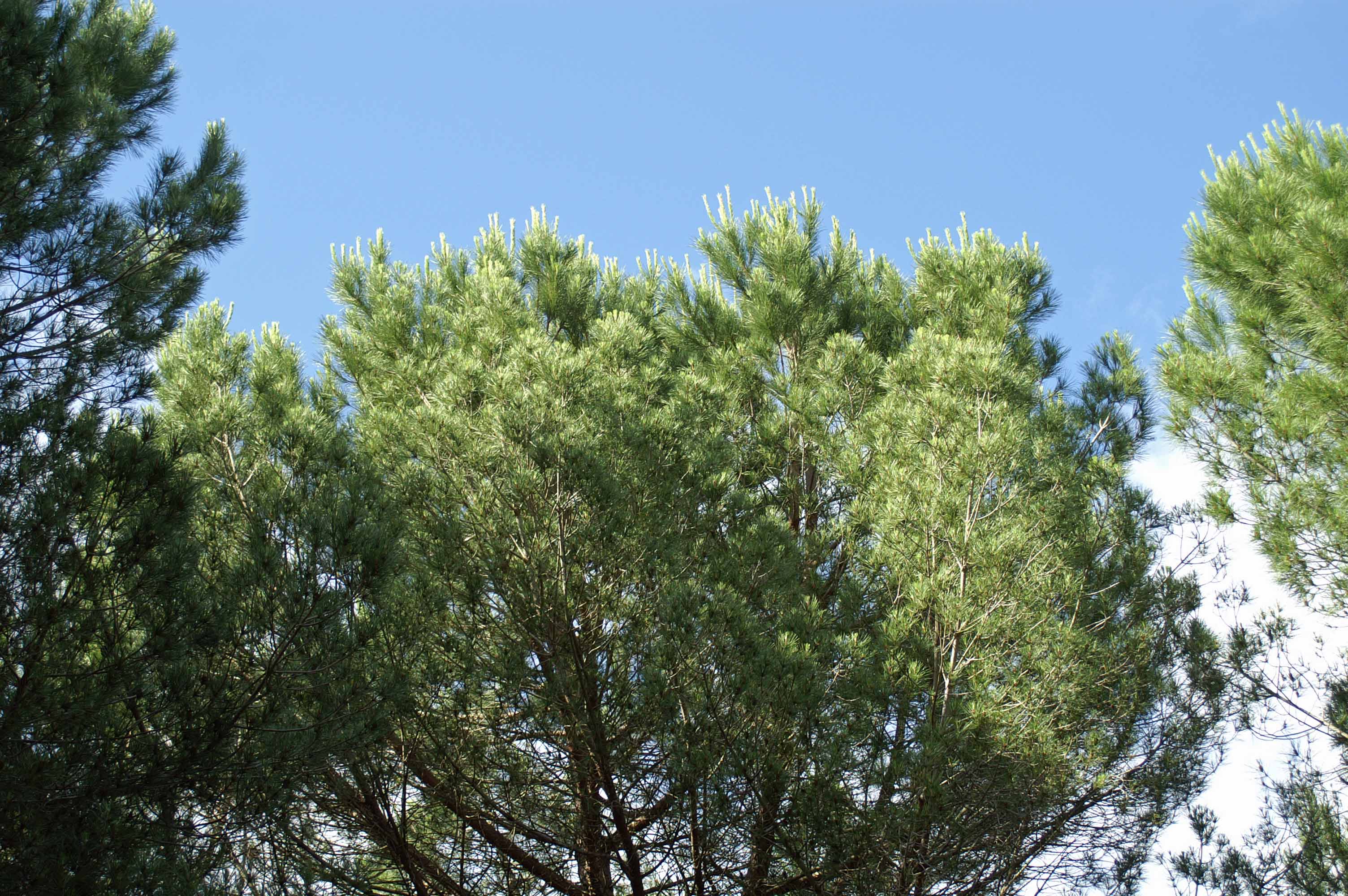
The first few metres of the track pass through a fairly open grassy area, where there were so many flowers calling to be photographed it would have been easy to spend a couple of hours in that one spot, but there was so much more to see we had to move on. There are a variety of tree species here, mainly pines and oaks, with an ancient species if pine and some special oak trees that have their stronghold here. The lower parts of the woodland we were walking through is comprised mainly of large Monterey Pines – Pinus radiata, that would originally have been deliberately planted. Higher up this introduced species gives way to the indigenous Pinsapo Pine-  Abies pinus. There are some huge ancient specimens of the Pinsapo in places within the park and many more young trees have been planted and nurtured to ensure its continued survival.

11/6/11-Spanish Fir or Pinsapo Pine-Abies pinsapo

Foliage of pinsapo pine

In 1837, during one of his exploratory visits to the south of the Iberian Peninsula, the Swiss Botanist Edmond Boisser discovered a new species of tree: Abies Pinsapo, popularly known as the Pinsapo pine or Spanish fir. Found only in the southern mountains of Andalucia and in the north of Morocco, botanists discovered that the pinsapo had been around since the Tertiary geological time period – predating  the Ice Age. The tree can grow up to 30m tall and live as long as 200 years. It has tiny needle-like leaves, which are extremely sharp and cylindrical in shape, and although this foliage appears lightweight, it throws out a very dense shade on the ground. 

We followed the track as it wound up the mountain slope, carefully negotiating the network of exposed tree roots criss-crossing the path. We stopped a few times to try to see birds we could hear calling or caught glimpses of flitting around in the branches above us that were largely species of Tit, Great Tit, Blue Tit,Coal Tit and Crested Tit but also Chaffinches and Chiffchaff (maybe Iberian) with limited success. Reaching a spot on the track where an opening in the trees allowed sight down  a slope we had more luck. There were a couple of large, dead trees here where we had a Serin singing, a Chiffchaff, a Great Tit with a beak full of food and best of all a beautiful male Redstart. It was apparent that the birds here were all still in the process of raising families, a good couple of weeks behind those at our lower altitude.

A little further on we stopped for a refreshment break and across the valley saw a flock of Chough take to the air; 50-60 birds were estimated and we found out later that other members of our party exploring over there had watched them flushed out by a pair of Golden Eagles.

11/6/11-Pigs living wild

Sadly we missed the Eagles in action and had to settle for a nearer sighting of a Booted Eagle (LP) and in the valley below us a family of pigs, which several people wanted to turn into wild boar, but although one of them was dark coloured, the other was very beige!
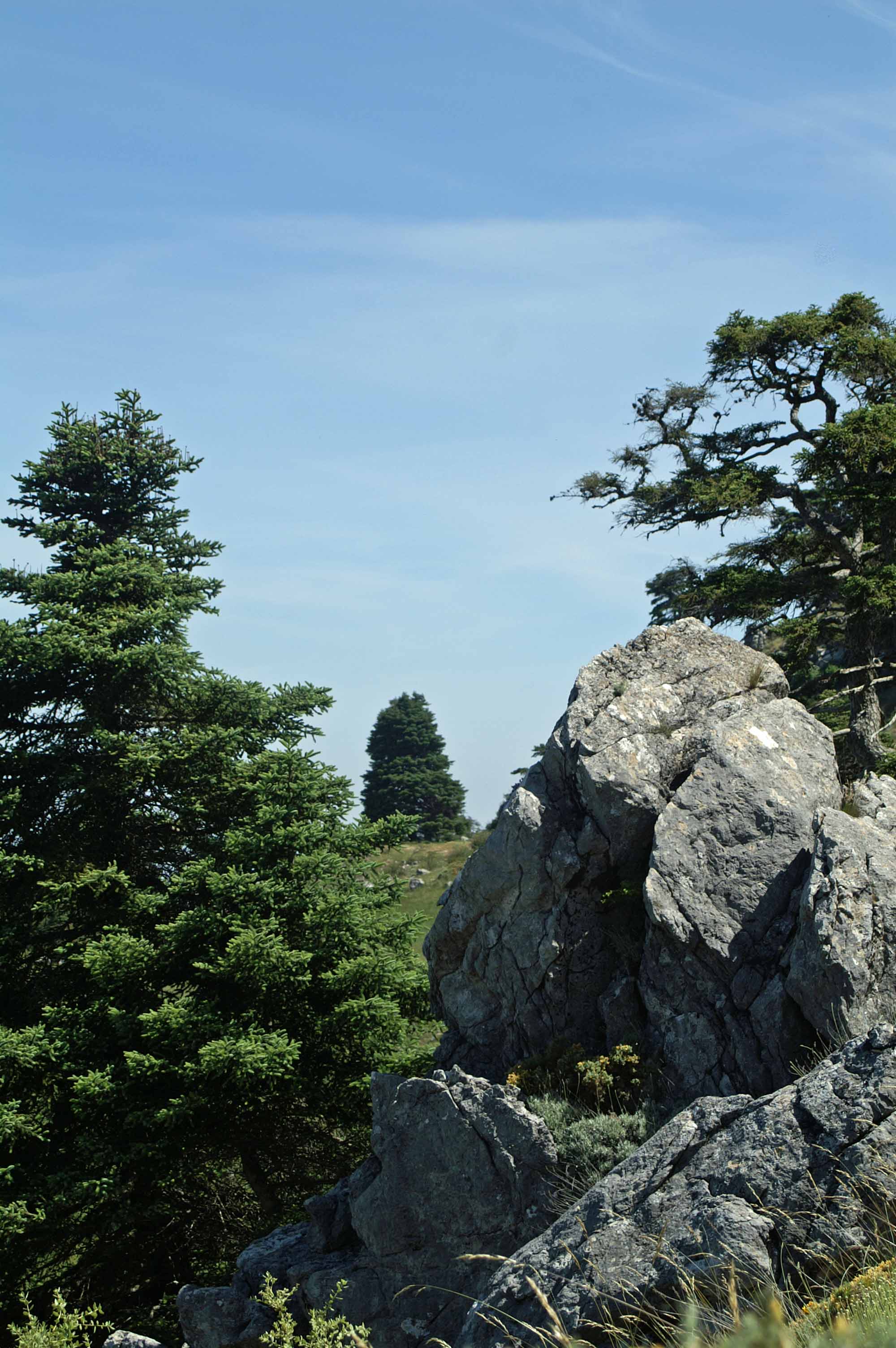
11/6/11-Pinsapo pines and sculpted rock

We climbed a little higher, rounding a bend onto a more level section of the trail where it loops around the side of the mountain. We upset a pair of Nuthatch here that were at great pains to let us know how much they resented our presence with much fierce scolding. A bird was singing too, but we did not recognise the song until we heard it again later and saw it was that of a male Redstart. Standing still for a few minutes to listen, I also had a very close view of a Crested Tit foraging in vegetation just a metre or so away. Moving on to catch up with the others I heard more scolding, this time from a Wren that had a very large larva,( or is it a slug?) in its bill, so large I’m amazed it could get any sound out at all.

11/6/11-Wren waiting to take in an enormous meal for a lucky chick

On the opposite side of the track more scolding – this time from the Nuthatches again that clearly had their nest near the top of another dead tree. Then more telling off from a very nearby Robin, whose picture I tried to wait  for as I could already see this year’s Christmas card of him perched in a Pinsapo… no luck there though.

At this point we realised that we had long been deserted by anyone who had any idea where we may be heading and tempting thought the trail ahead appeared, we decided we had to get off it and take a ‘short-cut’, (not my words!), that involved scaling a very ill-defined loose shale track, probably made by sure-footed goats, that would take us higher up our mountain and meet up with the surfaced track that would take us back down to the bottom of it.
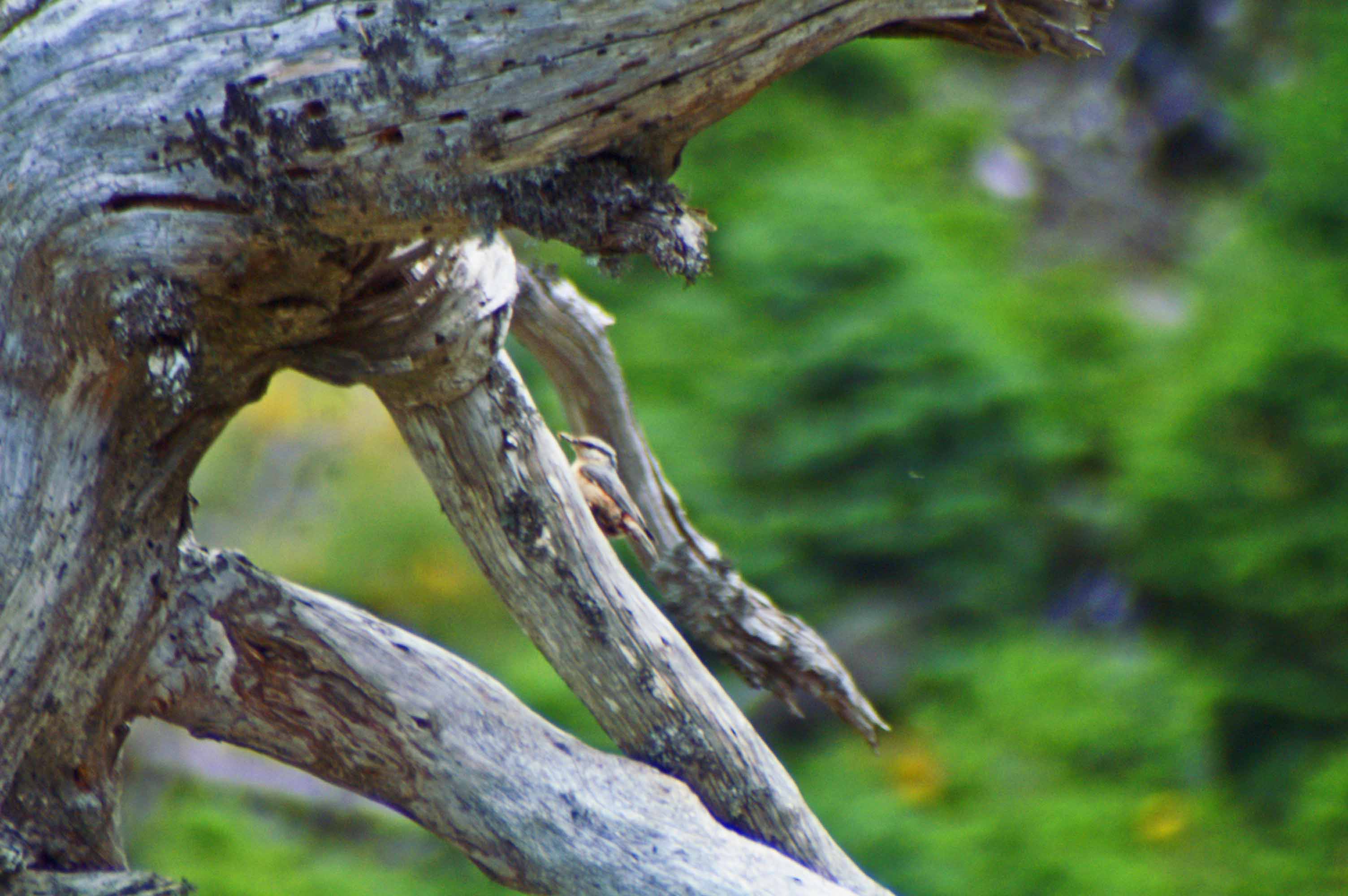
11/6/11-Nuthatch taking food into their nest in a dead tree

The track passed around the dead tree where the nuthatches had their nest and I couldn’t resist stopping for a few minutes to watch them.
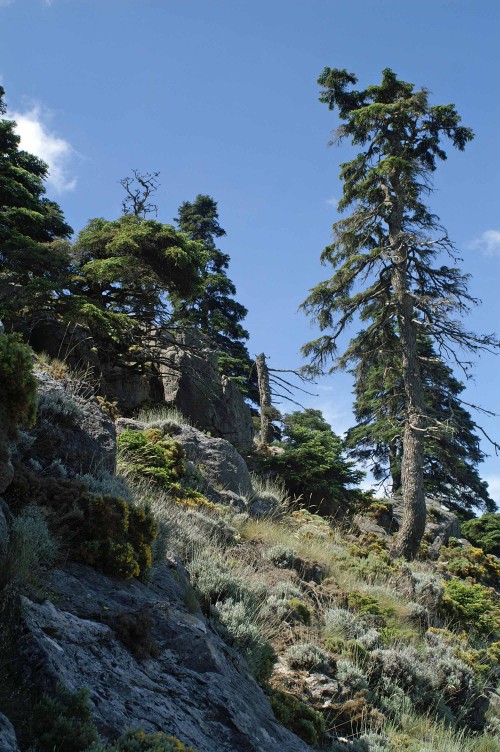
11/6/11-We were headed for the top of this slope above the old Pinsapo

Although parts of the track felt a bit loose and hazardous, it was beautiful, with flowering plants, shrubs and trees set amongst weathered and lichen-covered rocks – a perfectly artlessly designed rock garden.

2/6/06 -Some of the flora growing on this very slope 5 years ago
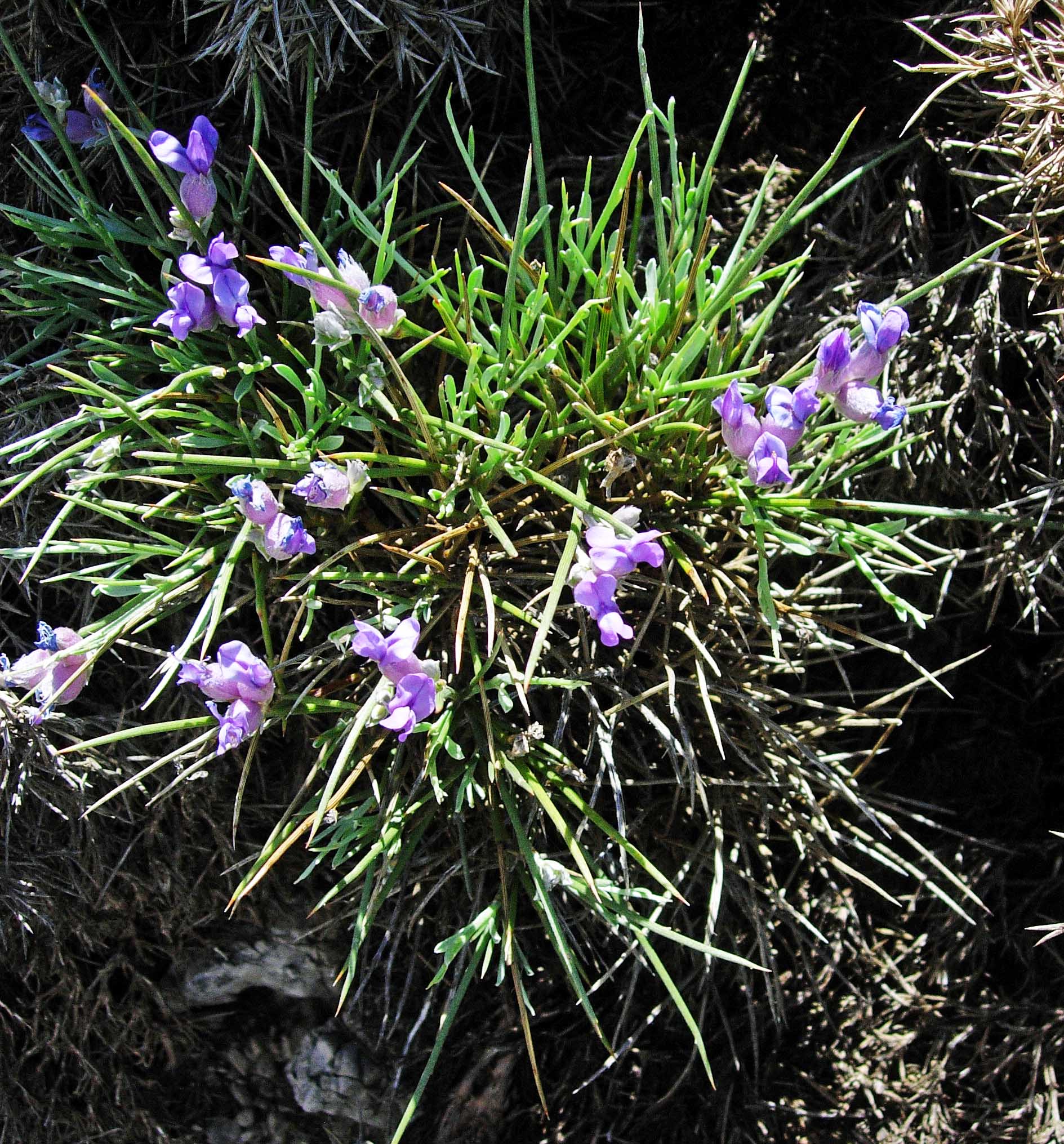
2/6/06-Blue Hedgehog broom -erinacea anthyllis. Evident today but almost at the end of its flowering

11/6/11-Still in full flower the lovely Common White Rockrose-Helianthemum appeninum
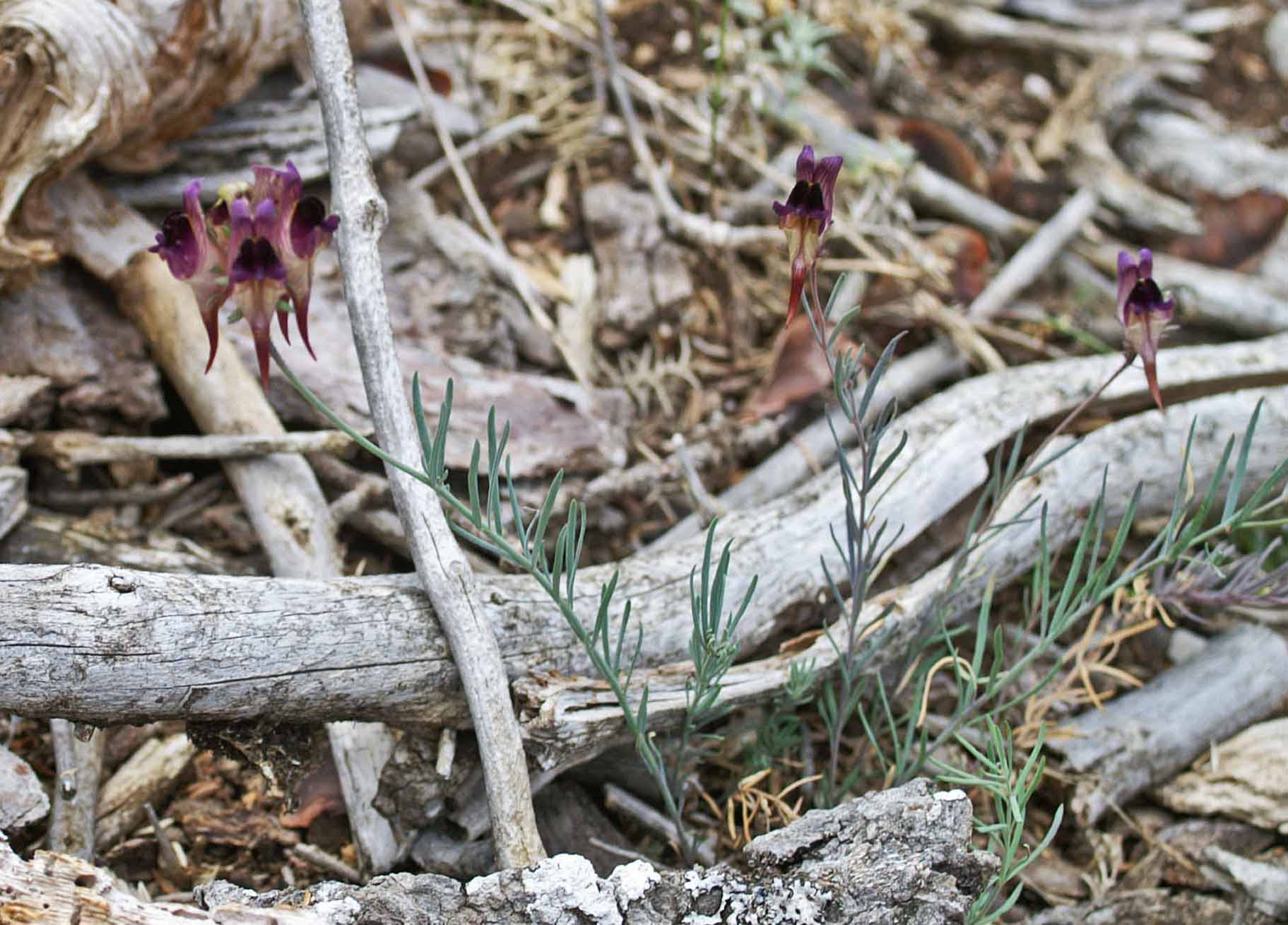
11/6/11- A small quiet flower with a wonderful name- Melancholy Toadflax- Linaria tristis

11/6/11-The lovely Grey-leaved Cistus-Cistus albidus, whose pretty flowers resemble crumpled paper is very attractive to insects

Approaching the top of the slope we had this wonderful view.

11/6/11- A view from the mountainside framed by pines


11/6/11- Part of the view from our picnic spot almost at the top of the mountain

Reaching the top of the slope we stopped to recover from our exertions to eat our lunch and to admire the fantastic views in front of us; panoramas of the mountains and valleys of the Sierra de las Nieves, the wider Serrania de Ronda and way beyond even that – mountain ranges continue to the far horizon and probably beyond.

We did find the road and met up with some of the members of our group that had left us previously to walk to the real top of the mountain as they were on their way down. This was where we discovered that our previously unrecognised singing bird had been a male Redstart; one was singing from the very top of a Pinsapo pine in front of us but growing from lower down the slope, so we had a very good view with binoculars. It was too far away to photograph well though.

11/6/11-Golden gorse was flowering prolifically

This part of the mountain is completely different to the side we had just left; to one side of the winding track there were high rocky cliffs while on the other side the land fell away and was well vegetated with Pinsapos pines, shrubs including gorse, cistus and lavender. This is the habitat preferred by the Black Redstarts, Rock Buntings and Wheatears that often choose clefts in the rocks to nest in.

We had several sights of Black Redstart males singing from the tops of the rocks on the ridge and a lovely view of a pair of Rock Bunting that sat on a rock while being summoned by their offspring perched in a small Pinsapo pine above them. One of the pair flew up the slope to a rock very close to us and posed quite nicely, I think it was the female as her colouring, although similar to that of a male was  slightly more subdued

11/6/11-Rock Bunting – Emberiza cia

There was a lucky, very brief glimpse of a male Northern Wheatear here too.

11/6/11-Northern Wheatear (m)-Oenanthe oenanthe

The afternoon had become much warmer and as we reached the bottom of the slope where there are areas of grass and wildflowers we began to see butterflies. At first just a few, all flying around rapidly, we quickly noted Marsh Fritillary, Spanish Gatekeeper, Marbled White, Common Blue, Clouded Yellow, Cleopatra and Meadow Brown, none of which settled for long enough to photograph. Further on there were more, a Wall Brown basking on the road, numbers of Marsh Fritillaries, a Black-veined White, a Small Skipper and a lovely Scarce Swallowtail that glided gracefully around flowering shrubbery but didn’t stop.

11/6/11-Black-veined White on Scabious

11/6/11- Marsh Fritillary

I would have loved to be able to stay chasing butterflies for longer, but it was time to go home and rest up the anticipated aching muscles.

Final bird, butterfly and moth sightings for the day from our group as a whole:

Birds:

Golden Eagle(2), Short-toed Eagle, Booted Eagle (lt ph), Griffon Vultures, Chough (50-60), Jay, Blackbird,Cirl Bunting, Greenfinch, Chaffinch, Bonelli’s Warbler,Chiffchaff, Nuthatch (pair), Stonechat, Wheatear, Black-eared Wheatear. Wren, Black Redstart, Redstart, Goldfinch, Serin, Blue Tit, Great Tit, Coal Tit, Crested tit, Rock Bunting, Woodlark, Red- legged Partridge, Woodpigeon, White Wagtail, Grey Wagtail (pair), 2 x Whitethroat feeding young, Lesser Whitethroat, Sub-alpine Warbler, Melodious Warbler and driving home we added Kestrel and 2 Rock Thrush, probably Blue but we couldn’t stop on the bendy main road!

Butterflies:

Black-veined White  Aporia crataegi ;Queen of Spain Fritillary Issoria lathonia;Common Blue Polyommatus icarus; Lorquins Blue Cupido lorquinii;
Marsh Fritillary Euphydras aurinia; Meadow Brown Maniola jurtina;
Escher’s Blue Agrodiaetus escheri;Painted Lady Cynthia cardui; Small White Pieris rapae; Bath White Pontia daplidice; Scarce Swallowtail Iphiclides podalirius;Spanish Festoon Zerynthia rumina; Spanish Gatekeeper Pryonis bathseba;Wall Brown Lasiommata megera; Iberian Marbled White Melanargia lachesis;Brown Argus Aricia cramera; Large Grizzled Skipper Muschampia proto;Lulworth Skipper Thymelicus acteon; Small Skipper Thymelicus sylvestris;Mallow Skipper Carcharodus alceae; Small Copper Lycaena phlaeas;Cardinal Fritillary:- Argynnis pandora; Speckled Wood Pararge aegeria; Grayling Hipparchia semele; Clouded Yellow Colias crocea; Cleopatra Gonepteryx cleopatra

and Moths:-

Forester sp.  Adcita sp.:-  A lovely metallic green winged day-flying moth
Royal Burnet Zygaena sarpedon;Synaphe moldavica:–  Everywhere in the grassy meadows; the most common moth around.
Hummingbird Hawkmoth Macroglossum stellatarumChrysocrambus dentuellus:–  Several of these well marked moths  seen on the stalks of grasses

More butterfly pictures can be seen in Pages – Fauna -Butterfly id

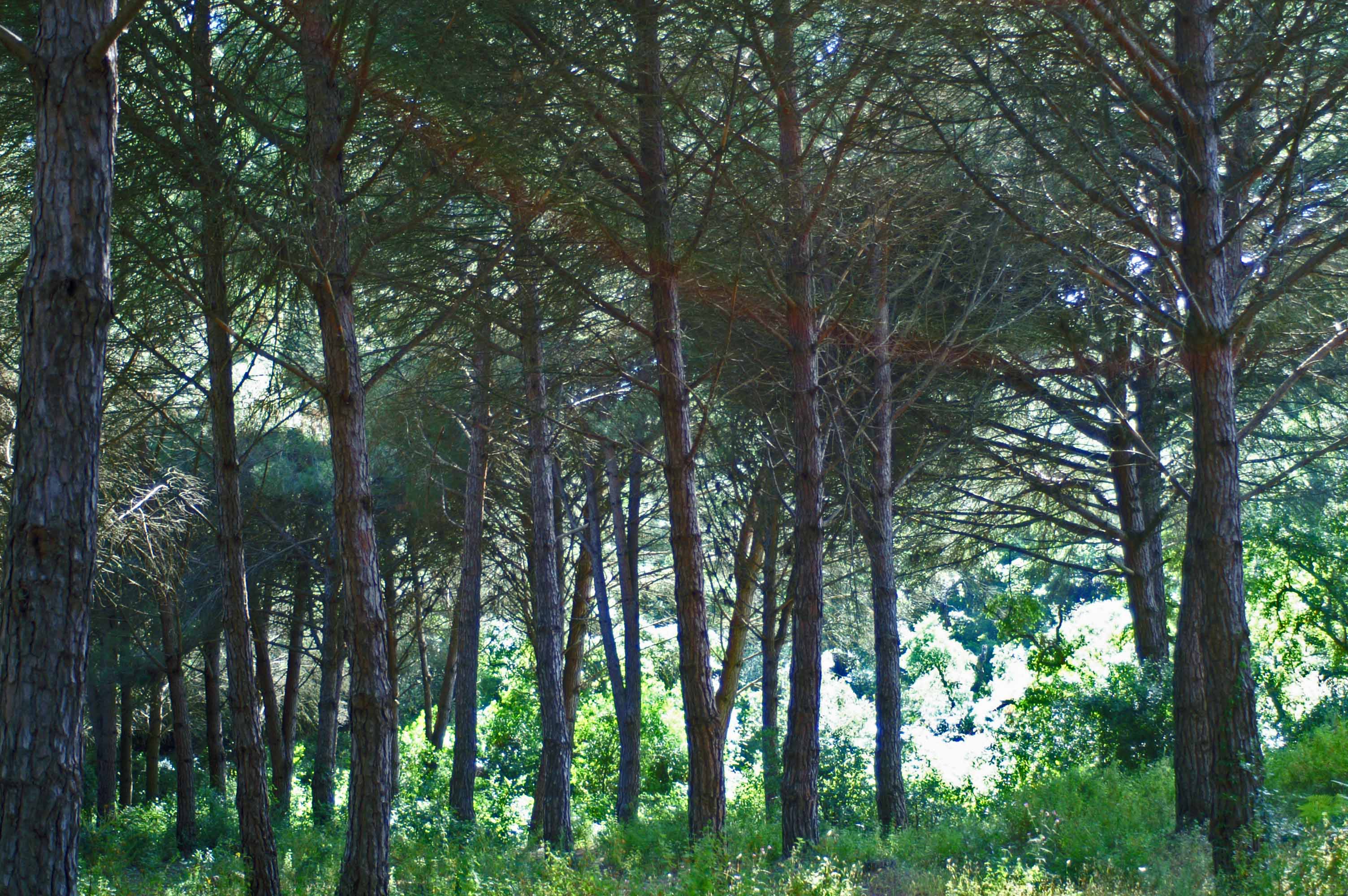
Sunday afternoon in a pine forest

Pinar del Rey – The King’s Pine Forest, lies to the north of the town of San Roque. It was planted in 1800 by the Spanish Navy to provide timber for building ships; the planting consisting of a combination of Stone Pines and Cork Oaks. In 1804, following the defeat of  the combined navies of Spain and France at the Battle of Trafalgar, the Spanish no longer needed the timber and the plantation was gifted to the people of San Roque by King Ferdinand VII as compensation for losing Gibraltar 100 years earlier.

A path through the pine trees

The area has long been used by the local people as a recreational area and now there are picnic areas and barbecues set up in cleared areas beneath the trees, some of them quite extensive. The shady woods are a lovely outdoor ‘breathing space’ for families living in the local towns and villages, and are probably the most popular nature spot for miles around. Many families spend a day out in the country here, and it is especially busy on a Sunday, the traditional ‘family’ day.

On Sunday outings I normally steer clear of any area I know to be a popular family venue. Today, feeling in need of some fresh air and gentle exercise, and persuading Jon that he did too, I went along with his suggestion to drive out to Pinar del Rey, albeit with some trepidation on my part. It’s not too far from where we live and once through the small town of San Roque you are out in the countryside. It is still green, and colourful now with the tougher flowers of summer, purple thistles, patches of yellow Spanish Oyster plant and the lime green-yellow flowerheads of Fennel. Turning into the entrance to the site it was immediately apparent that although it was by now late afternoon, there were a lot of people here: families sitting chatting around the wooden tables, lingering over their picnics, children playing amongst the trees and people just strolling along the shady pathways. It is great to see folks out and about and making the most of this wonderful public space, but, very selfishly I know, we were hoping for something a little more peaceful where there may be a chance of seeing some of the wilder residents of the area. There is just one paved road for cars that eventually reaches an abrupt end and the only way forward is on foot. That is where we stopped today, in a spot where there were no other cars or people in immediate sight and close to the beginning of one of the marked footpaths, the ‘Sendero de las Aguilas‘.

Stone Pines backlit by the sun with Cork Oaks behind

This is a lovely path, pleasantly shady and the air fragrant with the fresh resinous scent of Stone Pines. A Blackcap was singing, moving from tree to tree as we approached but picking up the song each time he changed perch. I heard a Greenfinch calling and caught sight of a Blackbird, otherwise all was quiet. The track is almost on the edge of the part of the forest dominated by Stone Pines, its edge is marked by a water course bounded by other tree species and shrubs such as Oleander; and beyond it is more woodland comprised mainly of Cork Oaks.

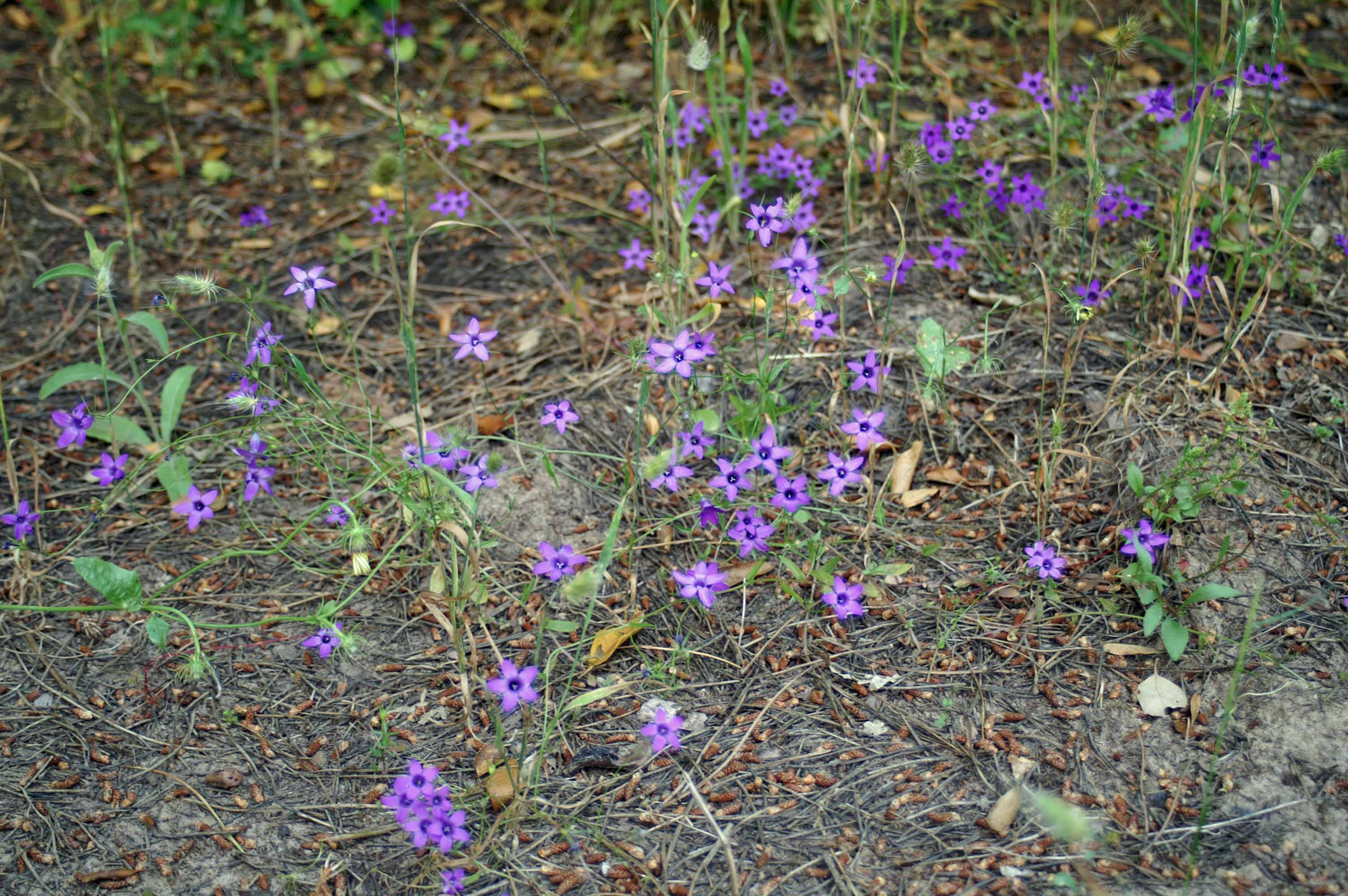
There were several patches of some very pretty and delicate flowers growing alongside the path that I had not seen before, coloured in various shades from pale mauve to purple and magenta.

The little purple flowers are held on very thin stalks

I discovered later that the plant is  a Campanula (Campanula specularioides). Apparently it got its latin name because of its similarity to the flowers of Venus’ Looking-glass, (sp. Legousia), which used to be called Specularia. (Betty Molesworth Allen).

A patch of campanula with bigger flowers showing several variations inn shade

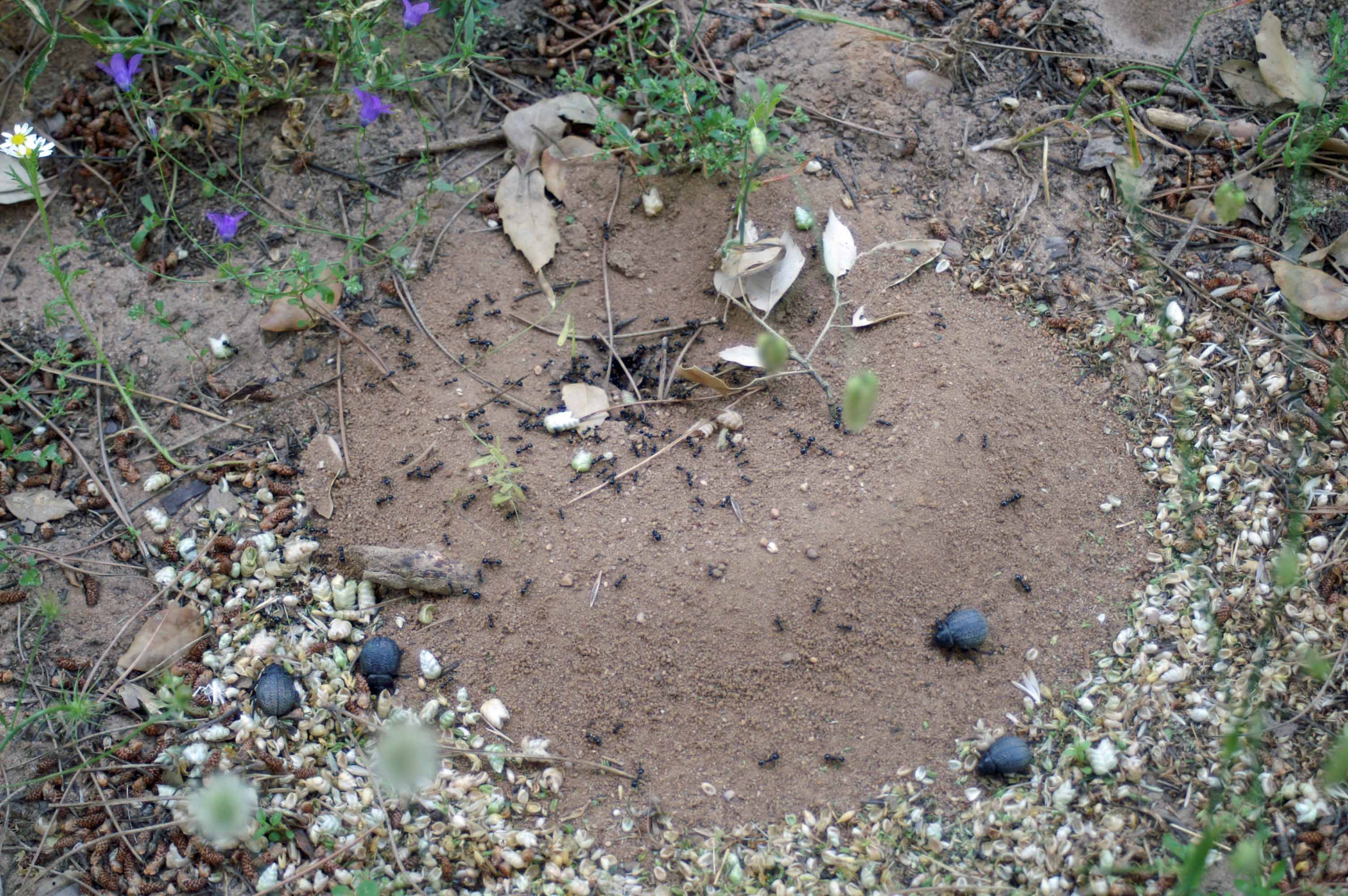
While I was busy with the flowers, Jon discovered a very intriguing scene that was being acted out on another part of the forest floor; where ants were milling around a large hole and running back and forth over a pile of freshly excavated soil.Some of them were actually carrying grass seed heads and there were a great number of similar seedheads piled around the edges of the soil pile, clearly harvested by the ants, that were either being carried into or out of the hole.Perhaps the oddest thing was the presence of four beetles, a couple of which were being harassed by ants, while others seemed to be burrowing into the piled up seedheads.

An intriguing scene involving harvesting ants and round-bodied beetles

Meanwhile, up in the trees a Crested Tit foraged around the pine cones. These lovely little birds are one of the most elusive species for me in terms of getting photographs and today was no exception. It was too shady there to get a decent picture anyway as I discovered when I attempted to capture an image of a pair of Blackcap in another treetop. A Jay was a little more obliging, sitting halfway up a better-lit trunk.

Jay - Garrulus glandarius

We heard a Robin singing and spotted him perched on a low branch next to the path, flying off as we approached.

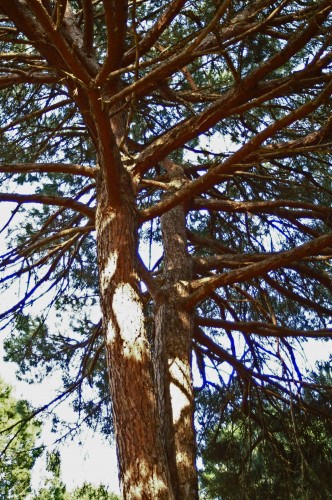
A very large old Stone Pine with a double trunk

Many of the pine trees are huge specimens that are reputed to be those originally planted in the early 1800s, they are impressive and beautiful and present countless opportunities for photographs; the light and shade on the trunks, the textures of the bark, the sunlight filtering through the canopy and so much more. Part of the track runs parallel to the river bank and the damper conditions here support a different flora, amongst which is the dramatic Acanthus. It is not a common plant in this area, except on calcareous outcrops, but it is often cultivated, so I am unsure if it would have occurred naturally here.

Acanthus leaf with greenbottle fly. The leaves of this plant were patterns for the design on capitals of many Corinthian pillars of the ancient world.

Acanthus mollis - flower. The common name of Bear's Breeches comes from the shape of the flowers.

The shape of the top of the tree gives it the common name of Umbrella Pine

We took a different route home as I was keen to see the progress of the Stork families, so at the entrance/exit to the park, rather than turning left towards San Roque town, we turned right to go to San Roque Estacion. This is a very quiet road, particularly since the new stretch of dual carriageway was constructed, and is not in very good repair, but it is much more scenic and tuneful too – we must have heard at least half a dozen snatches of Nightingale song as we passed by. We saw a Nightingale too, very unusually perched on a power cable near the junction of this road and the new one. We saw Storks on their nests from here too where the road crosses the railway line, but had much better views once on the road driving towards Jimena. Most of the nests had at least two or three grown-up young, and many were crowded with the whole family jammed in at once.

This is always a busy road, but we risked a very quick stop so I could take this photograph:

Parent White Storks with their grown-up young. The adult hiding her face at the back and looking a bit tatty is most probably the mother!

Summer begins

June 5th

The weather for the first days of this month has been rather unsettled; most mornings, although warm, have been overcast with levanter cloud and sudden strong breezes have sprung up from nowhere. But bursts of very hot sunshine and warm evenings that stay light until about 10pm, all confirm that summer has begun. The ambience of the garden and surroundings has changed noticeably now that many parent birds have fledged young to keep track of and feed. For a few days following seeing the young Nightingale I heard it frequently and loudly summoning its parents with a loud, insistent piping call. One morning I heard it piping frantically and went out to look just as a Kestrel swooped low through the garden, probably looking for the source of the calling. I’ve had a few glimpses of adult birds dashing across the garden, but haven’t  seen the young one at all.

Wren family 

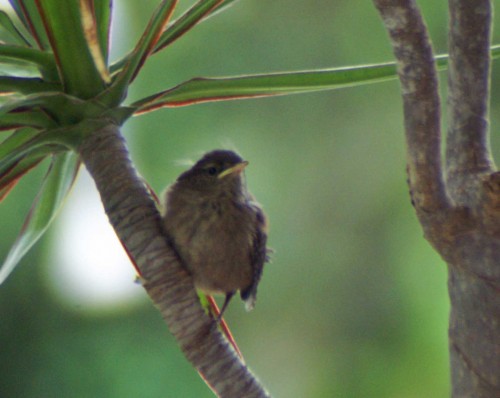
On Friday morning I heard baby bird calls very close by and discovered the source to be a tiny fluffy fledgling Wren that was perched on one of the dracaena plants on the covered terrace. It was incredibly cute, with its yellow gape and wispy downy tufts of feather still attached to its head. It was not alone either, there were two more tiny siblings close by, all ‘tsup,tsup, tsupping‘ animatedly and I could hear a parent urgently trying to muster them and persuade them to join them over the wall in the cover of the cork oaks.  Finally  they all took off at once, buzzing the short way across the lawn and up and over the way, tiny wings whirring, hardly bigger than large butterflies.

3/6/11-Fledgling Wren, downy 'ear' tufts still visible on its head

That wasn’t the last I saw of the little family; later in the evening I heard them just across the garden wall, in the same place they had headed to in the morning. One popped onto the top of the wall and sat enjoying the late evening sunshine.

3/6/11-8.00pm - A Wren fledgling enjoying the late evening sunshine

A little later again, while watching TV, through the window I caught sight of a bird fluttering around the light fitting on the terrace. Intrigued, I watched it pop in and out a few times. It was a Wren that then flew to the end of the terrace, began calling then flying back and forth and in and out of the light fitting. (Wrens have nested in that fitting twice in recent years and as I believe it may still be used as a roost by its maker, I have not cleared out the old nesting material). In response to the adult’s calling the babies came and with much fluttering and popping in and out, finally all seemed to settle in there. What a touching little scene that was and a wonderful display of bird parenting; I’m not sure if they were joined in there by an adult, but I’m sure they would have stayed close by. Much to my surprise and delight the family returned to roost on Saturday night too, again there was much fluttering around and popping in and out before they settled, but by 10pm they were tucked up safely for the night. Sunday brought a different scenario though. At least one Wren did arrive and popped in and out of the roost, but I don’t think any stayed in. Then from somewhere, a male House Sparrow appeared and although too big to get into the light fitting, he appeared to ‘guard’ it, blocking the entrance. He left after afew minutes, but by now it was almost dark. I didn’t see the Wrens come back, so either he had frightened them away or they were already inside and the House Sparrow had just been looking to see what was happening in there.

3/61/11-Ilex Hairsteak with large chunks of wings missing

I’m delighted that the pair of Spotted Flycatchers are in and around the garden frequently throughout the days, out hunting until it’s almost dark. (Their pairing was confirmed when I witnessed an attempted mating on a garden lounger!)  On several consecutive mornings I have watched them from the terrace as they hunt from perches low down on various plants and posts, and even garden furniture. A favourite place seems to be on the aeonium plant, which happens to be next to the patch of flowering thyme which the Ilex Hairstreak butterflies and various other insects visit for nectar. Not surprisingly there are a few butterflies struggling around with chunks of their wings missing.

3/6/11-Lang's Short-tailed Blue on marjoram

The privet flowers are all but over now, so the insects I had such wonderful views off recently will have had to seek pastures new. Fortunately the wildflowers at the front of the neighbouring cork oak plot, and those of the vacant plots opposite are all blooming profusely now. They won’t be there for much longer as the owner of the plots will be along anytime soon with his little tractor and cutting machine to mow them all down. I think he may have to do it as dried grass etc. could become a potential fire hazard in the summer. The thought of that spurred me to go and have a good look at what is growing there and see what other insects I might find too.

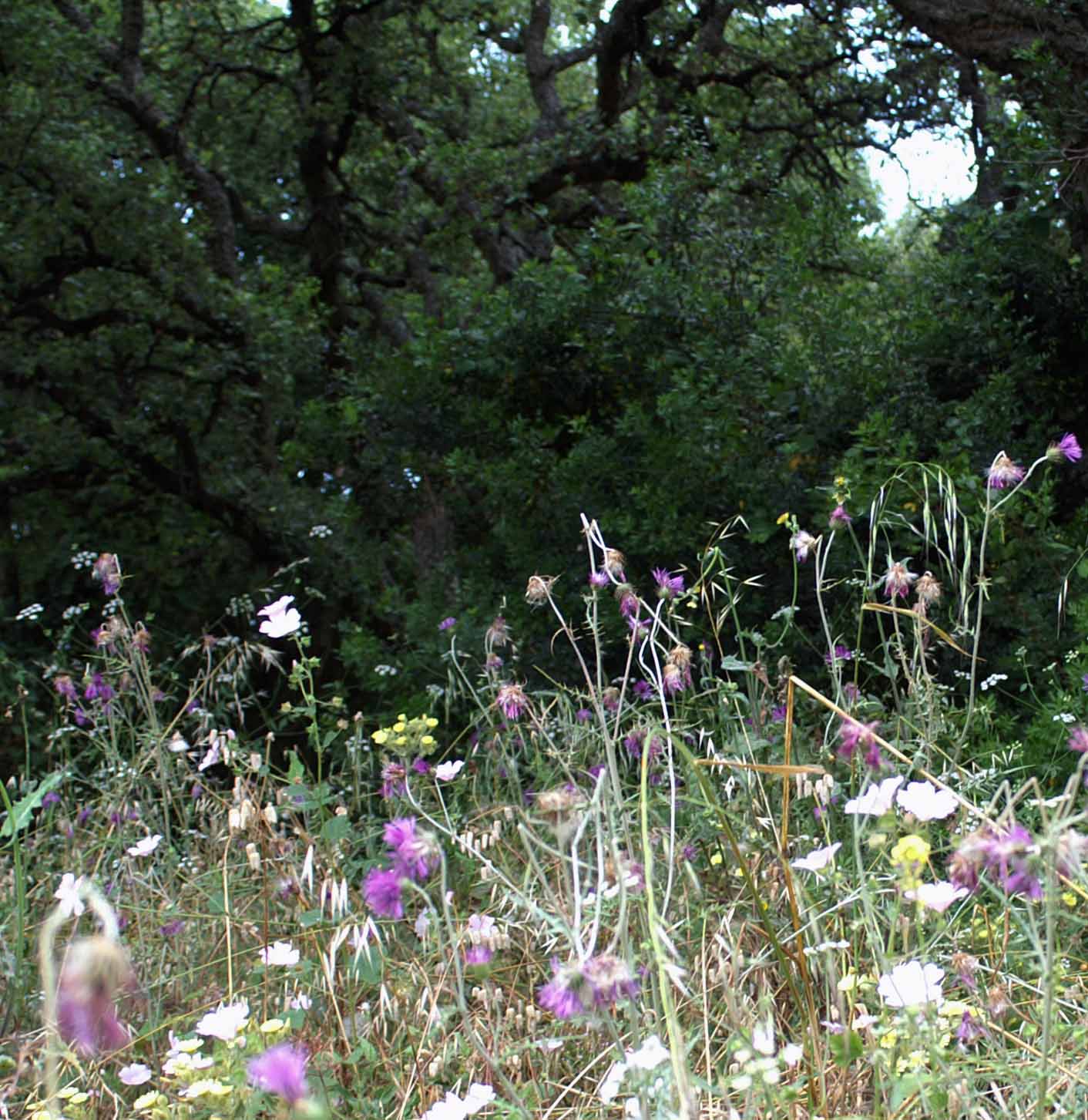
3/6/11-Wildflowers on the edge of the cork oak plot may look straggly, but there are a good variety of species there providing nectar for a range of insect species

The wildflowers growing at the front of the cork oak plot are a bit straggly as they are shaded by the trees for much of the day, but having a closer look I was surprised by the number of species I found there.

3/6/11-Rabbit's bread - Andryala integrifolia , with tiny hoverfly -Sphaerophoria scripta

3/6/11-Hoverfly-Syrphus ribesii

3/6/11-A pretty lemon-yellow flower of Tolpis -Tolpis barbata - a member of the daisy family

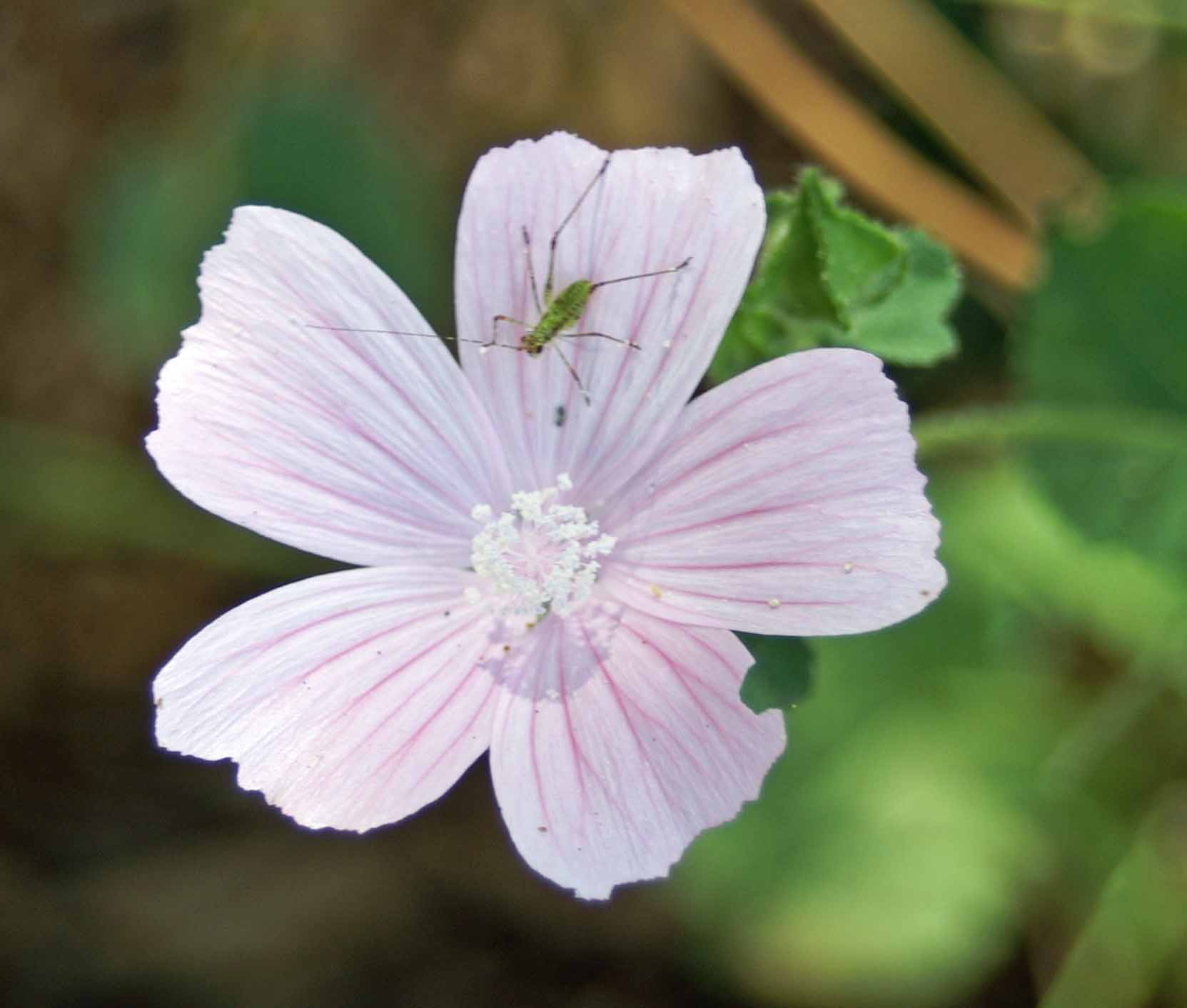
3/6/11-A mallow flower holding a tiny young Oak Bush Cricket

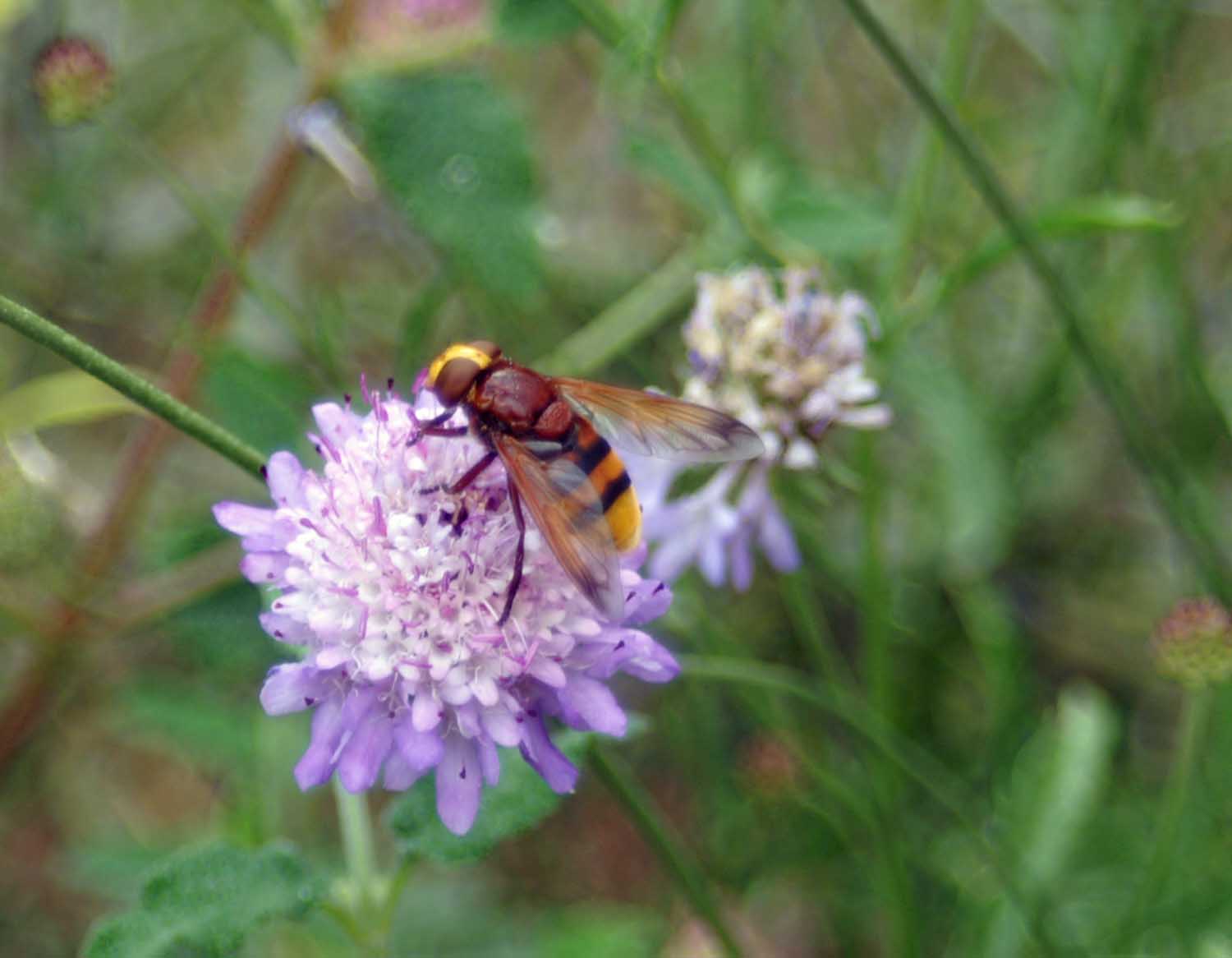
The wildflower species that appears to be one of those most important to an array of insect species, with plants in flower in various places from late spring through to September, is Scabious. It tends to be an untidy plant and the flowers are smallish but pretty, and everything from minute flower beetles, butterflies and hoverflies to the huge Mammoth Wasps and Violet Carpenter Bees seem to find it irresistible.

3/6/11-Scabious is very attractive to a wide variety of insect species

3/6/11-Sotogrande -Mammoth Wasp(m) - Scolia

3/6/11- A not-sure-what-this is, but it resembles the 'eristalsis' species

3/6/11-Banded Hoverfly-Volucella zonaria

I was sitting out on the terrace this afternoon and – aagh! – I saw a Geranium Bronze butterfly fluttering around my geranium plants, then land on a leaf. Oh dear, what to do? I hate to think about killing anything, but then I don’t want lacy-leaved, or no-leaved geraniums either.

5/6/11-Geranium Bronze butterfly, probably laying eggs on my geranium leaves

The final days of May

I’m starting this post with a tribute to the privet shrub, without whose bountiful blossom this spring I would not have seen the array of beautiful insects I have recorded recently.

When we first moved into the house the privet hedge, planted in front of the garden wall had been allowed to grow to a very straggly 2-3 metres high. I’d had plenty of past battles with rampant privet hedges, but rather than dig it out I cut it right down into a low hedge interspersed with some taller trunks I clipped into various topiary shapes. I like it kept neat and tidy, but usually allow some parts to blossom each spring as I am aware some insects are attracted to it. This year I missed out the usual early spring cut as I was away in Wales, so the whole hedge was already in flower when I got back. A very happy accident as it turned out, and although it’s untidiness does bother me a bit I will definitely leave it to finish flowering before I trim it and will also leave some to fruit for the birds to pick at later on.

_________________________________________________

Privet was originally the name for the European semi-evergreen shrub, Ligustrum vulgarum and later also for the more reliably evergreen  Ligustrum ovalifolium (Japanese privet), used extensively for privacy hedging. It is often suggested that the name privet is related to private, but the Oxford English dictionary states that there is no evidence to support this. The term is now used for all members of the genus Ligustrum which includes about 40-50 species of evergreen, semi-evergreen or deciduous shrubs and small trees, native to Europe, north Africa, Asia and Australasia with the centre of diversity in China, the Himalays, Japan and Taiwan. The generic name originated in Latin  and was applied by  Pliny the Elder (23 CE – 79) to L. vulgare. The genus is placed in the olive family, Oleacea.

The flowers are small and fragrant and borne in panicles. They have four curled-back petals and two high stamens with yellow or red anthers, between which is the low pistil; the petals and stamens fall off after the flower is fertilized, leaving the pistil in the calyx tube. The fruits, borne in clusters, are small purple to black drupes; individual shrubs may produce thousands of fruits, most of which are eaten by birds.

The Privet is used as a food plant by the larvae of some Lepidoptera  (moth) species including Common Emerald, Common Marbled Carpet,Copper Underwing, The Engrailed, Mottled Scalloped Hazel, Small Angle Shades, The V-pug and Willow Beauty.

Source : Wikipaedia

* Not mentioned above is the Privet Hawkmoth Sphinx ligustri, a large and attractive moth, with a wingspan of 100mm.

_________________________________________________

I spotted a Painted Lady zoom in over the wall  and after a bit of flying up and down it finally settled with its wing firmly closed.

30/5/11- Painted Lady

The butterfly was at the far end of the hedge, quite high up and as I looked at it, squinting against the bright sunshine, I caught a quick glint of metallic green. The light was very bright and all I could see was part of the underside of a large insect nestled right into the flower head against the stem. I moved around, trying to find an angle that would reveal what I hoped was a Rose Chafer. After several minutes of waiting, my patience was rewarded when out it crawled, albeit very briefly, into view. What glorious insects they are; deserving of a far more glamorous name than it has been given and definitely a jewel in my list of sightings so far this year.


30/5/11-A beautiful Rose Chafer on privet

Rose Chafer – Cetonia aurata

A beautiful scarab beetle, with a body length of around 20mm. It is a bright, metallic, jewel-like green, with whitish marks and stripes across the elytra. From mid-May they may be found on sunny days in flowery places on the blossoms of rose, hawthorn, elder etc. The larvae live in the rotting wood of old trees. 

There is still blossom left on the privet that is still attracting a few insects. I can’t imagine I can top what I’ve already seen, unless of course I may be very lucky and see a Privet Hawkmoth: they do fly in June and July…

The next insect I saw along the hedge took me from the dazzling to something much more modest, a subtly coloured and patterned Long-tailed Blue, another ‘new’ species for this year, similar in  general appearance to the Lang’s Short-tailed Blue I saw a few days ago. It came to rest on a privet leaf and I was able to get a fairly close look at it, although when I saw the photo I realised it  had actually lost its tails. It obligingly half-opened its wings too, revealing the bronze -brown uppersides, slightly suffused with violet-blue. This is a female; the male’s uppersides are bluish-lilac with a dark margin to the forewing  and a dark spot at the base of the tail streamer.

31/5/11-A closer look at a Long-tailed Blue- Lampides boeticus

31/5/11-Long-tailed Blue -A glimpse of the upperwings revealed this to be a female

Not too far along I spotted another of my favourite insects, a cute-looking, furry little Bee-fly that was feeding on lantana flowers.

31/5/11-A Bee-fly -Bombylius major

The Bee-fly is an expert flyer that generally resembles a small furry bumblebee. It plunges its long straight proboscis into flowers, using it to suck out nectar often whilst hovering skillfully, but sometimes using its long spindly legs to help it balance. The insects cute appearance belies its parasitic nature; the females lay eggs close to the nests of mining bees, and the larvae enter the nest and parasitize the bees.

31/5/11-Bee-fly using its long legs to help with balance as it probes a flower

Ilex Hairstreak butterflies continue to feed on the thyme flowers, but this afternoon there were also two on the yellow button flowers of the santolina (cotton lavender), which is where I have seen one or two in previous years.One of the butterflies was missing part of a hind wing, probably as a result of a bird attack, maybe one of the Spotted Flycatchers. 

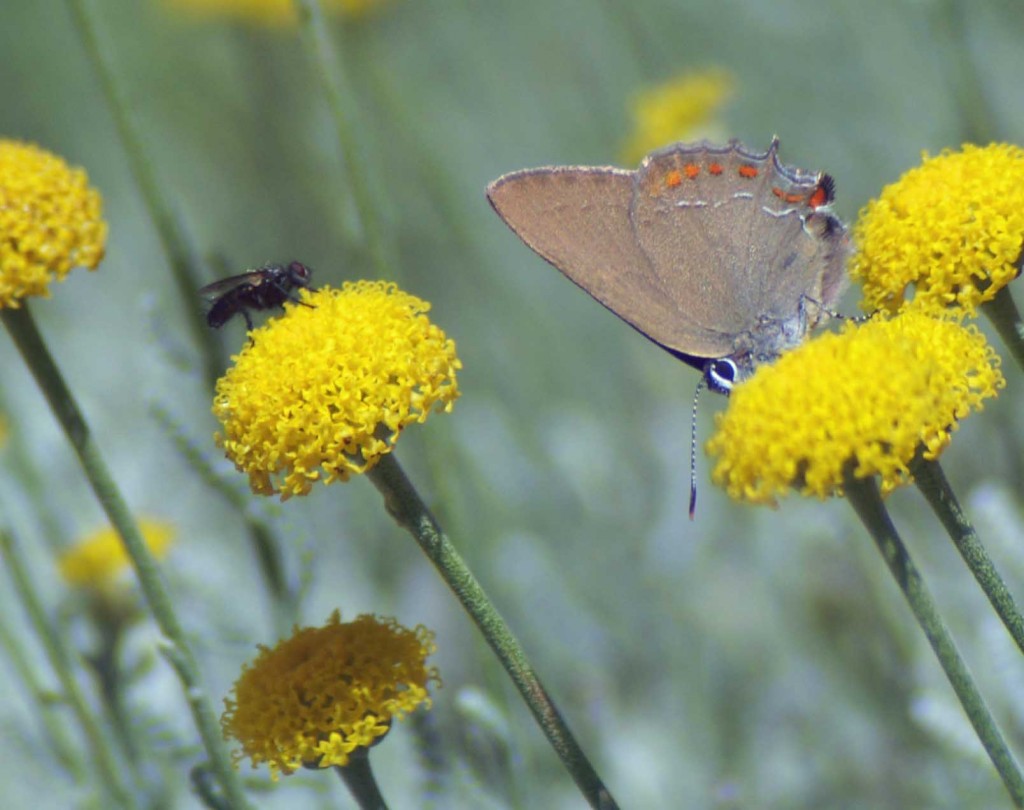
31MAY11-Ann Ilex Hairstreak & a tachinid fly feeding on santolina

A closer view of the small Tachinid fly - Phyrxe vulgaris

Tachinid flies are useful rather than beautiful insects: a species that help greatly to control various forest and agricultural pests: the larvae are internal parasites of numerous butterflies & moths.

31MAY11-A pretty view of a Speckled Wood on santolina flowers

Butterfly species recorded in and around the garden this month:

Large White, Small White, Cleopatra, Clouded Yellow, Ilex Hairstreak, Common Blue, Holly Blue, Lang’s Short-tailed Blue, Long-tailed Blue, Geranium Bronze, Speckled Wood, Meadow Brown, Small Skipper

(13 species)             

Spring’s promise of new life fulfilled

A small very dark coloured gecko can often be found on our black-painted front gates where he is much better camouflaged than he appears to be in the photograph. Waiting until the very last moment to move as you approach the gate it suddenly dashes off rapidly: it makes me jump every time, even though I half-expect it to be there.

27/5/11-Moorish Gecko keeping guard at the gate

28/5/11-A pristine Red-veined Darter- Sympestrum fonscolombei -posed beautifully on the car aerial

Despite their size and bulk Violet Carpenter Bees manage to land on the small flower heads of the cut-leaved lavender, the stem bending under its weight. Their attentions do not benefit the flower, they can take nectar without picking up any pollen.

A Violet Carpenter Bee taking nectar from a lavender flower

The last three wet winters we have had here have done wonders for increasing the variety of wildflower species that have colonised the ‘waste’, or vacant plots of land in our locality. At the moment they are at their best and attracting a fair amount of insects, which is good news for the birds still feeding unfledged or recently-fledged young and even better for the Spotted Flycatchers that are only just beginning their breeding cycle.

8/5/11 -Sotogrande, Wild Carrot flower

Wild carrot began flowering a while ago and although continuing to flower, earlier blooms have begun to go to seed now, I love the way it bunches its florets up into a tight, lacy goblet shape.

29/5/11-Sotogrande, Wild Carrot going to seed

Crown Daisies  most frequently have golden yellow flowers, but there is a  variety that produces white flowers with a yellow centre.

29/5/11-Sotogrande, Crown daisy - Crysanthemum coronarium var. discolor

One of the prettiest of the wildflowers growing locally is a mallow (malva). This is the plant that can often be seen in large patches along the roadsides.

Dwarf Mallow-Malva neglecta

There are quite a few malva, or mallow species found here, and they can be difficult to name, some also hybridise.

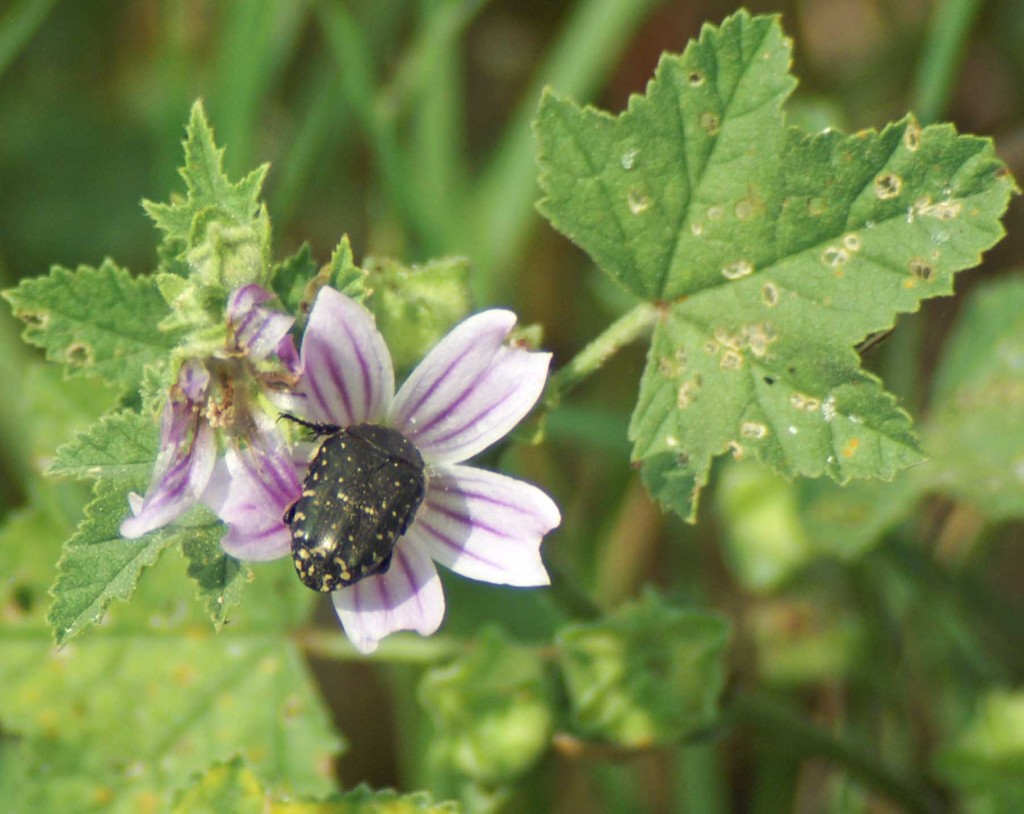
29/5/11-Sotogrande, a chafer (oxythyrea funesta) in the flower of Common mallow-Malva sylvestris

Two Clouded Yellow butterflies passed overhead,  a  blur of golden yellow engrossed in fierce aerial combat. Suddenly breaking apart they went their separate ways, one flew up and away while the other retreated to recover on a leaf amongst the long grass.

29/5/11-TGSOTOLCL-Clouded Yellow

A butterfly I was not quite so pleased to see was a tiny Geranium Bronze. A true native of South Africa, it’s thought their first introduction to Iberia was through Majorca,via imports of their LHPs, which as the name suggests is geraniums. They have spread quickly, colonising many parts of Southern Spain where the popularity of brightly coloured pelargoniums and suitable climate provides them with ample opportunity to thrive. This is the first individual of the species I have seen so far this year, so I’ll be guarding my geraniums now, they’ve been looking so good this year too.

29/5/11-Sotogrande - Geranium Bronze

I had set out on this little wildflower expedition to try to find a particular little butterfly and just as I had decided to turn round and head home I spotted it – just one  Small Skipper on a scabious flower, a plant which is beloved by a good many species of butterfly and an important LHP to several species too.

29/5/11-Sotogrande, Small Skipper-Thymelicus sylvestris on scabious

Feeling very pleased with my sighting I was walking home and heard a very strange sound coming from low down in some shrubbery beneath a cork oak tree on the boundary of two vacant plots. I began to head for the boundary fence to have a look to see if I could see what was making the sound, a sort of loud warbling, piping sound with frog-like tones, then froze as a Nightingale flew onto the fence right in front of me. It turned and headed into the vegetation in the direction of the strange noises which stopped momentarily, so I assume they were the summoning calls of one of its young. I carried on walking a little way and the Nightingale flew in front

29/5/11-Sotogrande, a young Nightingale trying to land on a grass stem (photo taken through wire fence)

of me again, this time from the other side of the vegetation into the neighbouring empty plot, heading for the cork oaks next door to our house. Spotting movement low down on a branch where the bird had flown out from I looked to see that a young one had followed it and was wobbling trying to balance itself. It flew out, attempted to land on a grass stem, then flew back into cover, piping plaintively.

I carried on home and stayed there for a few minutes to let things settle down, then set off again hoping to get more views of the Nightingales. Waiting by the gate where I had the earlier sighting I was lucky enough to see an adult that flew from very close by across the road to a cork oak, then another bird came in to the tree in front of me. Not a Nightingale, but a perfect view of a Spotted Flycatcher.

29/5/11-Sotogrande, Spotted Flycatcher in cork oak

Back at home once more I could hear the almost constant and very loud piping of a young nightingale and had a couple of views of it as it perched briefly on top of the wall then perched in a small tree.

There were other recently fledged birds around too. Yesterday I heard young-bird- summoning calls emanating from the cork oaks and traced them to two Short-toed Treecreepers. It was late afternoon and too shady to try to photograph them, but hearing similar sounds this afternoon I went to investigate. I located the source of the sounds, quite high above me in a tree, but they were not those of Treecreepers, these were two lovely young Serins.

29/5/11-Sotogrande, Serins, both a very young male and a female

It is wonderful to be witness to the next generation of these beautiful young birds of very different species venturing out into the world, and I’m sure if I pay due attention the next few days will bring forth even more. One thing I have noticed they all have in common is the small size of their families. The Chaffinches that fledged a couple of weeks ago had just two chicks, the Nightingales may have two, but I suspect just the one this year,there were two young Short-toed Treecreepers and just the two Serins. I can only speculate that family sizes are tailored to the amount of locally- available food; it makes sense to be able to feed two offspring well than more insufficiently.

Hoverflies and wasps

May 21st-31st

Sunny mornings and the privet in full flower attracted some interesting insects to the garden this week. I am a big fan of bees, wasps and hoverflies: most are very attractive insects and even the bigger ones pose little or no threat to people. Many species are important pollinators, wasps clean up a lot of debris and hoverfly larvae consume aphids, so they are very useful visitors to our gardens too.

The first hoverfly  to attract my attention this morning would have been impossible to overlook, a large colourful insect, the Belted hoverfly – Volucella zonaria was completely absorbed in its quest for nectar.

Belted hoverfly - volucella zonaria

Volucella zonaria is a large, impressive hoverfly with a wingspan of up to 45mm. Overall effect of the insect is slightly reminiscent of to that of a hornet, although it behaves like a typical hoverfly, frequently sunbathing then darting off. It is thought the larvae probably live in wasp’s nests.

Hoverfly - Volucella zonaria, a large colourful and impressive insect

There were greater numbers of other slightly smaller, but still quite large hoverflies, recognising two different Eristalsis species.

Drone-fly - Eristalsis tenax

Eristalsis tenax is also known as the Drone Fly referring to its mimicry of a male honey bee. It is a common and familiar species with a wingspan of 24-28mm. A rather hairy insect, highly variable in its appearance, but basically deep brown with 2 quite narrow, whitish rings, and greater or lesser amounts of orange on the edges of the abdomen. It occurs in a wide variety of habitats, almost anywhere there are flowers.

31/5/11-Drone fly - Eristalsis tenax

29/5/11-Sotogrande, Honey bee -Apis mellifera- has 4 wings

Eristalsis pertinax is rather similar to the Drone Fly, but slightly more slender and with a strongly tapering abdomen that has one pair of broad yellow-orange markings. The front legs are wholly orange. 

30/5/11-Sotogrande, Eristalsis pertinax

30/5/11-Eristalsis pertinax

There were a few smaller hoverflies around too, some were familiar, but there were others I have so far been unable to identify.

Syrphus ribesii is a common and fairly typical hoverfly with a wingspan of 20-24mm. It is found in most flowery habitats such as rough grassland, hedgerows and gardens.

31/5/11-Sotogrande, Common Hoverfly-Syrphus ribesii

Metasyrphus corollae is even smaller, with a wingspan of just 16-18mm. This is a very widespread and common insect found in similar habitats to the above.

Hoverfly-Metasyrphus corollae

27MAY11-A very tiny hoverfly (or wasp) I have not yet identified

I was watching Ilex Hairstreak butterflies nectaring on the thyme flowers and was distracted from them by a large dark-winged insect that was also interested in the nectar. More used to seeing them on the ground, it took a minute to realise it was a Sand Wasp. It kept retreating to the stone in the photograph, then running back to the flowers, scrambling through them rapidly, while constantly flicking its wings. It was joined by another, showing no aggression towards it. I thought they were perhaps hunting for caterpillars for their nests, but I didn’t see them find any.

Sand Wasp - Ammophila sabulosa

Sand Wasp – Ammophila sabulosa:  a very distinctive large species, with a body length of 20-24 mm. The females catch caterpillars, dragging them back to pre-dug nests. They stock each nest with a single large caterpillar and lay an egg on it before covering it over. 

A Sand Wasp enjoying nectar from a thyme flower

Over the next few days I began to see Sand Wasps all around the garden, the one below was on the ground scurrying around some flowerpots when I disturbed it and it flew across to a rosemary shrub, staying very still as though trying to hide. I saw them scouring the lantana and the thyme often, always in a big hurry and with wings almost constantly flickering impatiently. I watched one disappear under a fallen palm frond from which it did not re-emerge so I assumed it had dug itself into the ground there. I have yet to see one with a captive caterpillar.

31/5/11-A Sand wasp trying to hide in the rosemary shrub

The following wasp is another I’ve spent quite a bit of time trying to identify without absolute success yet. I think it may well be wasp of the family Eumenidae, which includes potter and digger species.

30MAY11-Sotogrande- query wasp of Eumenidae family

* I am not overly-familiar with a lot of the insects from these species myself and am trying to identify them as I come across them, but I am not going to claim that I’m right in my conclusions, so as always, I am pleased to be corrected.

Sunshine and butterflies

May 22nd-28th

A wonderful few days for butterflies, including two that are new to this blog. Most were familiar ones and most were not numerous, but several different species were represented none-the-less. Friday (27th) was an exceptional day, hot and sunny with very little breeze and I saw more butterflies in one day than I think I’ve ever seen here in this garden.

It’s only right that I start my list with a Speckled Wood, our most consistently-present butterfly, which has been particularly numerous this week. I’ve seen them all over the garden, in dappled shade, in full sun, fighting amongst themselves and chasing off other intruding species. They’ve also been taking nectar from the privet, and one I saw, from thyme flowers. There is always one in the part of the garden on either side of the entrance gates that regularly patrols the shrubbery and hedge, defends its patch vigorously and takes siestas on ivy leaves, so I chose to photograph him.

22/5/11-Speckled Wood- Pararge aegeria - resting but alert on an ivy leaf

On Monday I caught  sight of what I thought was a Large White dipping down to flowers at the bottom of a lantana shrub. It was a lovely female Cleopatra that was so perfect it must have been newly emerged and that stayed feeding for at least half an hour.

23/5/11-Cleopatra - Gonepteryx cleopatra on lantana

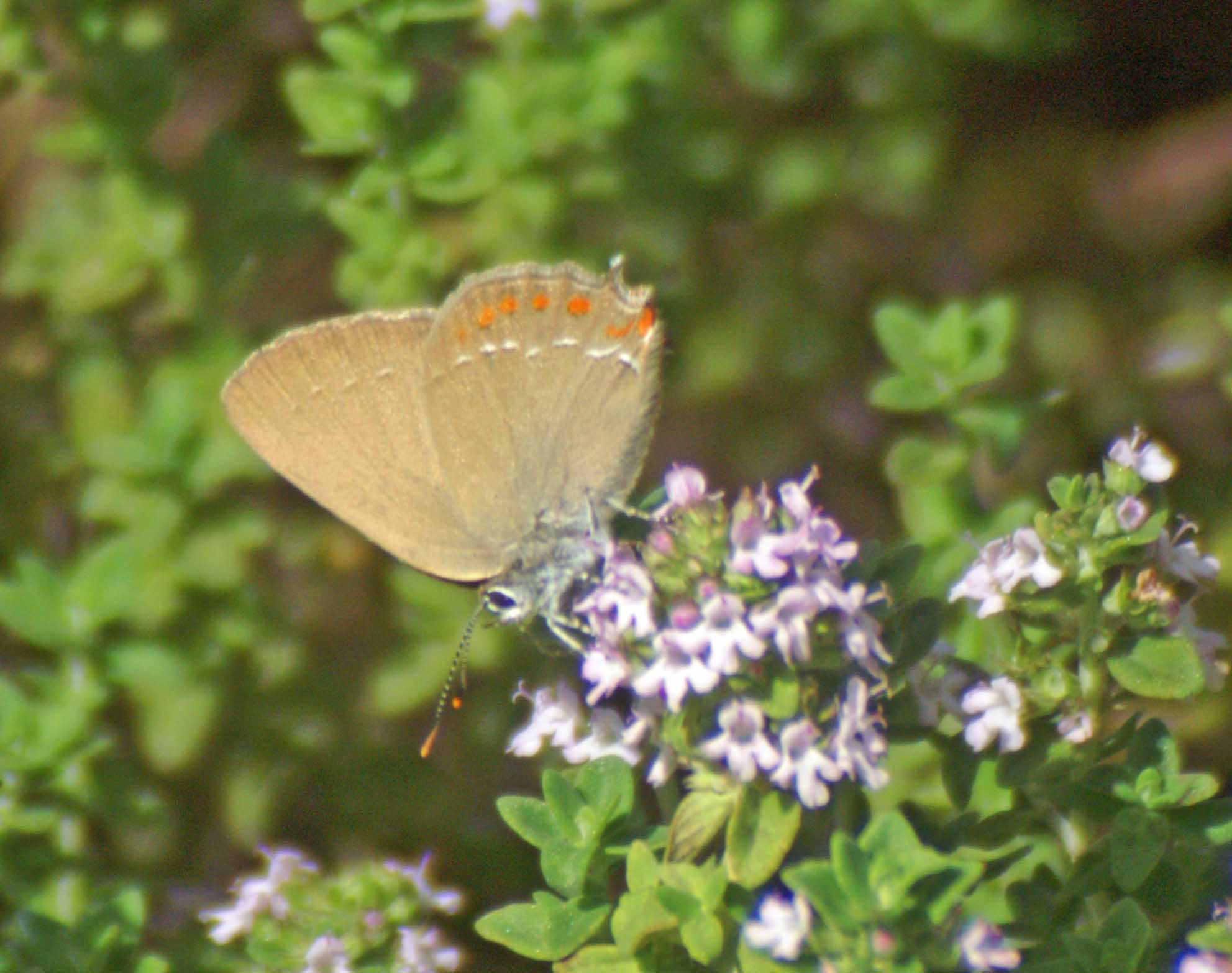
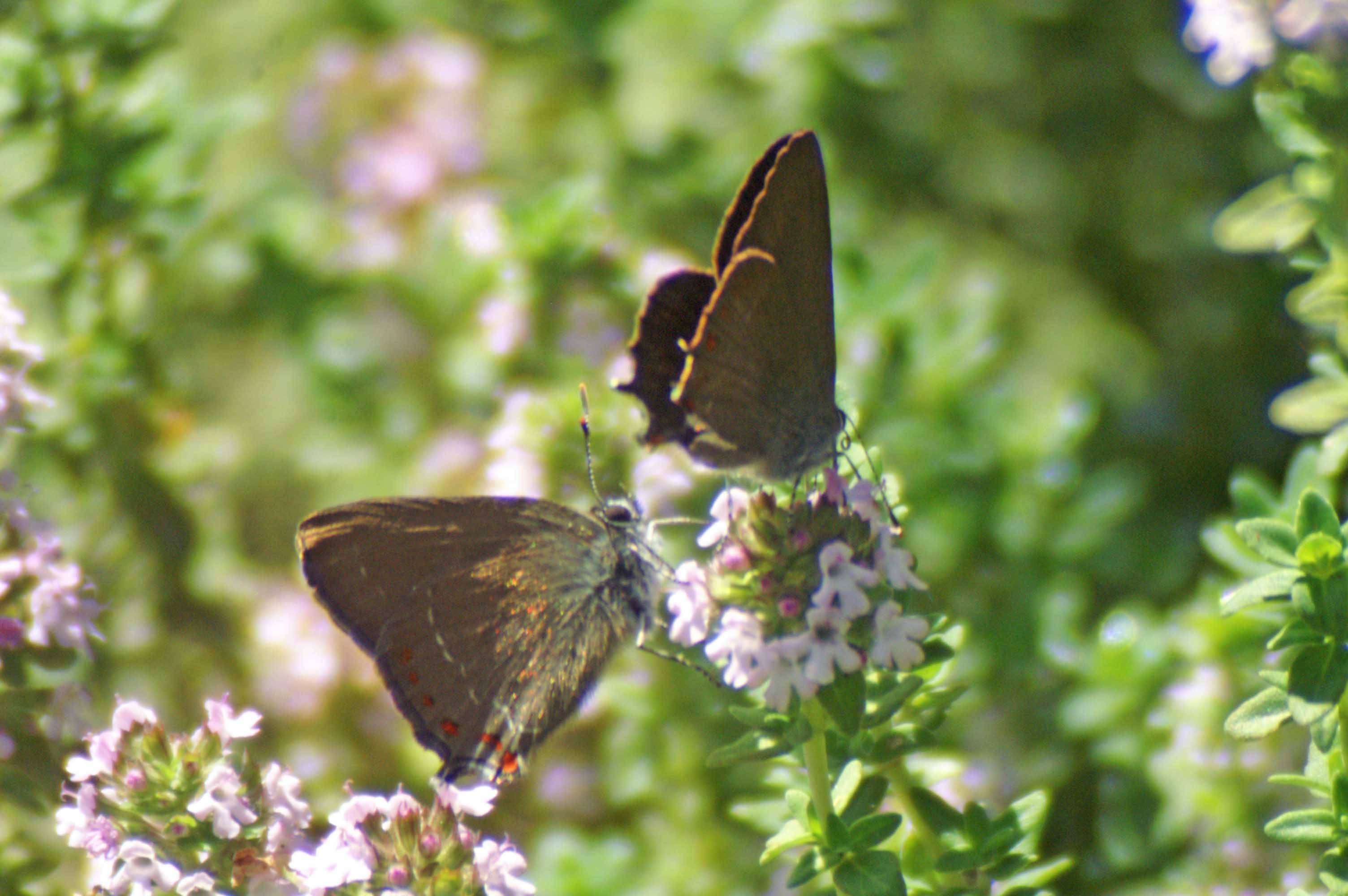
There are a mass of flowers on my thyme plant now that have been attracting a few little hairstreak butterflies. These are Ilex Hairstreaks that I have seen in the garden in ones and twos in previous years, when they have been attracted to the yellow button flowers of the santolina (cotton lavender).

27/5/11-Ilex Hairstreak - Satyrium ilicis

27/5/11-In the sunlight the butterflies have a bronze sheen to their wings

I have not had a very good look at their uppersides as the second they land they snap their wings shut. I have seen individuals moving their hindwings back and forth, passing one over the surface of the other,  giving glimpses of only the edges of the upperside surfaces of the wings. I’ve seen this behaviour in other species too and have wondered why they do it. I’m sure it will be something to do with mating; maybe the change in air current it makes wafts pheromones into the air, or makes some kind of high frequency sound audible only to another butterfly. Maybe it lowers their body temperature a little, circulating air around their furry bodies.

Whilst photographing the hairstreaks a little blue butterfly passed close by and landed on one of the little yellow flowers that populate an area of my lawn. A male Common Blue.

27/5/11-Common Blue - Polyommatus icarus

I came across another blue that had dropped in to sample the marjoram flowers, this one a little butterfly that originates from Africa but that is a common migrant here and may have become resident, a Lang’s Short-tailed Blue.

27/5/11 - Lang's Short-tailed Blue - Leptotes pirithous on marjoram

A butterfly I was surprised to see was a Meadow Brown. It was flying very low to the ground in the shady strip of garden between the boundary wall and the house, pausing to rest first on a violet leaf which it was probing with its proboscis and then on a dry leaf on the ground.

27/5/11 -Meadow Brown- Maniola jurtina on a dry leaf on the ground

Other species I saw but did not/could not photograph were Small and Large Whites, almost constantly on the wing and too fast for me, clearly energized by the sunshine. Holly Blue(s) that I have had several sightings of as it fluttered along the tops of the hedges then up to the tops of the trees. A Clouded Yellow that popped in over the wall, raced along the hedge then popped back over the wall.

Wading birds – an outing to Brazo del Este, Seville

14th May 2011

This outing was arranged by the Gibraltar Ornithological and Natural History Society. We have visited this site in the plains of Seville in the two years previous to this one, on 14th May 2009 and 15th May 2010, which is interesting for noting consistencies and changes in this very dynamic landscape.

The outing requires an early start from the Gibraltar/Spain border, meeting at 6am, then setting off on a journey that takes around two and a half hours if you drive directly there, or more like three if you stop for a breakfast break, as we do. It is a long drive, but easy going via the scenic dual carriageway from Los Barrios to Jerez de la Frontera, and then continuing towards Seville on the AP5. At this time of the morning there is very little traffic, but the new speed limit of 110 kph added a few minutes to our journey today – of course we kept to it – Jill set cruise control!

Brazo del Este is located 20 km south of Seville in the Guadalquivir river estuary and is an area with one of the highest levels of biodiversity in the Iberian peninsula. This former branch (brazo) of the Guadalquivir is east (este) of the river and has become an extensive wetland, marsh and reedbed area that is surrounded by rice plains and farmland where a variety of crops are grown. It is an outstanding ornithological site, where over 230 species of birds have been recorded. It is noteworthy for its high numbers of waterfowl especially in winter, while in times of drought, birds from the nearby Doñana National Park flock here.

We may have witnessed more dramatic and colourful daybreaks than this morning’s, but as the light slowly brightened we saw a good few raptors, at least one Short-toed Eagle, a Kestrel, Booted Eagles and Black Kites setting off from various night-time roosts, flapping over fields or perching up on pylons and power lines. The number of White Stork’s nests on the tops of shorter pylons along the roadside seems to increase each year, the bird pairs visible in the half-light sitting or standing on their nests, most of which will now house quite well-grown young.

We stopped for breakfast, as always when heading in this direction, at the service area of las Palmeras, located at the turn off for Alcalá de los Gazules. One of the early morning features here is the cacophony of House Sparrows waking up and exchanging noisy but cheerful greetings.  Refreshed, we continued our journey, finally reaching the small town of el Palacio at around 8.45am, where Jacaranda trees in full bloom line the main street and numbers of Swifts were already racing around squealing delightedly, and where the temperature had already reached 21°C.

Common Buzzard - Buteo buteo

The road leading from the town to our target site is long, narrow and almost straight, passing through vast acres of flat cultivated landscape that is short on significant features. On its left side there are a few scattered clumps of  farm buildings surrounded by large ploughed fields, and a line of telegraph poles is set along its edge. We had our first close bird sighting of the day here; a Common Buzzard that sat enjoying the sun, ignoring us determinedly as we sat in the car looking up at it.

Chicory thrives here

For a good length of it, the land opposite is screened by a windbreak of tall eucalyptus trees fronted by a deep reed-fringed dyke that was brimful of deep water. Windows down, we heard our first birdsong, the unmistakeable loud scratchy tune of a Great Reed Warbler.

A Great Reed Warbler, singing at full throttle

It took very little effort to locate the singer, perched high on top of a bedraggled old reed seedhead. We watched him for a minute, until he flew up into a nearby tree. A Moorhen crossed the road in front of us and a Crested Lark meandered along it further ahead. We stopped again almost next to another Great Reed Warbler, enjoying very close views of him, and  spotted Reed Warblers discreetly travelling around low in the reed thicket beneath his perch. Two Black-winged Stilts flew across towards the water and a couple of Black Kites flapped past, high above the fields.

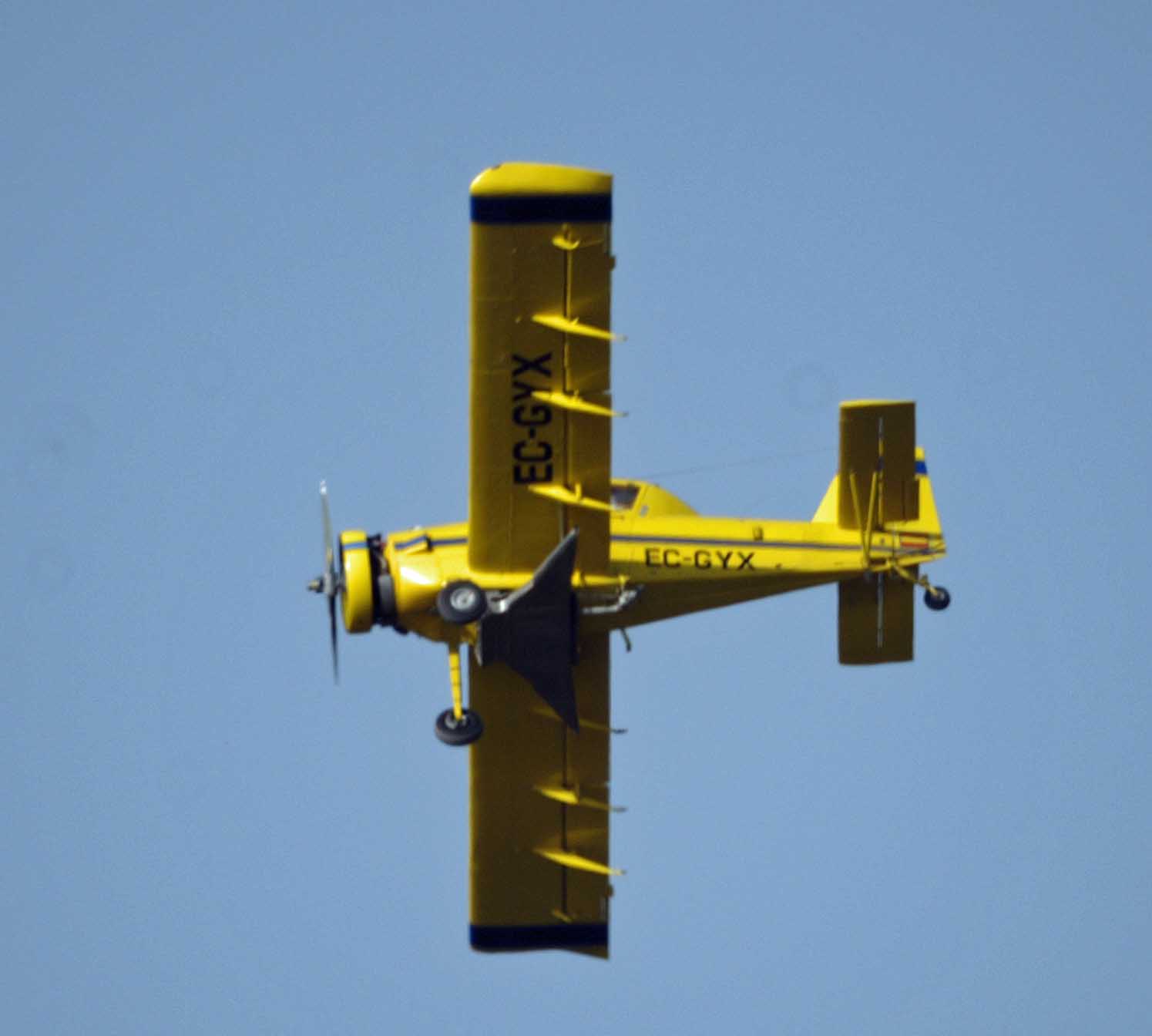
Crop spraying was underway

Inside the site, we had a few moments of concern on seeing that a large area of what was reed-bed last year had been cleared and ploughed. To add to our woes a small crop-spraying plane was buzzing across the fields discharging its cargo. The thoughts that after travelling all this way, not only would there be no birds to see but that we may also be either poisoned or fertilised for our efforts, did cross our minds. But this is a very intensively farmed area, and although a designated Parque Natural, people here have to work hard at making a living; at least there were no tractors racing up and down the track covering us with great clouds of dust as they were last year! (I’m really selling this place aren’t I?)

Our spirits soon lifted when we saw more singing Great Reed Warblers up on reeds, and driving on a short way we discovered large areas of damp and, in places, wet reedbeds. Beyond the tall reeds there were Black-winged Stilts stalking through the shallow water, Purple Gallinules skulking around its reeded edges, Moorhens and the first of several views of a flying Little Bittern. A Cetti’s Warbler threw out its song and three tiny Fan-tailed Warblers were engaged in a tight battle, two of them breaking away and spiralling up and across the road oblivious to us.

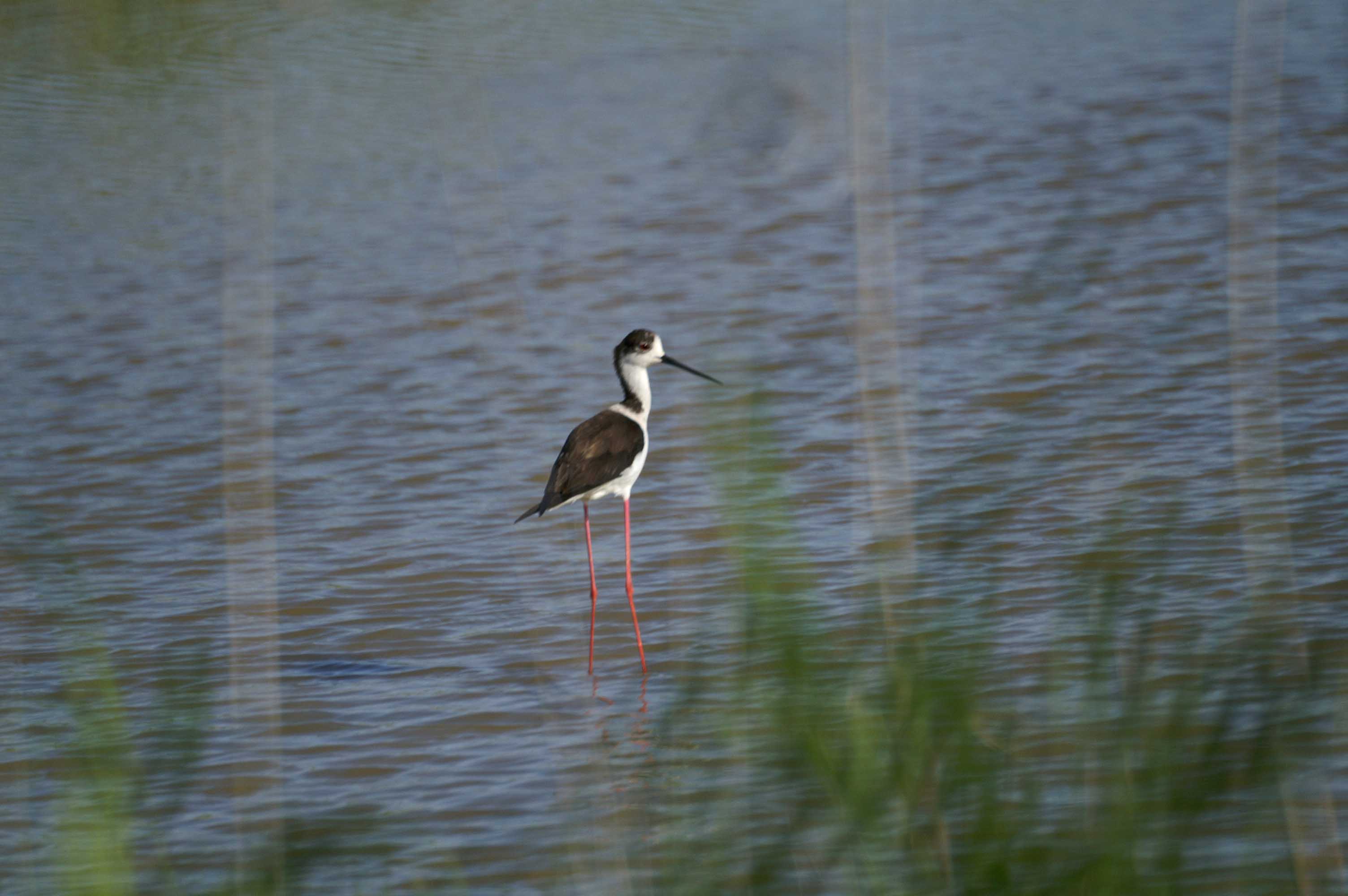
Black-winged Stilt- Himantopus himantopus

Jill set up her telescope here and picked up that there were Dunlins in the mix too, one of which had lost a leg but that seemed to be coping well. A raptor flew across and landed on a distant pylon, through the ‘scope we could see it was a Black Kite that had perched up to eat something indeterminate but bloody. The presence of the Black Kite disturbed a large flock of smallish birds that we at first thought were Dunlins, but that turned out to be Ringed Plovers. We went on to discover there were large numbers of them scattered throughout the site, clearly on passage through and feeding before setting off to their more northerly breeding areas.

Purple Heron - Ardea purpurea

Our best views of Purple Herons were of individuals flying between various parts of the site, once they land amongst the reeds they are amazingly well camouflaged and they prefer to stay that way, much less commonly seen feeding openly as their Grey Heron cousins. There were other good sightings of flying waders too,  Grey Herons were frequent spots, Night Herons were out and about too. There were a couple more sightings of Little Bittern and most unusually, one of a Common Bittern. Two Glossy Ibis flew across, their profiles unmistakeable against the increasingly bright sun, although not a great light to photograph against.

Glossy Ibis - Plegadis falcinellus

We had a superb view of a Spoonbill flying low over the reeds: last year we had wonderful sightings of a flock then of them wading as a large group with a solitary Sacred Ibis attached.

Spoonbill - Platalea leucorodia

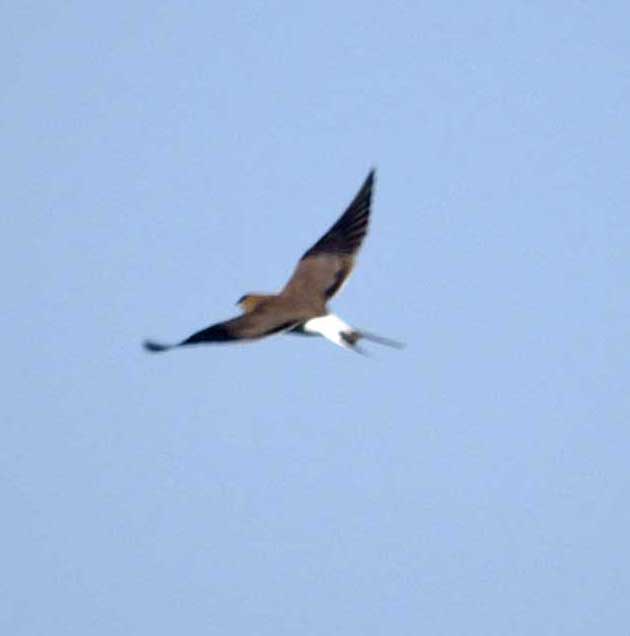
 Collared Pratincole – Glareola pratincola

Collared Pratincoles are one of the characteristic and I think most charismatic birds of this area, resembling Plovers (charadrius) on the ground and terns in flight.

Collared Pratincole standing on a mud bank

The habitat of Brazo del Este is perfect for their needs, they favour large flat expanses of land with some shallow pools and marsh, often dried-out flood areas, grazed shore meadows and salt steppe adjoining coastal lagoons and deltas. (They also occur in the la Janda area)

Collared Pratincole in flight; they catch insects on the wing

Moving on a little further we had closer views of Ringed Plover and Dunlin feeding on the muddy shores of  a rapidly drying pool, then further back in an area with more water were Spoonbills, Grey Herons, a Purple Heron, White Storks,Little Egrets, Redshanks, Avocets, Black-winged Stilts and Dunlins.

A few of the White Storks & a Little Egret that were part of a larger mixed group

Another moment of alarm occurred when we spotted ‘objects’ floating around on the surface of another pool: at first we thought they may be dead birds, but closer inspection revealed dead fish. We could only speculate as to what had killed them, but nothing was venturing to eat them.

Dead fish

There were not a huge amount of smaller birds flying around, but there were a few Whiskered Terns, Little Tern, Yellow Wagtails and Goldfinches to be seen. There were more Reed Warblers spotted and Great Reed Warblers continued to be heard, but as the heat increased were less frequently seen as they dropped lower down in amongst the reed stems.

Great Reed Warblers continued to be heard but less frequently seen

Much as I love to see birds, I am interested in habitats as a whole and am prone to becoming distracted by ‘other stuff’. The natural vegetation of the site as a whole is of course dominated by stands of Giant Reeds. The roadsides are so dry and sun-baked for most of the year that only the toughest of plants can hope to survive, so the vegetation there consists largely of thistles, plantains etc.

A hedge of thistles along part of the roadside

Aestivating snails clinging to thistle seedheads

Those in flower now attract a surprising number of insects, I saw bees, a few dragonflies, butterflies and a little diurnal moth. The most common butterflies were Clouded Yellows, I also saw mating Small Whites, Green Striped Whites and a pristine Painted Lady.

Clouded Yellow-

Green-striped White - Euchloe belemia

Another pool held an exciting find – a flock of beautiful Grey Plovers, the males in their handsome summer plumage. The sun high in the sky and reflecting off the water, together with the distance away made a decent photograph impossible, so I have included one that I took whilst on another outing on 6th May 2007, at Trebujena.

A pair of Grey Plover in summer plumage

Most of the wading birds we had come across had been on reedbeds  on the river side of the track (to our left going in), but we had one of our best collection of species sightings in a pool fairly distant from the track and on its other side. Here there were White Storks, a number of Grey Herons, (at least two of which were very young, probably of this year’s brood), Little Egrets, Grey Plovers, Dunlin, Ringed Plovers and gulls.

A variety of wading birds gathered together

A more expansive view of where the birds were showing the receding water

This was the last of the expanses of reedbed, but we decided to continue along a little further as we knew from last year there were some potentially interesting spots ahead providing a slightly different habitat and attracting some different species of birds. It was a good decision; our first spot was a Kestrel that we watched land on the bare earth of a ploughed field. There was another Kestrel already on the ground and the two of them stayed down, so had clearly found something worth eating.

We arrived at the small bridge that crosses a concrete-lined waterway, where last year we had come across the amazing spectacle of  White Storks, Grey & Purple Herons, Little Egrets & a Night Heron all feasting together on fish stranded in shallow water. There were no waders here today, but we did spot Red-rumped Swallows flying around the bridge and stopped to watch as they landed to collect mud from the bottom of the almost-dry dyke, then swooping up and under the bridge, where they are clearly building their characteristic ‘igloo- style’ nest.

Red-rumped Swallow - Hirundo daurica

On the other side of the bridge is a large pool surrounded by a grassy field, where again, last year we had seen two Squacco Herons. No Squacco’s today, but there was a Little Grebe. There were Black-winged Stilts too, actually nesting in the exact same place as they were last year in a surprisingly open spot in the field. Opposite there we had our best Purple Heron sighting of the day as it stood out in the open on the bank of a small river.

We turned back here to head for our favourite venta in the village of el Pinzón, first experiencing a bit of deja-vu as we encountered birds that we had seen in the exact same location in almost the same spots as last year. I am referring to an area of rough pasture that has pylons and cables that last year had Bee-eaters skimming over it; this year we saw only one up on the cables, but it was there. Last year a Short-toed Eagle was perched atop a telegraph pole on this bit of roadside and lo and behold, there it was again today. The final bird in the set was a Corn Bunting perched on the cable and yes, there was a Corn Bunting there today too. It’s reassuring to see that not everything changes in a hurry.

Back on the road and driving away from the site we had our most exciting bird sighting of the day. As we reached the end of the line of eucalyptus trees, a Marsh Harrier shot out from behind them then continued to fly low and fast parallel to the road. Jill adjusted her speed to keep pace with him and to try to keep him in clear view for me  to try to photograph through the open driver’s side window. Good job it’s a straight piece of road!

Marsh Harrier keeping pace with the car

At the venta there was another now-familiar sight – a Stork’s nest that is located on top of a tower on the opposite side of the narrow street where the parents were once again feeding growing young.

White Stork feeding young

Sotogrande spring catch-up

3rd -13th May

I was beginning to think Spring would be over before I managed to get to catch up on what’s been happening here in Spain since I got back from the UK, but here’s just one person’s very tiny glimpse of the most eventful season in the Spanish natural calendar.

The weather has been variable and at times dramatic; the day I arrived home being an example of the latter. Flying with Easy Jet from London Gatwick, our take-off was delayed by about an hour and a half as the plane had a flat tyre that had to be replaced while we all sat in it. As it turned out that was fortunate in respect of our landing in Gibraltar as due to very strong winds, flights arriving earlier had been diverted to Malaga and ours was the only one to land that day.

On the journey home it didn’t take long to start noticing the changes to the landscape. Still green and lush thanks to the late rains and cooler than usual weather, the masses of golden yellow Spiny Broom that covered the hillsides I left at the end of April had gone, replaced, although to a much lesser extent, by the later flowering Spanish Broom. Along the roadsides the broom  is augmented by frothy pink Tamarisk and darker pink Oleander.

The Spiny Broom & gorse have been replaced by Spanish Broom

It always takes a few days to get back into the rhythm of things, but I had a good start as Jon told me he had discovered a bird’s nest located hardly a metre away from our upstairs bathroom window, but higher up, so about 6 – 7metres or so above the ground. He had been attempting to cut back some of the more intrusive branches that were almost coming in through the window, but stopped when he realised the nest was there. He thought the bird may have been sitting on it for a week or so.

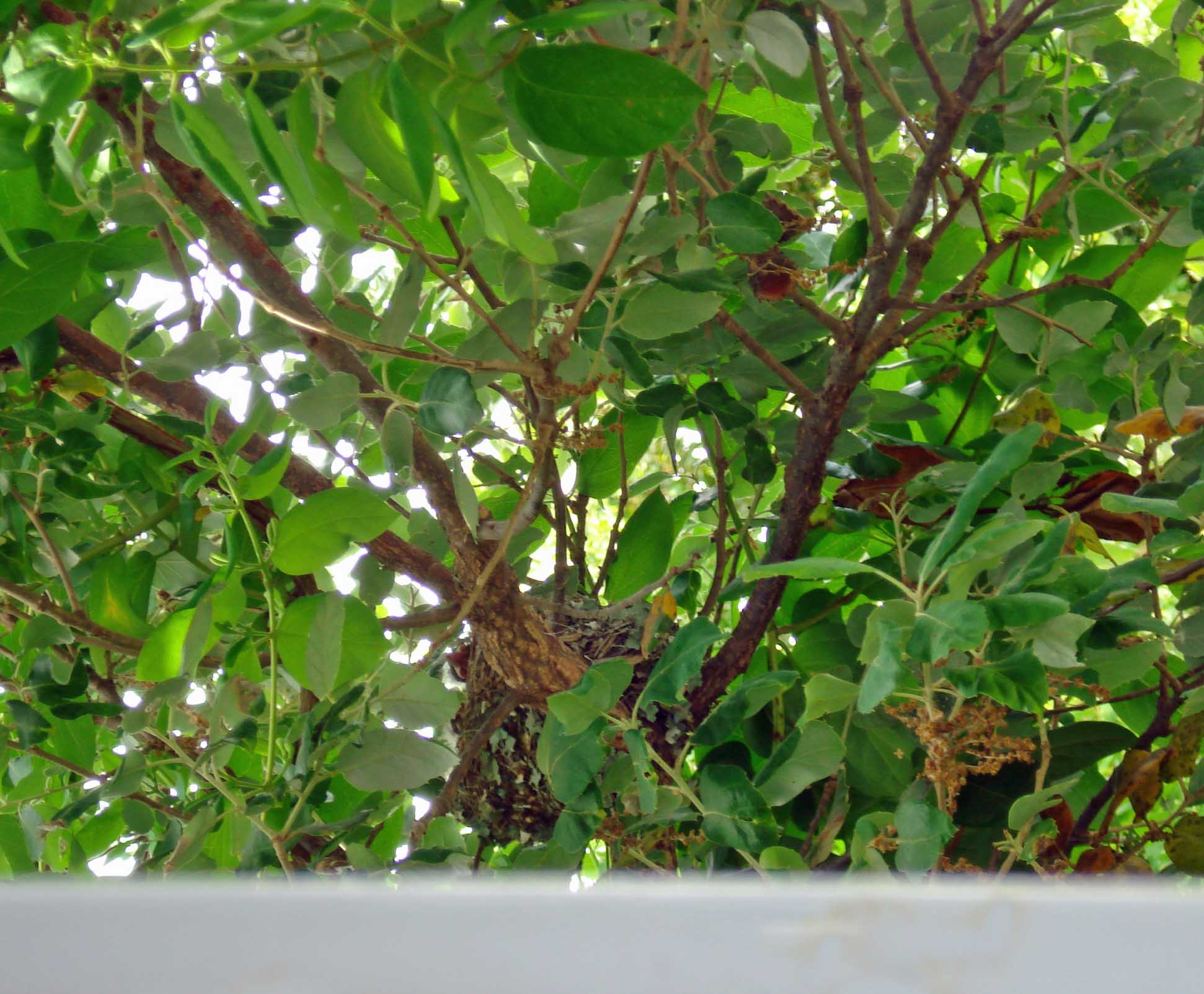
Chaffinch nest from the bathroom window, through the window grille

The nest is a beautiful construction with lichen on the outside of it. Photo taken from the bathroom window.

It’s a perfectly beautiful nest, fitted into the junction of some fairly sturdy branches of the overhanging Cork Oak tree and screened by twigs, tree leaves and by honeysuckle that has twined all the way up there and will be shaded from direct sunlight. The nest is deep and all you can see of its maker is a tail and sometimes a bit of a head, so I couldn’t immediately work out whose nest it was. I only realised it belonged to a Chaffinch pair when I saw the female fly back to it.

Before I left the cork oaks had begun shedding their old dry leaves, a very messy process at the best of times, but when the process is aided by heavy rainfall and strong winds it’s even messier and our drive is covered with a thick layer of them. The trees have flowered too, so the wind has covered every outdoor surface with a thick layer of their yellow-green pollen dust and the flower tassels are also falling. I love those trees, but don’t look forward to these few weeks of their annual spring-clean.

A Cork Oak tree covered in a mass of flowers

In the garden the privet is in full flower and attracting all sorts of insects, including butterflies. There have been Red Admirals and Painted Ladies, but most surprising was a Clouded Yellow that stayed feeding for quite a few minutes, then left to return several times over a couple of hours. They’re usually in a big hurry, rarely still for long, so it was a  bit of a treat to have its company for so long.

A surprising visit from a Clouded Yellow butterfly

There have been more moths around too, some of which I’ve come across outside in the daytime.

A LargeYellow Underwing on a curtain. I couldn't see its antennae, so don't know if it was concealing them - surely it couldn't have lost them both?

This rather faded Crimson Speckled moth settled on the lawn

It’s good to see House Martins darting around the skies again; I noticed they are in the process of rebuilding nests under the eaves of a house where there have clearly been nests before. People sadly do knock them down, but it’s also possible that the amount of torrential rain we had through the winter and in recent weeks may have been responsible for the damage.

8MAY-House Martins are in the process of rebuilding nests in a spot where it looks as though old ones have been removed

Since much earlier in the year I’ve seen Kestrels in the locality, often two together over-flying the area, then a single one that regularly perches in the dead eucalyptus tree I can see across the main road in Sotogrande ‘alto’. I’ve even seen them in the garden several times, usually flying away after I’ve disturbed them from a perch high up in a palm tree. So, I know they’re around and have assumed they are nesting somewhere close by, but I had a most surprising sighting early one recent afternoon: a Booted Eagle suddenly appeared flying low across the garden towards me, swerving quickly as it almost collided with the corner of the roof, closely and noisily chased by a much smaller Kestrel! It was another of those ‘did that really happen moments?’, but as my son was standing talking to me at the time, he confirmed it! Then lo and behold just a couple of days later the scene was repeated, but this time the pursued was a Black Kite and I although I was out with my camera was far too slow to record the speeding action, but I did manage a quick shot of the feisty little pursuer as it flew back, mission accomplished. I guess the birds chased away must have been on passage and strayed into the Kestrel’s territory.

Seeing the photograph afterwards I had another surprise; I think it may be a Lesser Kestrel and am hoping someone might comment on that. It does appear to have the longer projecting central tail feathers.

This Kestrel is afraid is no-one

Apart from that bit of excitement, the general bird population seems to be busy going about the business of raising families. Blackbirds have a nest in the bay shrub, the female hardly ventures out, so she may be sitting on eggs and I’ve seen the male very close by, singing from the top of the nearby hedge and foraging for food on the lawn and around the flower beds.

The wildflowers are this spring are rampant and, just glorious, there is no other word to describe them. It is difficult to convey the extent of them as photographs can’t come close to truly portraying the sights, but here are a few of a field that stretches from the back of Pueblo Nuevo de Guadiaro, behind the football pitch and up to the A-7 Cadíz – Malaga road.

This display mainly comprises purple bugloss, white ox-eye daisies and lime green euphorbia

There's not much grass between the flowers for the horses

A mass of wildflowers at the field edge including Purple Viper's Bugloss, Rabbit's Bread & Euphorbia

I will be following up with a more detailed post of the plants and adding some to my wildflower id page, but I’ve got more catching up to do first.

Pied Flycatchers on migration

4 April 2011

This is my last ‘live’ posting from Spain for a few weeks as in a couple of days I will be flying out to spend some time with my family  in the UK. Spring has always been my favourite season and I have already had some of the best of it in Spain, so I’m really looking forward to being a little further north where it happens a little later. I consider myself very fortunate that I will have been able to experience some of the best of two springs this year and then be back in Spain for the latter end of the season there in early May.

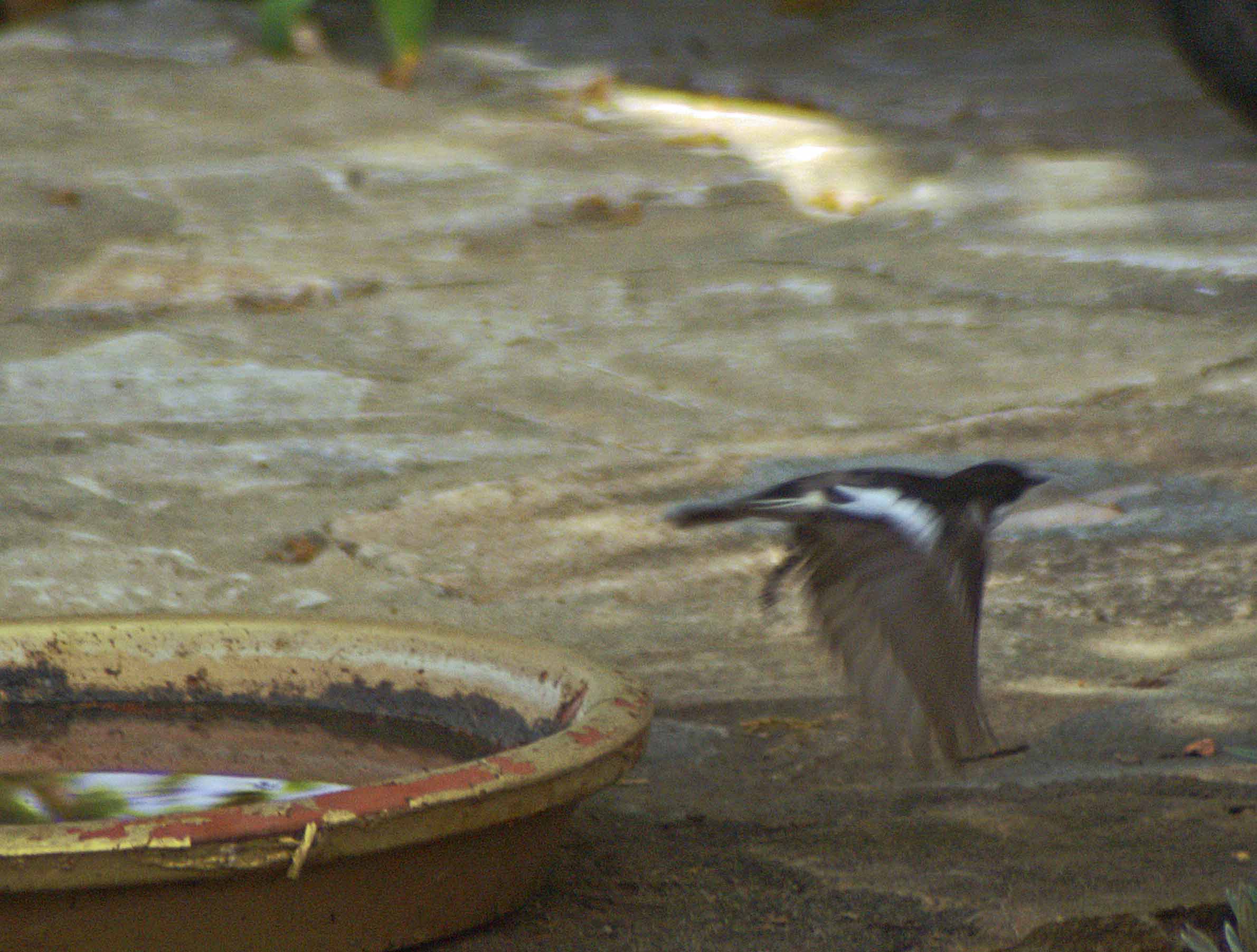
One last lucky bird-spot this morning was this gorgeous male Pied Flycatcher; he would be a recently returned migrant and had stopped in the garden for a while to have a drink and to take a look around for food. I have been lucky to have had Pied Flycatchers dropping in whilst on passage every year so far, but in the past each spring it has been a female that stayed around for a few days with perhaps a few glimpses of a male, then again in the autumn often just a female.

Pied Flycatcher - Ficedula hypoleuca

20/9/06-Pied Flycatcher (f)

In May 2008 a male and a female stayed around locally for a week or so, visiting the garden to bathe and to hunt

Pied Flycatcher female taking a bath