Category Archives: Cadíz Province

Aftermath of a winter storm

The western end of  the Mediterranean coastline of Southern Spain, closely linked to the Atlantic Ocean by the Straits of Gibraltar, may often be battered during the winter months by storms and wind, rain and high seas can cause a lot of damage.

When I first began visiting the  Guadiaro Nature Reserve in Sotogrande in 2004, there was a boardwalk in place that began at the entrance to the beach, ran right along the edge of the reedbed and ended at a rotunda set close by the mouth of the estuary. The structure made a good viewing platform from which to look over the reedbeds as well as offering protection to the reserve area, keeping people and dogs at bay.

The boardwalk that used to be in place along the beach with Gibraltar in the background

Part of the boardwalk that used to be in place along the beach with Gibraltar in the background

Winter storms soon began to take their toll on the woodwork and repairs were made each spring until they more or less admitted defeat and/or ran out of money in 2007. I made this entry in my journal on January 30th 2007, following a particularly dramatically stormy weekend.

Keen to see the effects of the weekend’s storms and to take advantage of a sunny morning, I decided to head for the Reserve to see what was about.

The reedbeds around the lagoon have been battered and flattened by the storms; much will have been done by the wind, but I suspect that the sea may have reached over there too. At first it appeared that there were few signs of life; nothing moved on the water, although I could hear the sounds of small birds about in the reeds and shrubs around the hide. The belting calls of a Cetti’s Warbler were so close I thought that today I may have a good chance of seeing the elusive little bird, but no luck again. Then a Chiffchaff called and appeared for me to see, complete with a leg ring.
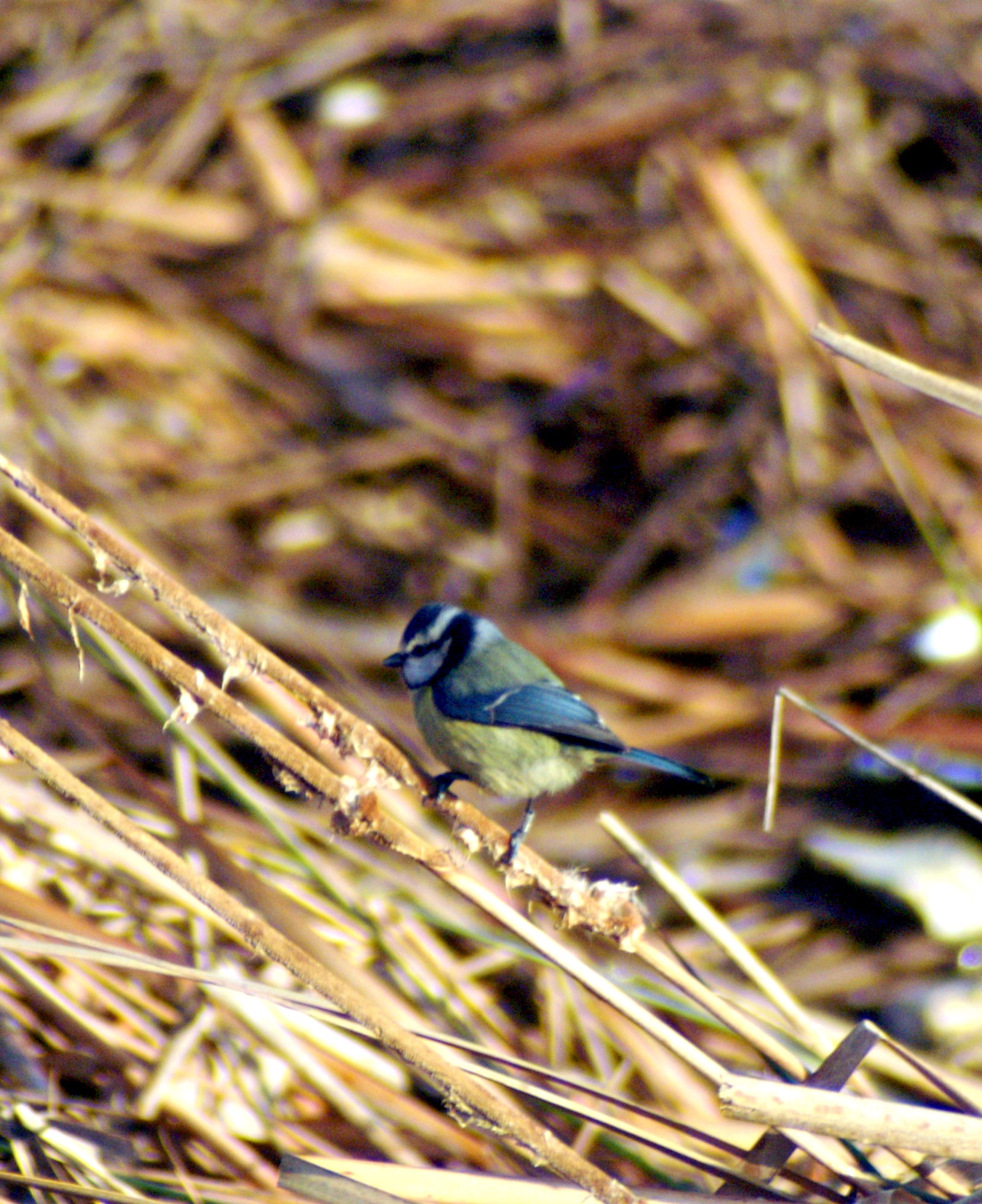
Blue tit

Blue tit with leg ring

A beautiful brightly-coloured Blue Tit arrived to feed on the reed seed-heads, again complete with leg ring.  One of my biggest bug-bears about people using this little stretch of beach is the amount of rubbish they leave behind and there’s nothing like a good storm for exposing the extent of the problem. It seems so wrong to see beautiful birds rummaging around plastic bags and bottles in what should be a natural setting; but then on the other hand, the birds are probably around the rubbish as it attracts, or gives cover to insects. Birds are quick to learn to exploit our less savoury habits and are far more concerned with survival than aesthetics.
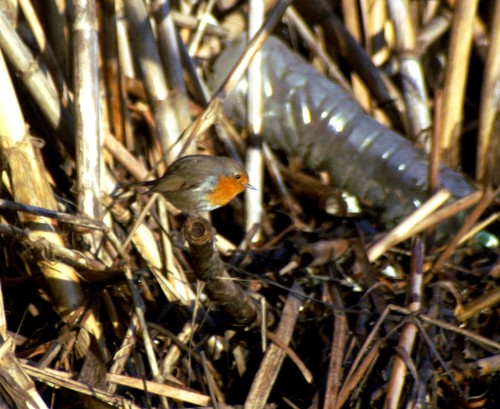
A beautiful robin hunts around a plastic bottle

A beautiful robin hunts around a plastic bottle

Black Redstart (m)

Black Redstart (m)

A beautiful Robin appeared from low down amongst the reeds to perch on an old cut stem and a handsome male Black Redstart flew in to take up a higher viewpoint; both had their feathers well fluffed out against the chilly breeze.

A pair of Moorhen emerged from the cover of the reeds at the water’s edge to investigate the area in front of the hide. They too are in their breeding- best now, with glossy, colourful plumage and bright shiny yellow-tipped red beaks.
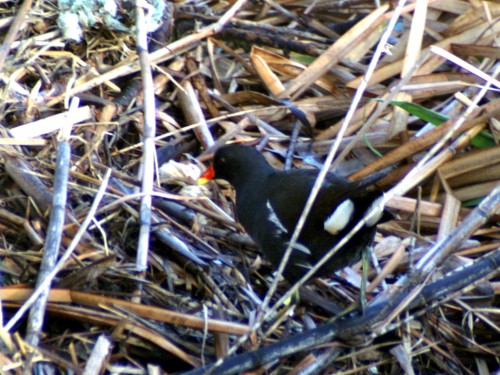
A moorhen looking in peak condition

A moorhen looking in peak condition

Breaking the peace, a flock of about ten or so Snipe  flew in fast and explosively, scattering themselves and rapidly settling into various spots around the edges of the water, where perfectly camouflaged, they effectively disappeared from view in seconds. From over the top of the hide, almost simultaneously with the Snipe, a Marsh Harrier swooped over the water, landing in on a low shrub a short distance away in the midst of the long reeds; maybe chasing the snipe? Surprised,  I didn’t even think to grab my binoculars. I watched and waited for quite a while to see if it would move again, but it seemed content to stay put.
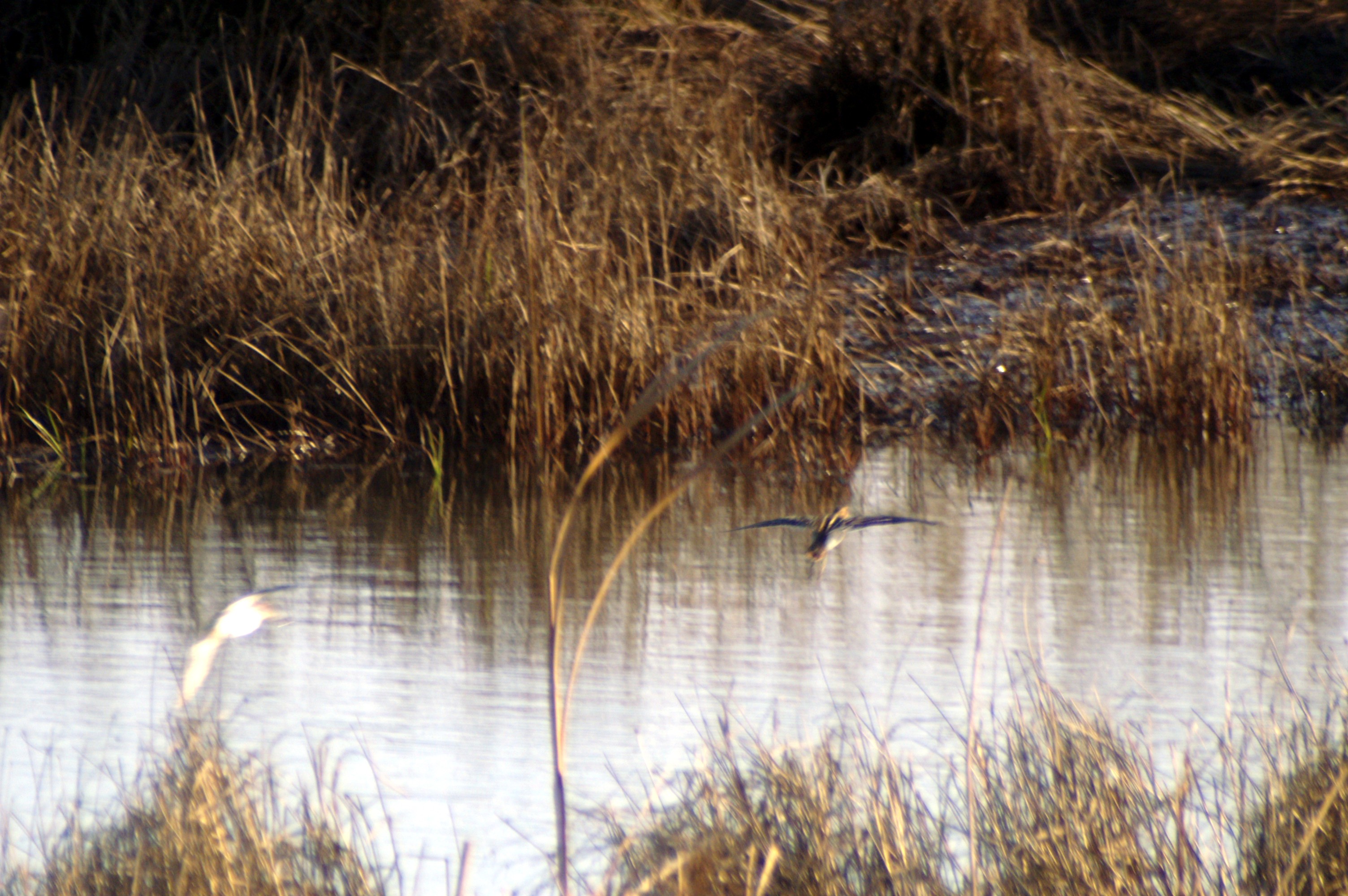
Snipe heading rapidly for cover

Snipe heading rapidly for cover

Outside the hide the sun was bright and it was warm but there was a definite nip in the air; the best winter weather, although it didn’t look set to last as there was plenty of cloud around too.

Walking towards the beach, I heard Fan-tailed Warblers, saw more Chiffchaffs and a Sardinian Warbler, I heard the Cetti’s again and watched a Moorhen that was swimming about close to the nearside edge of the lagoon, it was flicking its wings and flashing its white tail-end; perhaps the Marsh Harrier was still about.

Arriving at the boardwalk it began to become apparent that the storms had once again wreaked their havoc on this ill-fated construction. The ramp to the new rotunda had separated from it, leaving a wide gap to step across to get onto it. But that was minor damage compared to what had happened further along. Much of the new length of boarding that was only put in place last year has been shattered and incredulously, whole sections have been lifted and hurled piecemeal back to the edge of the reedbed.

A displaced section of the Boardwalk

A displaced section of the Boardwalk

It’s such a shame after all the time and effort that went into rebuilding it, but you do have to question why previous experience hasn’t led to a more substantial structure being built. I wonder how long it will be before it will be repaired this time, if at all? The major problem now is that it leaves the reserve open and vulnerable once more as there is no fencing to protect it either.

A lot of pebbles have been dredged up from the seabed and piled up in places to cover a lot of the previously sandy beach. Large numbers of cockle shells have also been thrown up and mainly scattered randomly along the sea edge, but in a few places there are piles of them. Some were evidently alive when wrenched from their rocky homes and now the poor dead animals await being eaten by gulls or flies. It’s quite a gory sight to see them like that, but its surprising how differently we view them when they’re cooked and on a plate!
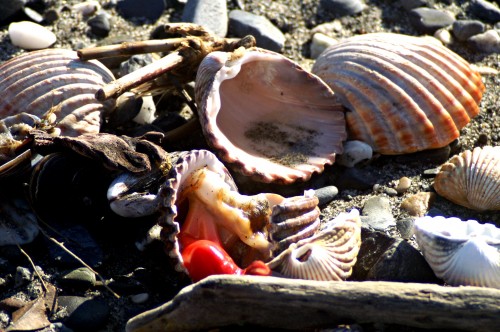
Cockle shell open, exposing the animal inside

Cockle shell open, exposing the animal inside

Cymbium shells

Cymbium shells

Unusually, there were quite a number of Cymbium shells of varying sizes, with one of them also still containing the animal. I have only ever found two of these lovely shells before, one sun-bleached one on the sand on the water-works side of the beach and the other here a short while ago, but broken. Research I have done puts these as native to the seas around the coast of Portugal, but I suppose that’s not so far away and they could easily be carried through the Straits to arrive here. It is interesting that they were all thrown up in the same spot though, I wonder if they are, or maybe were, living in one of the reefs close to the shore?
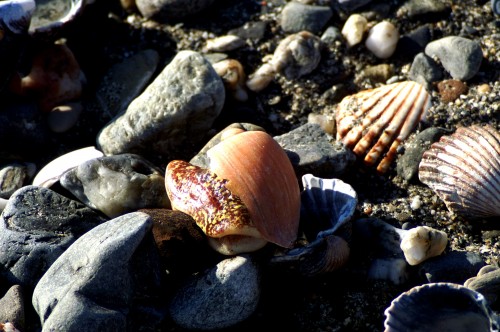
Cymbium, body exposed

Cymbium, body exposed

There were dozens of oranges scattered along the length of the beach as there often are after stormy weather. I don’t know for sure, but I imagine they arrive here after being carried downriver out into the sea and are then washed back in again. 

The beach is always strewn with oranges after a storm

The beach is always strewn with oranges after a storm

More Chiffchaffs flitted back and forth between the shrubs at the back of the beach, where there was also a Sardinian Warbler, a Robin and several Goldfinches. Cutting across towards the estuary there were Cormorants flying hurriedly to and from the sea and the usual host of Yellow-legged Gulls. There were more on the water together with a smaller number of Black-headed Gulls. A  Grey Plover, a Turnstone and a small flock of Sanderling were resting behind some debris.

At the Estuary, a Grey Plover, Turnstone and a small flock of Sanderling resting behind debris on the water's edge

At the Estuary, a Grey Plover, Turnstone and a small flock of Sanderling resting behind debris on the water’s edge

The water level of the estuary has risen  considerably and the sand around it was still very soft and waterlogged so walking further around was not going to be easy, so I turned round and took a brisk walk back the way we had come.

A Grey Wagtail flew in over the reedbed to land by the water and near to the rotunda a pair of Stonechats came out to perch atop a low shrub, the male flying up and diving down; their characteristic display to a female.

Male Stonechat perched on debris on the beach

Male Stonechat perched on debris on the beach

Getting back to the spot where the shells were washed up I stopped again to see if I could find anything else, I sat down on the sand at the back of the beach and lost in thought I didn’t immediately notice that there were three Turnstones very close by pecking around in the sand and taking no notice of me either. All that spoilt the moment was the plastic supermarket carrier bag immediately behind them.

Turstones- a very close-up view

Turstones- a very close-up view

Back on the path going out there seemed to be Chiffchaffs everywhere; flying around the stands of tall reeds that grow on the land in front of the buildings on the opposite side to the lagoon, perched on the wire fence and in or on almost every available shrub. It would seem that they are on the move, maybe they stopped here en route from Africa to wait for the storms to pass.

My Bird List for the morning was quite amazing, amounting to 22 species:

Cormorant; Common Moorhen; Marsh Harrier; Purple Swamp Hen (Gallinule); Grey Plover; Sanderling; Turnstone; Common Snipe; Black-headed Gull; Yellow-legged Gull; White Wagtail; Grey Wagtail; Blue Tit; Goldfinch; Robin; Stonechat; Black Redstart; Common Blackbird; Cetti’s Warbler (heard); Fan-tailed Warbler; Sardinian Warbler; Common Chiffchaff (numerous);
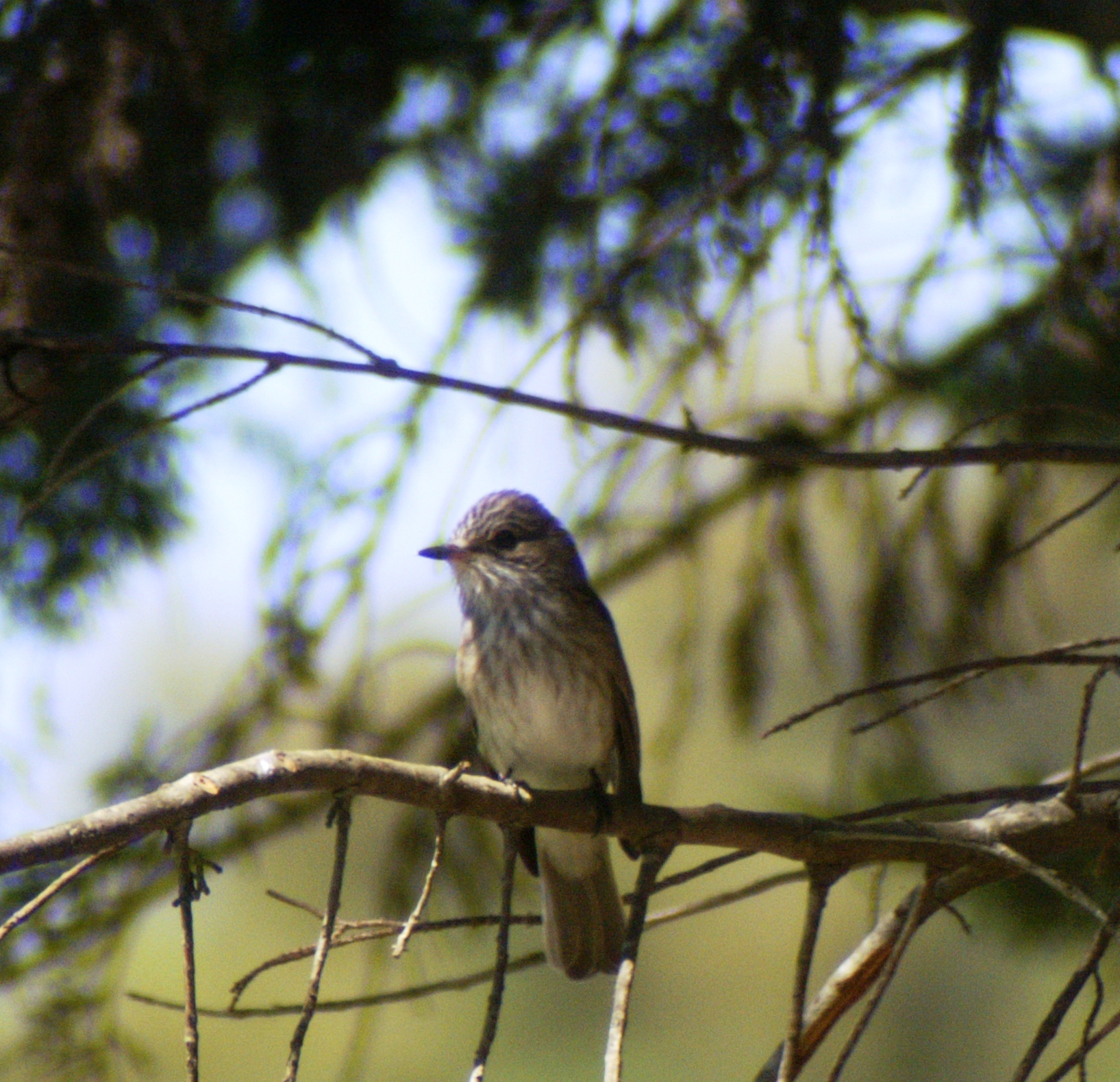
The Spotted Flycatcher

July and August are not the best months to see birds in Southern Spain, but one that can still be seen in a diverse number of locations, fairly frequently and right through to mid-late September  is the Spotted Flycatcher. Although not colourful, they are very attractive and characterful and very entertaining to watch as they dart from their perch to chase acrobatically after flying insects.

Spotted Fly Catcher – Muscicapa striata

Spanish: Papamoscas gris

‘Spotted’ Flycatcher is a bit of a misnomer, as the adult bird’s head and greyish-brown throat and breast is streaked with brown rather than spotted, as suggested by the ‘striata‘ of its scientific name. Having said that, the young birds could be described as spotted, so perhaps that’s where it stems from.

Spotted Flycatchers are summer migrants to Southern Spain, and are then very common throughout the region, often staking a claim to territories that include gardens and other ‘humanised’ areas. They arrive from their wintering grounds in Africa to breed here, sometime around the end of April to the beginning of May, as insect numbers are rising.

This one arrived in the garden on May 1st

This one arrived in the garden on May 1st

We were very lucky to have had Spotted Flycatchers return to our garden every year and I used to look forward very much to their arrival and the opportunities to watch them at very close quarters. I have no way of knowing whether any of the returned birds were the same ones that had been to this particular place in previous years; I have been informed by people that are far more knowledgeable than me on the subject that it is not very likely and that this is simply a ‘territory’, open to claim by whichever bird gets there first and can hang onto it.

I still like to think that at least for some of the years it may have been perhaps at least one of a pair that had been before, or perhaps one of the young ones that had been raised there. I also discovered from the BTO website that the maximum recorded age for a Spotted Flycatcher is 7 years 10 months 7 days (Recorded in 1963), so surely they don’t go about hunting for a new home every year!

I’ve never witnessed a territorial dispute between Spotted Flycatchers and have no idea if they arrive alone or with a mate. I also admit that I have never heard one sing, which was a bit puzzling as I spent so many hours watching their behaviour over several years. I was quite relieved to read the following on the Wildlife Sound Recording website http://www.wildlife-sound.org/journal/archive/1983wsv4n5_pr_flycatchers.html  “Sound is not a conspicuous feature as spotted flycatchers arrive in their nesting territories. It is true that the male will sing a high-pitched warble from time to time but this occurrence is far from being common and it is no disgrace for an ornithologist to admit that he has never heard the true song.”

I first saw this one on 6/5/07

I first saw this one on 6/5/07

Some newly returned birds made more of their arrival than others. On a couple of occasions I have become aware of them as the first thing they did was to take a bath. Others arrived quietly and were just suddenly ‘there’. The occasional one arrived with some drama. The day the bird in the photograph above arrived back I was out in the garden having just taken some photographs of a lovely Red Admiral butterfly that was posing obligingly on some blossom. I thought I had glimpsed the bird a little earlier on perched in our tall yucca tree, but was taken completely by surprise when it suddenly swooped past me, snatched the butterfly from where it was basking and swooped back to the tree with it. At least I had a photograph of the butterfly to mark its short life.

The Red Admiral before it was snatched away by the Spotted Flycatcher

The Red Admiral before it was snatched away by the Spotted Flycatcher

Within our garden there were several favoured perching spots, some of which were in open spots that were clearly visible from the house so I could watch them closely and without disturbing them; one was on the hand rail of the swimming pool, another on the top of the outdoor shower. They definitely show a preference for perches that are not too far above the ground and in other locations I often saw them on boundary fences or on top of posts.

Watching for prey from the handrail of the swimming pool

Watching for prey from the top of the swimming pool

While they wait for prey to fly into range, the bird sits upright, head slightly sunk into its shoulders. When it spots potential prey it darts out after it, then depending on the outcome it may loop around to return to the same perch or swoop to another.

29/5/09-On top of the shower pipe in typical slightly hunched hunting pose

29/5/09-On top of the shower pipe in typical slightly hunched hunting pose

A range of insects in addition to flies will be pursued as potential food including butterflies, bees, wasps and hoverflies.

Breeding

The birds begin breeding in May, soon after their return. In June 2006, I was thrilled to see ‘our’ pair of flycatchers together with a family of three young ones. They were all gathered on a branch of one of the cork oaks that overlooked the garden at the back of the house and the parents both worked hard at keep their offspring supplied with food. 

One of the adults perched  on the corner of the roof beneath the cork oaks watching for flies

16/6/06 One of the adults perched on the corner of the roof beneath the cork oaks watching for flies

The following day I was even more delighted to see that two of the young birds were perched together in the small fig tree that grew against the wall on the boundary with the Cork Oak plot and no more than a metre from a bedroom window.

060616TGSPN-Spotted Flycatcher young-Sotogrande, Spain

Two of three young Spotted Flycatchers in a fig tree

The young or juvenile spotted flycatchers are a more grey-brown than the adults and are prominently speckled; they remain dependent on their parents feeding them for about three weeks after leaving the nest. It must take quite a bit of practice before they become adept at catching their own.

A closer look at one of the young birds

A closer look at one of the young birds

The birds will be around until at least September, as long as there is food available, before heading back to their winter feeding grounds. They may well be joined by others on their return migration south from Northern Europe too, that stop to refuel before also heading off.


A note of thanks

As you may have noticed, I haven’t posted much here over the past few months. Despite that a good many people still manage to find their way to the blog, in fact more on an average day than get to my more current ‘Everyday Nature’  UK blog! I also still get comments and questions relating to posts and pages on the blog too, so it appears it is still serving a purpose, which is really good to know.

I lived in Southern Spain for just over ten years and during that time learned a lot about the nature of the area, visited some amazing places, encountered a lot of amazing wildlife and took a few thousand photographs. I would love to share more of those experiences and perhaps inspire a few people to visit some places a little more off the beaten track of the regular tourist trails, or just to help out a little in the identification of some of the fauna and flora commonly encountered within the area.

I have decided to keep the blog posts going, at least until I run out of ideas and although they won’t be current, I will keep them seasonal and hopefully relevant. Thank you to everyone that has dropped in to look at the blog and a very special thanks to those that have continued to follow it and to those that have begun to follow recently.

Theresa

Tarifa

I’m not in Spain currently, but my thoughts return there often, particularly on cold grey days. To me, Southern Spain is at its absolute best in the spring and I’ve been looking back through my photo archives to remind myself of where I may be wandering if I was there now.

One of my all-time favourite places, especially at this time of year is Tarifa, which has to be one of the most spectacular places in Europe. Miles of white-golden sandy beaches are a great attraction in themselves, but  Tarifa is also known as the “wind-surf” capital of Europe due to the very high winds caused by the vortex effect created by the two land masses on either side of the Strait of Gibraltar. At weekends and during the summer months it is a hugely popular area and best avoided if you are visiting to seek out the wildlife. However, out of season, and particularly on week days it is much quieter and there is plenty of space to enjoy this beautiful and often wild and windswept place in peace.

The town of Tarifa is situated on the Atlantic shore, the Costa de la Luz, at the western end of the Strait of Gibraltar in the province of Cadiz. Being the most southerly point of Europe and a mere 16 kilometres  from the African continent makes this an area of great importance during the migration periods when an estimated half a billion birds, including thousands of storks, vultures, eagles, kites and other raptors, along with seabirds cross and pass through the strait.

The following photographs were taken in early March a few years ago, when two of my friends and I drove down to  spend  the day there. Spoilt for choice as to which part of the area to make for , on this occasion we settled on  Punta Paloma, located just a few kilometres to the west of Tarifa town.

A view towards Tarifa town from Punta Paloma

Abandoned or wrecked small boats are often found on the beaches of this part of the coast, many used by would-be migrants from North Africa

The prow of one of the abandoned boats

Wind surfer

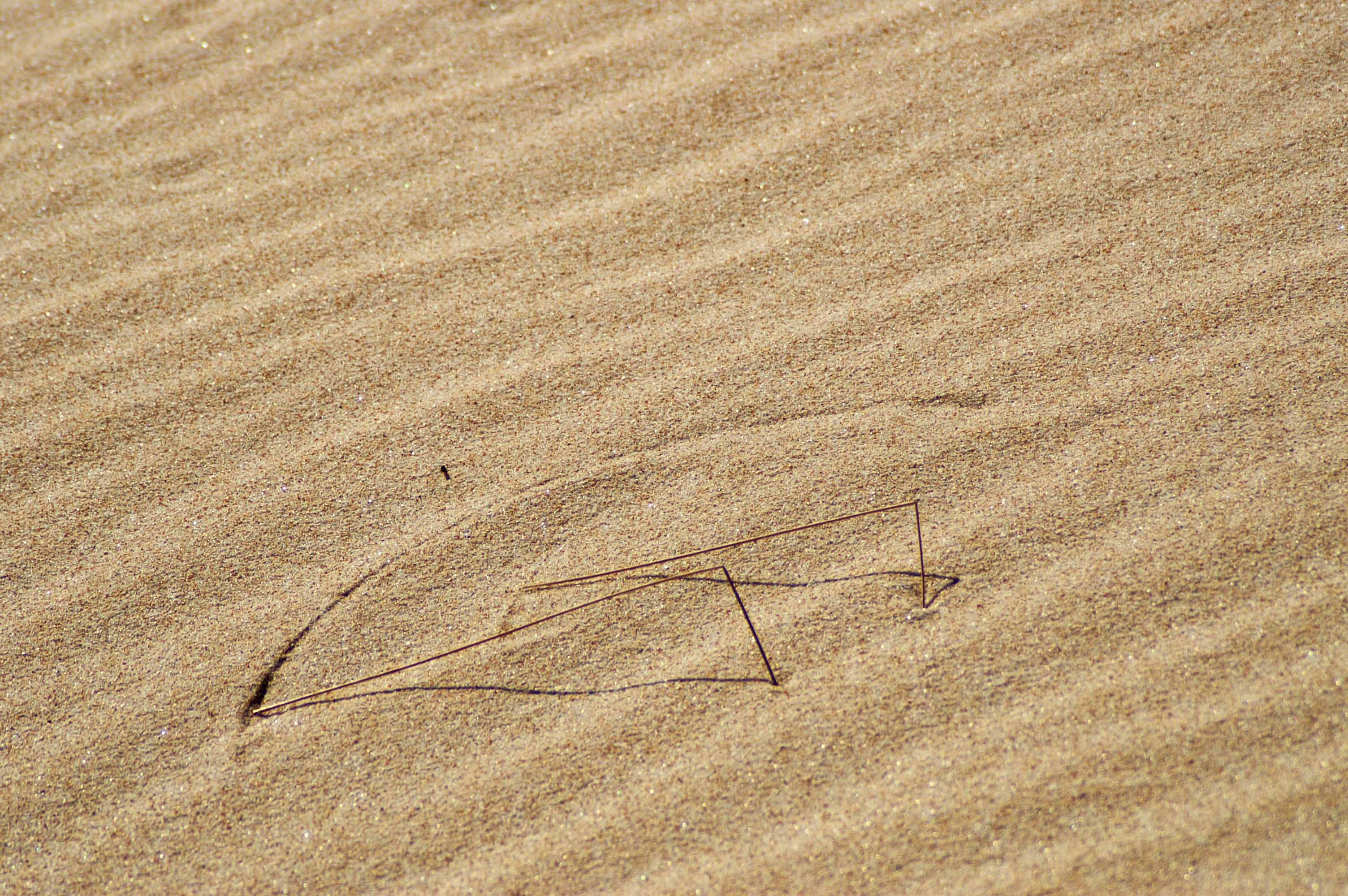
Lines in the sand

A sculptural sandy rock

Giant sand dunes, some of the largest and most important in Europe, form the western end of the beach.  The dune ecosystem is unusual, fragile and is protected by the “habitats” directive of the network Natura 2000, but its conservation is very vulnerable. This is  due in no small part to the area’s popularity with large numbers of visitors and holidaymakers.

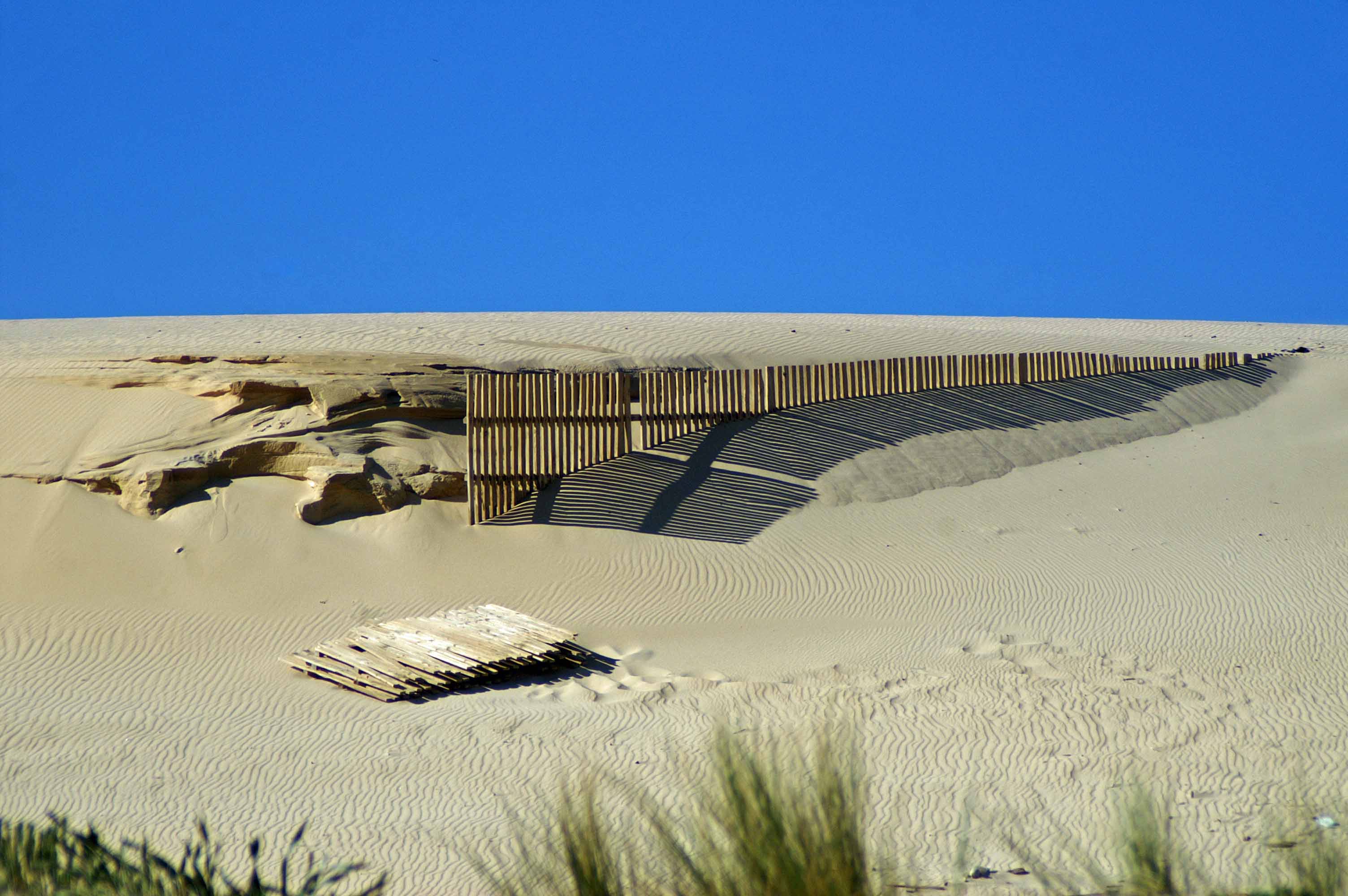
Lengths of wooden palings are used to help stabilise the dunes

The sand dunes of Tarifa are some of the most important in Europe

The dune habitat supports a surprising number of plant species which have evolved a number of survival strategies to counter the effects of this hostile environment, many of which produce their flowers in the early spring.

A member of the parasitic Broomrape family Cistanche – Cistanche phelypaea-grows on the dunes here

Southern Birds-foot Trefoil- Lotus creticus

One of the most beautiful plants growing on the sand dunes is Shrubby Pimpernel – Anagallis monelli. The white flower growing amongst this specimen is Sweet Alison – Lobularia maritima

The sad remains of a dead turtle

A small river, el Rio de Valle reaches the sea here and its small estuary attracts a  variety of wading birds, particularly during peak migration periods.

River meets the sea

In the spring the area around the river’s edges are covered with coarse green grass with wildflowers growing through it.

Romulea

Star of Bethlehem-Ornithogalum orthophyllum

Sticky Catchfly-Silene nicaeensis

Winged Sea Lavender-Limonium sinuatum

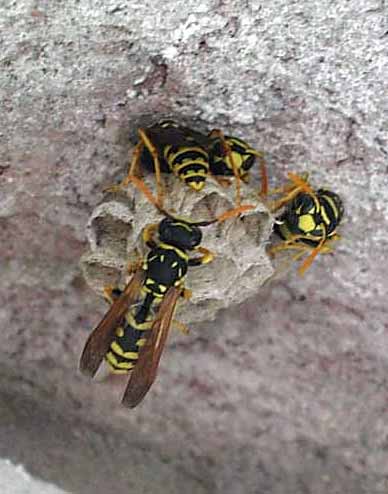
Paper Wasps

During the late summer the number of wasps around our garden increases dramatically. Although  similarly coloured and striped black and yellow, they are not the same species as the wasps that fly into houses and around outside tables seeking to share our food, (although we do get them too, in small numbers). These are members of the generally less intrusive  Polistes genus, the most common type of Paper Wasp. They are the builders of the papery open- celled nests seen suspended upside down beneath the tile overhang of roofs, or out in the open campo, attached to a plant (Prickly Pear cactus pads seem to be popular sites).

Polistes is the most common genus among social Wasps and has a worldwide distribution. In Europe and North America their colonies outnumber those of all other social Wasps combined; although they are present in central Europe, they are not found in the UK and are rare in northern Europe.Two species that resemble each other closely, P. dominulus and P. gallicus  are the most widely spread in Europe and are especially relevant in Mediterranean areas.

Description: Polistes sp. or Paper Wasps, are 3/4 to 1 inch long, slender, narrow-waisted wasps with smoky black wings that are folded lengthwise when at rest. They may be quite easily identified by their characteristic flight as their long legs dangle below their bodies.

Polistes wasp taking nectar from lavender


I have read various accounts of Polistes wasps that state them to be aggressive, but personally have not found that to be the case; the only two incidents involving them stinging have both occurred when they have been inadvertently stepped upon by people with bare feet. Being one of the people stung I can say it really hurt for a while! All Polistes species are predatory, so of course are equipped with a sting with which to paralyse  prey and if threatened they can be provoked into defending their nests.

Polistes wasps forage around plants for insect prey

Life cycle

Paper wasps are semi-social insects and have a relatively simple life cycle, which is well suited to a warm climate such as in the Mediterranean. Fertilized queens, which appear similar to workers, overwinter in protected habitats such as cracks and crevices in structures or under tree bark, or in the case of those around our house, under the roof tiles. In the spring they select a nesting site and begin to build a nest. Eggs are laid singly in cells and hatch into legless grub-like larvae that develop through several stages (instars) before pupating. The cells remain open until the developing larvae pupate.

The first  to emerge will become daughter workers in the growing colony and tend to be sterile and smaller and assist in further building and defending the nest and feeding developing young.A mature paper wasp nest may have 20 to 30 adults. Later broods are fertile, providing for several queens; sexual larvae are produced starting in August, and in September adults (including the only recently produced males) leave the nest and mate outside. Mated females then seek a safe place to hibernate. The remainder of the colony does not survive the winter.

In late summer, queens stop laying eggs and the colony soon begins to decline. In the autumn, mated female offspring of the queen seek overwintering sites.

A polistes wasp stripping the bark from a dry twig of a cypress tree; this will become material for nest construction

Food source(s):  Adult Paper wasps take nectar from flowers, but prey on insects such as caterpillars, flies and beetle larvae which they feed to larvae. They actively forage during the day and all colony members rest on the nest at night.

13/7/07-Polistes wasps beginning to build a new nest

Polistes wasp with prey

On several occasions I have witnessed Paper Wasp’s nests being attacked by ants whilst still apparently viable. Last September I found a dislodged nest on the floor of the terrace covered in ants, which I ‘borrowed’ from them for a few minutes to photograph.

The dislodged nest

The nest from the back showing the single stem it was attached by

I don’t know for sure that there is a connection, but simultaneously with the demise of the nest a group of Paper Wasps located themselves inside a tubular pocket of fabric covering one of the horizontal supports of the hood of our swing seat. Individuals flew in and out on a fairly regular basis and there were always one or two guarding the entrance that met and checked out each returning wasp.

Polistes wasp being ‘greeted’ by a guardian at the entrance to their gathering place

There were quite a number of wasps in there, but it was not possible to see inside to see what they were doing

Fascinating stuff about Ants & Vultures

Ants

This morning I was searching around the internet for information about ants as I am interested in identifying the species of those that I have seen lately both in Pinar del Rey and in Jimena last week as their behaviour was quite different, the former colony were taking seeds into their nest, the latter insects.

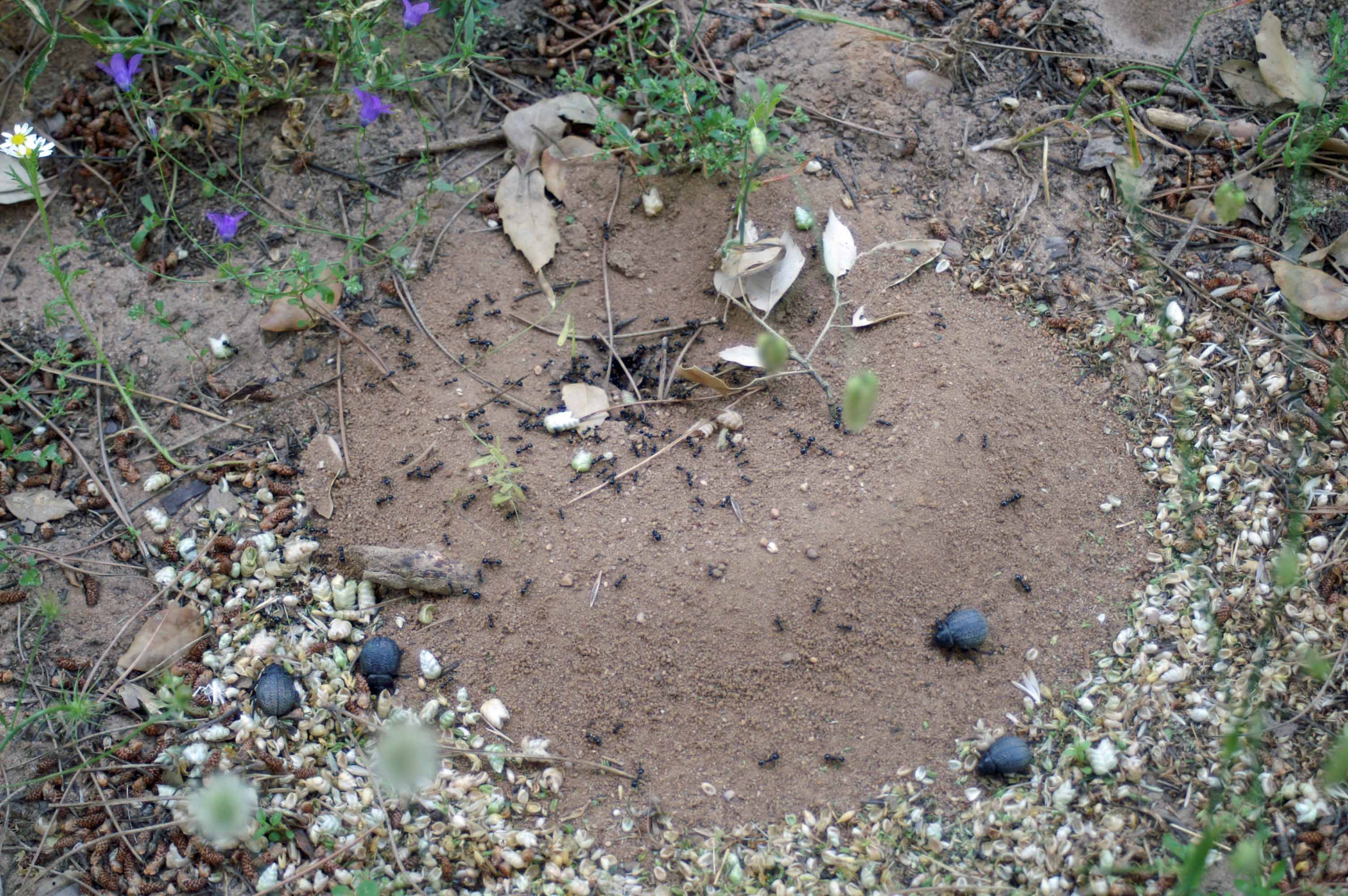
On our recent outing to Sierra de las Nieves I had already asked one of the gonhs team, an entomologist, what he thought the former lot were up to and he explained that these would be Harvester Ants gathering grass seeds for their food stores. The workers doing the actual harvesting take back grass seeds whole, i.e still enclosed in a protective sheath.Once back at the nest the grain is extracted from the husk and taken in either to be stored or to be fed to the Queen or developing larvae. The unwanted parts are then discarded. He didn’t know why the beetles may have been there, but speculated they may have been finding food amongst the detritus. I have put the picture in again as a reminder (click on it to enlarge).

An intriguing scene involving ants, their harvest of grass seeds and beetles

I am assuming then that these are Harvester Ants of the species Messor barbarus. I learnt more interesting stuff about these ‘granivorous’ ants, including the important role they play in seed dispersal.

The other insectivorous group (Jimena) were harder to pinpoint down, but I think they may be Argentine Ants, a species that has apparently spread all over the world. I checked the Iberia Nature website for anything they may have on ants in Spain and although I didn’t find what I was looking for I came upon this article, it is so amazing I have to share it:-

Unicoloniality and supercolonies

Most commonly, ants from different nests exhibit aggression toward each other. However, some ants exhibit the phenomenon called unicoloniality, where worker ants freely mix between different nests. A group of nests where ants do not exhibit mutual aggression is known as a supercolony — this form of organization is known as supercoloniality, and ants from different supercolonies of the same species do exhibit mutual aggression. Populations in supercolonies do not necessarily span a contiguous area.

Until 2000, the largest known ant supercolony was on the Ishikari coast of Hokkaidō, Japan. The colony was estimated to contain 306 million worker ants and one million queen ants living in 45,000 nests interconnected by underground passages over an area of 2.7 km2 (670 acres). In 2000, an enormous supercolony of Argentine ants was found in Southern Europe (report published in 2002). Of 33 ant populations nested along the 6,004-kilometre (3,731 mi) stretch along the Mediterranean and Atlantic coasts in Southern Europe, 30 belonged to one supercolony with estimated millions of nests and billions of workers, interspersed with three populations of another supercolony.The researchers claim that this case of unicoloniality cannot be explained by loss of their genetic diversity due to the genetic bottleneck of the imported ants. In 2009, it was demonstrated that the largest Japanese, Californian and European Argentine ant supercolonies were in fact part of a single global “megacolony”.

Another supercolony, measuring approximately 100 km (62 mi) wide, was found beneath Melbourne, Australia in 2004.

http://news.bbc.co.uk/earth/hi/earth_news/newsid_8127000/8127519.stm

Vultures

In the previous post I mentioned seeing a whole flock of  Griffon Vultures that appeared to be circling over what I assumed to be food. Whilst on the Iberia Nature website, reading ‘Nick’s blog’ I came across this bit about Vultures and their problems finding food, complete with the fantastic photo:

Accompanying following article- original source unknown

18th Oct 2010 – A new Spanish study has highlighted the role played by vultures in reducing energy consumption in Spain, saving the annual energy use of an estimated 9,000 homes and preventing 193,000 tons of CO2 from being released in the atmosphere. Spanish livestock farmers produces 380,000 tons of carrion, whose incineration involves a high energy cost. An adult vulture consumes some three kilos of meat a week, with all vultures in Spain consuming some 10,000 tonnes a year. Unfortunately the strict EU rules, as a result of mad cow’s disease, force many farmers to incinerate dead animals in official centres at a high cost to both them and in terms of CO2 production. I’d be interested in knowing how much CO2 the vultures would save if and when the EU rules are eventually relaxed.

This is a precis of a report on another blog (La Cronica Verde): (link also on my front page)

http://blogs.20minutos.es/cronicaverde/2010/09/27/los-buitres-ahorran-tanta-energia-como-9-000-familias/

Further discussion from Birdlife International on how they believe the EU rules could be changed:

http://www.fida.es/…/BirdLife%20Amendments%20to%20Commission%20proposal%20on%20.

Flaming June

June 12th

Summer arrived overnight and the thermostat shot up a few notches this week giving us some scorching days and hot nights that don’t usually arrive till July. Today the local beaches were ablaze with colour, and car parks overflowed, as local families headed for the cooler seaside, a regular event throughout the summer on Sundays, but this was the first one to occur on this scale this year. Each family, that includes grandparents and every other relative through to infants, sets up a colourful camp of parasols and gazebos, collapsible chairs, tables and towels in one unbroken line where possible, extending from one end of the beach to the other, just a couple of metres back from the sea edge. They arrive early, equipped with portable barbeques, plenty of food and drink and many will still be there till very late in the evening.

There is none of the self-conscious display of reserve we’re used to on British beaches, where we set up our camps as far away from each other as possible in an untidy hotch-potch, surround ourselves with windbreaks for privacy as well as protection  and erect a unique (well we hope unique) makeshift flag so our kids can find their way back to us when they’re done paddling! Goodness knows how wandering children find their way back to their camp here, although I have heard it rumoured that each family has their ‘own’ spot on their local beach, and any unsuspecting tourist that may inadvertently set up in it will either be closely surrounded or otherwise encouraged to vacate it.

Monday June 13th

13/6/11-Tiny praying mantis

We discovered several tiny Praying mantids on a sage plant this morning. Perfect miniatures of the adults, they were maybe 2.5 – 3cm long and very aware of being noticed. They will have very recently emerged from their communal ‘ootheca’ or egg case, along with their siblings that could number up to 300 or more. Naturally they are very vulnerable to predation while at this stage and it will take the whole summer for them to grow into adults.

Generally most of the local birds appear to be done with nesting and on to the hard part – keeping up with their teenagers!

13/6/11-A young Blue Tit foraging in a cork oak tree

Wednesday June 15th

I see and hear families of Blue Tits, Great Tits, Goldfinches and Greenfinches most mornings as they are foraging in the trees in the cooler hours of the mornings, and I caught a glimpse of a male Chaffinch being very attentive to one of his very demanding youngsters.

15/6/11-A male Chaffinch feeding one of his offspring

I photographed them in our sprawling cypress tree, the one I think of in terms of ‘the big ugly’ as it is a bit of a pain, constantly dropping dead needles and is really not beautiful. But, it is such a haven for the birds and provides perches for the insect hunting Flycatchers as well as welcome shade. There’s food for some birds too at the moment, I’ve seen Great Tits and Greenfinches eating the seeds from its little cones, although only a few are open as yet.

15/6/11-A Great Tit flying towards me, looking like a tiny owl

15/6/11-A goldfinch enjoying a moment in the sunshine,perched on the cyprus tree

There have been several visits from Kestrels this week, and although I haven’t spotted one until it has flown up from its perch, usually high up in one of the palm trees, the smaller birds have always given it away. Blackbirds in particular sound a very loud alarm and the Spotted Flycatchers keep up a constant ‘tcking’, but most others are noticeable by their complete silence and lack of activity.

15/6/11- 11.55pm (Madrid time) - eclipse of the moon as we saw it

Our view of tonight’s eclipse of the moon was not as dramatic as we hoped, but we did almost forget about it. The photograph doesn’t do it justice as it did look truly beautiful; it was bright and luminous, as though it was lit from the inside and its features were very clear.

Saturday June 18th

I’ll be returning to the UK shortly and will be gone for most of the summer, so I drove over to Jimena this afternoon to spend a couple of hours with my friend.   As always the drive over there was scenic and I saw a surprising number of birds. The roadside are still full of wildflowers; there were masses of frothy white blossoms of wild carrot and related species and more fennel than I have ever seen, in fact there were some large fields absolutely covered with a tapestry of creamy white and lime green. In several places there were splashes of colour too, where clumps of the intensely pink common centaury were growing.

Summer is the best time to see raptors and on my short journey I saw a good few. I first stopped to watch a Kestrel hovering over a field close to the road, a lovely sight as it dived down then swooped up again, intently scanning the ground beneath it. Along the main road I couldn’t fail to see a large flock of Griffon Vultures that were circling low over the brow of a hill beyond one expanse of flowery field, they must have been intent on feeding, but I daren’t stop to have a proper look. I counted at least 30 birds and there were probably more behind the hill or on the ground. The collective noun for a flock of vultures is a ‘venue of Vultures’ , unless they are circling, in  which case it is a ‘kettle of vultures’. (wikipedia)

At the road bridge over the railway line there were three Lesser Kestrels flying around, but I was able to pull in for a quick look at them. I had a great view of a Short-toed Eagle as it flapped away low over a field too.

At my friend’s house it was scorching hot, the thermometer inside reading 26°C, and outside in the walled garden it was even hotter. We sat in the shade of the sun room, with a glass of delicious home-made lemonade, freshly made from fruit from her own tree. (Since it began to get very hot the tree has dropped all its remaining ripe fruit, probably as a way of conserving moisture for the new crop that is already beginning to swell.) There was entertainment too, a pale coloured gecko, possibly one of the biggest, plumpest ones I have ever seen, waddled over the wall and squeezed itself behind the wooden frame of a trellis.

18/6/11- A gorgeous gecko concealing itself behind the trellis

The area is being plagued by small black flies at the moment, troublesome to people, but they are being assisted in their disposal by Swallows and in particular House Martins that were swooping around, chattering constantly as they flew here, there and everywhere close together in family groups. The close views of their aerial acrobatics was delightful, particularly as parents were feeding young ones on the wing, the two hovering closely together for a split second to make the pass. They were momentarily stunned into silence, scattering into cover as we had a surprise, very close-up visit from a  Booted Eagle (light-phase), clearly drawn by all the activity and noise. Wow. It didn’t catch anything though.

The stars of the afternoon though were the Red-rumped Swallows. There have been one or two pairs returning to the immediate area for the last few years, and although they have shown interest in this garden and have roosted in the small covered area, have not nested – until now.

!8/6/11-The nest of the Red-rumped Swallow is a distinctive, upside-down igloo shape

The Red-rumped Swallow builds a very distinctive nest, made of mud as those of other hirundines, but with the addition of a long tunnel through which the birds access the main chamber. This one is in the shade provided by a concrete and cement block utility area attached to the house next door, but we had very good views of it over the top of the garden wall.

18/6/11-A swallow entering the nest, giving a glimpse of its red rump

The pair clearly have nestlings and the rate of their feeding was impressive, with one or other of them returning every 2 minutes or so at one point. Red-rumped Swallows are known to have regular ‘hunting’ routes and here they fly very closely to the house, sometimes skimming the swimming pool, then up and over the roof circling around to reappear from the garden on the other side to the one they are nesting in.

Returning from a wander around the garden, our attention was diverted to the ground by the sight of a mass of ants labouring to haul a butterfly chrysalis across the terrace. Back at the nest entrance they spent some time attempting to force the bulky prey in through the narrow crack in the cement between bricks, turning it this way and that to no avail.

18/6/11-Ants attempting to force a chrysalis into the entrance to their nest

18/6/11-Still trying to get the pupa in, another party arrived with a smaller bee

Naturally, being ants, notoriously resourceful and enterprising, they persisted in their attempts to get the pupa in. We thought they may have to resort to cutting it into smaller pieces, but then considered the possibility that it may well still be a bit of a gooey mess inside and may not store well if opened up.Meanwhile, another hunting party was returning with their ‘bag’ – a wasp or large hoverfly, still quite large but that appeared small enough to fit in with less problems. The others must have thought so too, so moved their chrysalis out of the way to let the wasp haulers through.

18/6/11-Those carrying the chrysalis moved aside to let the wasp party through

A hugely entertaining afternoon with some very special moments and all while enjoying a chat and hardly leaving our comfortable seats. Who needs TV?

To the mountains

The Sierra de la Nieves,  which literally translates from the Spanish as  ‘Mountain range of the Snows’, forms part of the Serrania de Ronda and rises dramatically above the surrounding valleys and countryside. The Natural Park covers an area of 30km by 20km, or 18,530 hectares; the peak is the tip of the ‘Torecilla’ at 1,919 metres. Historically, this was a place of refuge for highwaymen and outlaws, but today the Sierra de las Nieves is considered one of the best places in Europe for the study of nature.  The area was studied in the 19th century by Swiss botanist Edmond Boissier and in 1933 by Luis Ceballos;  in 1970 the park was declared a National Hunting Reserve and then in 1995 a Biosphere Reserve by UNESCO.

___________________________________________________

The annual (gonhs) outings to the Sierra de las Nieves have been one of the highlights of the last six years for me; it is a truly wonderful part of the world and the best place I have visited in this region, for the sheer abundance of wildlife. The mountain scenery is spectacular in its own right, but this is a haven for  a rich and diverse flora, which includes many endemic species, more butterflies and other insects than you can count from  a wide variety of species, an array of  birds, many of which breed here and it is home to Ibex, deer and other mammal species as well as reptiles, making this a magical place. The natural park covers  a vast area and a few hours of one day are hardly enough to scratch the surface of what is here.There is so much to find that you can hardly take more than a few steps without discovering a beautiful plant or spotting a bird or being awed by a view, so it’s impossible to go home disappointed, except perhaps that you have to leave at all. Having said that you can camp here too.

11th June 2011

11/6/11-Giant Squill – Scilla peruviana

Arriving at the area recreativo, situated well inside the park, at about 10am it was already sunny but still coolish, perfect weather for walking. There are several options for possible routes to take, illustrated on painted sign boards, but today we knew we were heading for a trail we have taken before that would take us up a mountainside through pine woodland.

11/6/11-Honeysuckle-Lonicera etrusca

11/6/11-Wild Gladiolus- Gladiolus illyricus

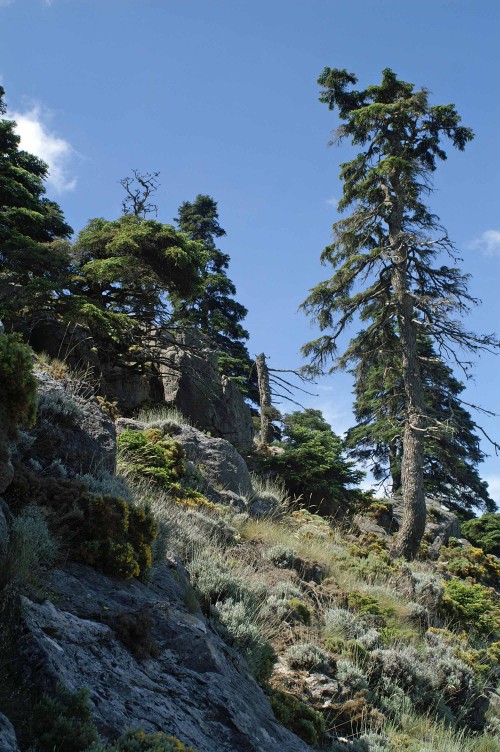
The first few metres of the track pass through a fairly open grassy area, where there were so many flowers calling to be photographed it would have been easy to spend a couple of hours in that one spot, but there was so much more to see we had to move on. There are a variety of tree species here, mainly pines and oaks, with an ancient species if pine and some special oak trees that have their stronghold here. The lower parts of the woodland we were walking through is comprised mainly of large Monterey Pines – Pinus radiata, that would originally have been deliberately planted. Higher up this introduced species gives way to the indigenous Pinsapo Pine-  Abies pinus. There are some huge ancient specimens of the Pinsapo in places within the park and many more young trees have been planted and nurtured to ensure its continued survival.

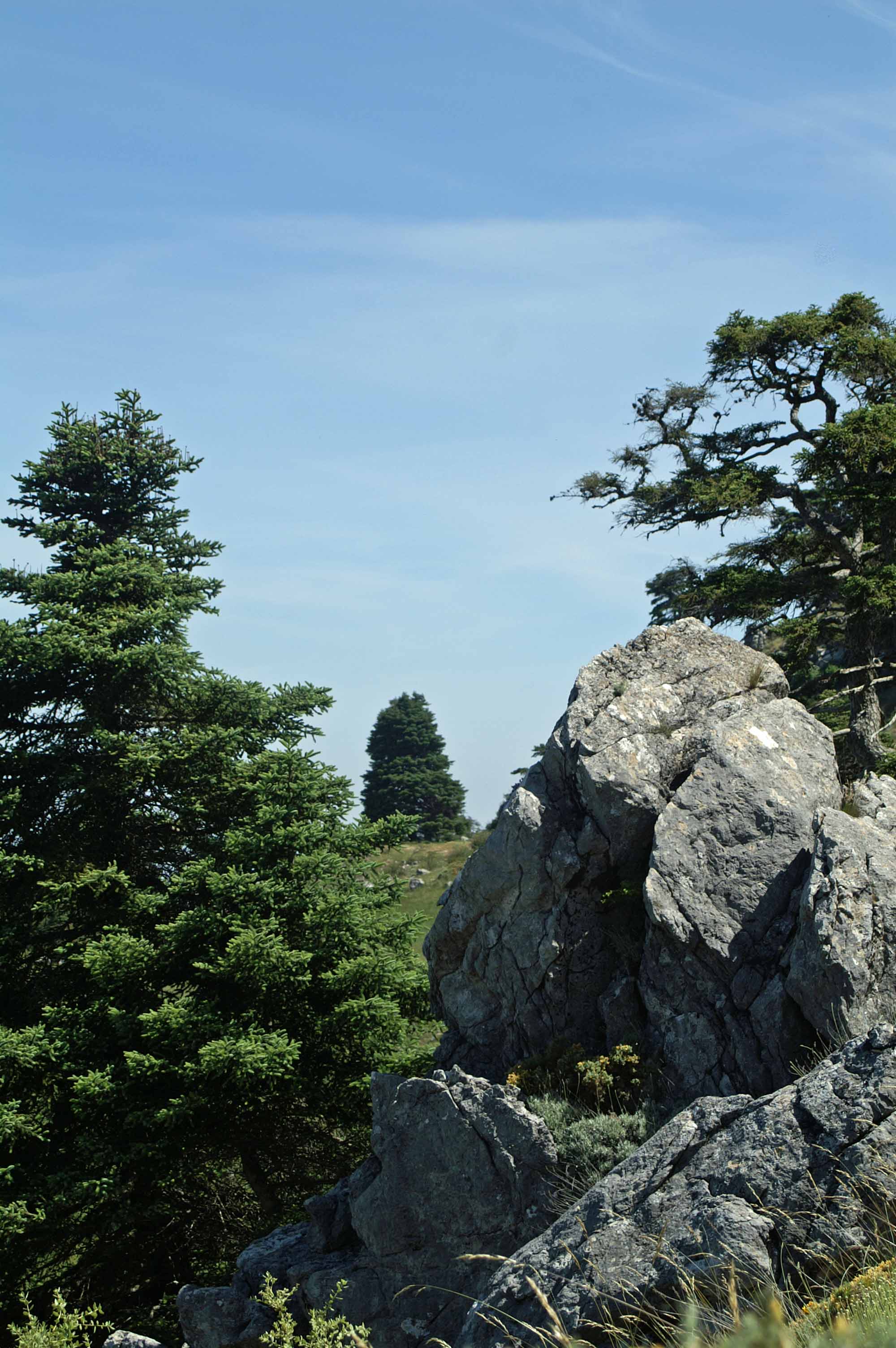
11/6/11-Spanish Fir or Pinsapo Pine-Abies pinsapo

Foliage of pinsapo pine

In 1837, during one of his exploratory visits to the south of the Iberian Peninsula, the Swiss Botanist Edmond Boisser discovered a new species of tree: Abies Pinsapo, popularly known as the Pinsapo pine or Spanish fir. Found only in the southern mountains of Andalucia and in the north of Morocco, botanists discovered that the pinsapo had been around since the Tertiary geological time period – predating  the Ice Age. The tree can grow up to 30m tall and live as long as 200 years. It has tiny needle-like leaves, which are extremely sharp and cylindrical in shape, and although this foliage appears lightweight, it throws out a very dense shade on the ground. 

We followed the track as it wound up the mountain slope, carefully negotiating the network of exposed tree roots criss-crossing the path. We stopped a few times to try to see birds we could hear calling or caught glimpses of flitting around in the branches above us that were largely species of Tit, Great Tit, Blue Tit,Coal Tit and Crested Tit but also Chaffinches and Chiffchaff (maybe Iberian) with limited success. Reaching a spot on the track where an opening in the trees allowed sight down  a slope we had more luck. There were a couple of large, dead trees here where we had a Serin singing, a Chiffchaff, a Great Tit with a beak full of food and best of all a beautiful male Redstart. It was apparent that the birds here were all still in the process of raising families, a good couple of weeks behind those at our lower altitude.

A little further on we stopped for a refreshment break and across the valley saw a flock of Chough take to the air; 50-60 birds were estimated and we found out later that other members of our party exploring over there had watched them flushed out by a pair of Golden Eagles.

11/6/11-Pigs living wild

Sadly we missed the Eagles in action and had to settle for a nearer sighting of a Booted Eagle (LP) and in the valley below us a family of pigs, which several people wanted to turn into wild boar, but although one of them was dark coloured, the other was very beige!

11/6/11-Pinsapo pines and sculpted rock

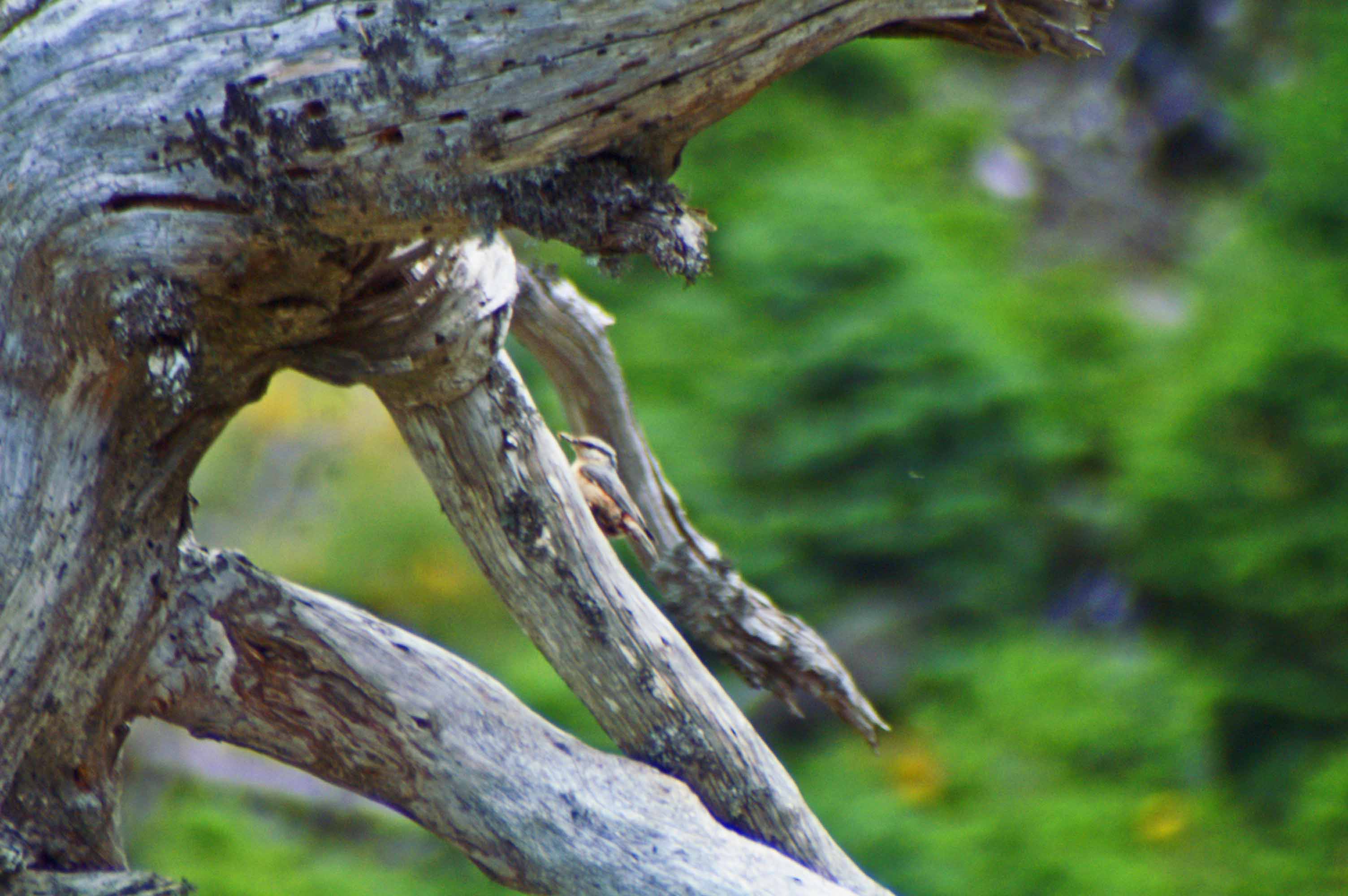
We climbed a little higher, rounding a bend onto a more level section of the trail where it loops around the side of the mountain. We upset a pair of Nuthatch here that were at great pains to let us know how much they resented our presence with much fierce scolding. A bird was singing too, but we did not recognise the song until we heard it again later and saw it was that of a male Redstart. Standing still for a few minutes to listen, I also had a very close view of a Crested Tit foraging in vegetation just a metre or so away. Moving on to catch up with the others I heard more scolding, this time from a Wren that had a very large larva,( or is it a slug?) in its bill, so large I’m amazed it could get any sound out at all.

11/6/11-Wren waiting to take in an enormous meal for a lucky chick

On the opposite side of the track more scolding – this time from the Nuthatches again that clearly had their nest near the top of another dead tree. Then more telling off from a very nearby Robin, whose picture I tried to wait  for as I could already see this year’s Christmas card of him perched in a Pinsapo… no luck there though.

At this point we realised that we had long been deserted by anyone who had any idea where we may be heading and tempting thought the trail ahead appeared, we decided we had to get off it and take a ‘short-cut’, (not my words!), that involved scaling a very ill-defined loose shale track, probably made by sure-footed goats, that would take us higher up our mountain and meet up with the surfaced track that would take us back down to the bottom of it.

11/6/11-Nuthatch taking food into their nest in a dead tree

The track passed around the dead tree where the nuthatches had their nest and I couldn’t resist stopping for a few minutes to watch them.

11/6/11-We were headed for the top of this slope above the old Pinsapo

Although parts of the track felt a bit loose and hazardous, it was beautiful, with flowering plants, shrubs and trees set amongst weathered and lichen-covered rocks – a perfectly artlessly designed rock garden.

2/6/06 -Some of the flora growing on this very slope 5 years ago

2/6/06-Blue Hedgehog broom -erinacea anthyllis. Evident today but almost at the end of its flowering

11/6/11-Still in full flower the lovely Common White Rockrose-Helianthemum appeninum

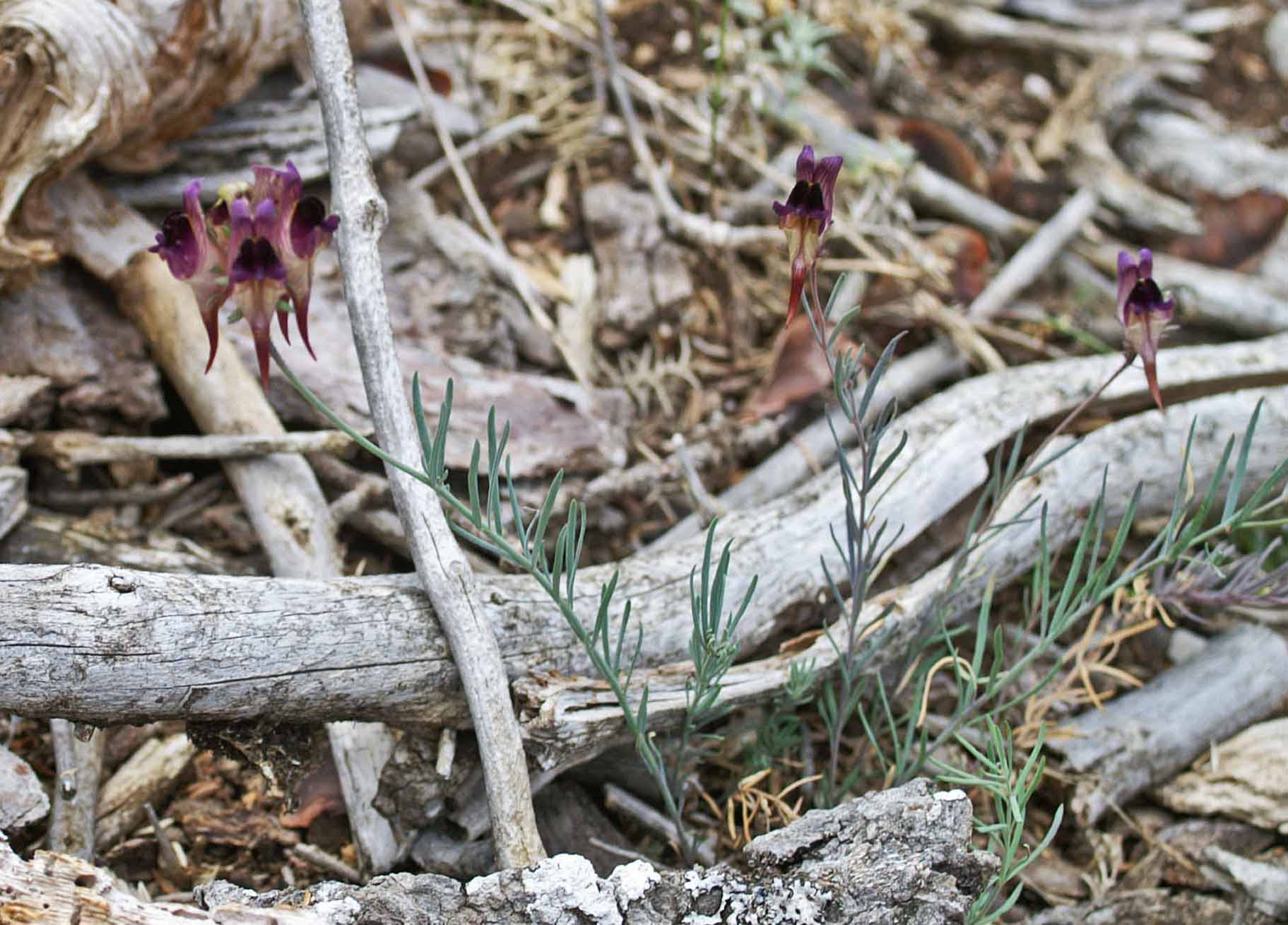
11/6/11- A small quiet flower with a wonderful name- Melancholy Toadflax- Linaria tristis

11/6/11-The lovely Grey-leaved Cistus-Cistus albidus, whose pretty flowers resemble crumpled paper is very attractive to insects

Approaching the top of the slope we had this wonderful view.

11/6/11- A view from the mountainside framed by pines


11/6/11- Part of the view from our picnic spot almost at the top of the mountain

Reaching the top of the slope we stopped to recover from our exertions to eat our lunch and to admire the fantastic views in front of us; panoramas of the mountains and valleys of the Sierra de las Nieves, the wider Serrania de Ronda and way beyond even that – mountain ranges continue to the far horizon and probably beyond.

We did find the road and met up with some of the members of our group that had left us previously to walk to the real top of the mountain as they were on their way down. This was where we discovered that our previously unrecognised singing bird had been a male Redstart; one was singing from the very top of a Pinsapo pine in front of us but growing from lower down the slope, so we had a very good view with binoculars. It was too far away to photograph well though.

11/6/11-Golden gorse was flowering prolifically

This part of the mountain is completely different to the side we had just left; to one side of the winding track there were high rocky cliffs while on the other side the land fell away and was well vegetated with Pinsapos pines, shrubs including gorse, cistus and lavender. This is the habitat preferred by the Black Redstarts, Rock Buntings and Wheatears that often choose clefts in the rocks to nest in.

We had several sights of Black Redstart males singing from the tops of the rocks on the ridge and a lovely view of a pair of Rock Bunting that sat on a rock while being summoned by their offspring perched in a small Pinsapo pine above them. One of the pair flew up the slope to a rock very close to us and posed quite nicely, I think it was the female as her colouring, although similar to that of a male was  slightly more subdued

11/6/11-Rock Bunting – Emberiza cia

There was a lucky, very brief glimpse of a male Northern Wheatear here too.

11/6/11-Northern Wheatear (m)-Oenanthe oenanthe

The afternoon had become much warmer and as we reached the bottom of the slope where there are areas of grass and wildflowers we began to see butterflies. At first just a few, all flying around rapidly, we quickly noted Marsh Fritillary, Spanish Gatekeeper, Marbled White, Common Blue, Clouded Yellow, Cleopatra and Meadow Brown, none of which settled for long enough to photograph. Further on there were more, a Wall Brown basking on the road, numbers of Marsh Fritillaries, a Black-veined White, a Small Skipper and a lovely Scarce Swallowtail that glided gracefully around flowering shrubbery but didn’t stop.

11/6/11-Black-veined White on Scabious

11/6/11- Marsh Fritillary

I would have loved to be able to stay chasing butterflies for longer, but it was time to go home and rest up the anticipated aching muscles.

Final bird, butterfly and moth sightings for the day from our group as a whole:

Birds:

Golden Eagle(2), Short-toed Eagle, Booted Eagle (lt ph), Griffon Vultures, Chough (50-60), Jay, Blackbird,Cirl Bunting, Greenfinch, Chaffinch, Bonelli’s Warbler,Chiffchaff, Nuthatch (pair), Stonechat, Wheatear, Black-eared Wheatear. Wren, Black Redstart, Redstart, Goldfinch, Serin, Blue Tit, Great Tit, Coal Tit, Crested tit, Rock Bunting, Woodlark, Red- legged Partridge, Woodpigeon, White Wagtail, Grey Wagtail (pair), 2 x Whitethroat feeding young, Lesser Whitethroat, Sub-alpine Warbler, Melodious Warbler and driving home we added Kestrel and 2 Rock Thrush, probably Blue but we couldn’t stop on the bendy main road!

Butterflies:

Black-veined White  Aporia crataegi ;Queen of Spain Fritillary Issoria lathonia;Common Blue Polyommatus icarus; Lorquins Blue Cupido lorquinii;
Marsh Fritillary Euphydras aurinia; Meadow Brown Maniola jurtina;
Escher’s Blue Agrodiaetus escheri;Painted Lady Cynthia cardui; Small White Pieris rapae; Bath White Pontia daplidice; Scarce Swallowtail Iphiclides podalirius;Spanish Festoon Zerynthia rumina; Spanish Gatekeeper Pryonis bathseba;Wall Brown Lasiommata megera; Iberian Marbled White Melanargia lachesis;Brown Argus Aricia cramera; Large Grizzled Skipper Muschampia proto;Lulworth Skipper Thymelicus acteon; Small Skipper Thymelicus sylvestris;Mallow Skipper Carcharodus alceae; Small Copper Lycaena phlaeas;Cardinal Fritillary:- Argynnis pandora; Speckled Wood Pararge aegeria; Grayling Hipparchia semele; Clouded Yellow Colias crocea; Cleopatra Gonepteryx cleopatra

and Moths:-

Forester sp.  Adcita sp.:-  A lovely metallic green winged day-flying moth
Royal Burnet Zygaena sarpedon;Synaphe moldavica:–  Everywhere in the grassy meadows; the most common moth around.
Hummingbird Hawkmoth Macroglossum stellatarumChrysocrambus dentuellus:–  Several of these well marked moths  seen on the stalks of grasses

More butterfly pictures can be seen in Pages – Fauna -Butterfly id

Sunday afternoon in a pine forest

Pinar del Rey – The King’s Pine Forest, lies to the north of the town of San Roque. It was planted in 1800 by the Spanish Navy to provide timber for building ships; the planting consisting of a combination of Stone Pines and Cork Oaks. In 1804, following the defeat of  the combined navies of Spain and France at the Battle of Trafalgar, the Spanish no longer needed the timber and the plantation was gifted to the people of San Roque by King Ferdinand VII as compensation for losing Gibraltar 100 years earlier.

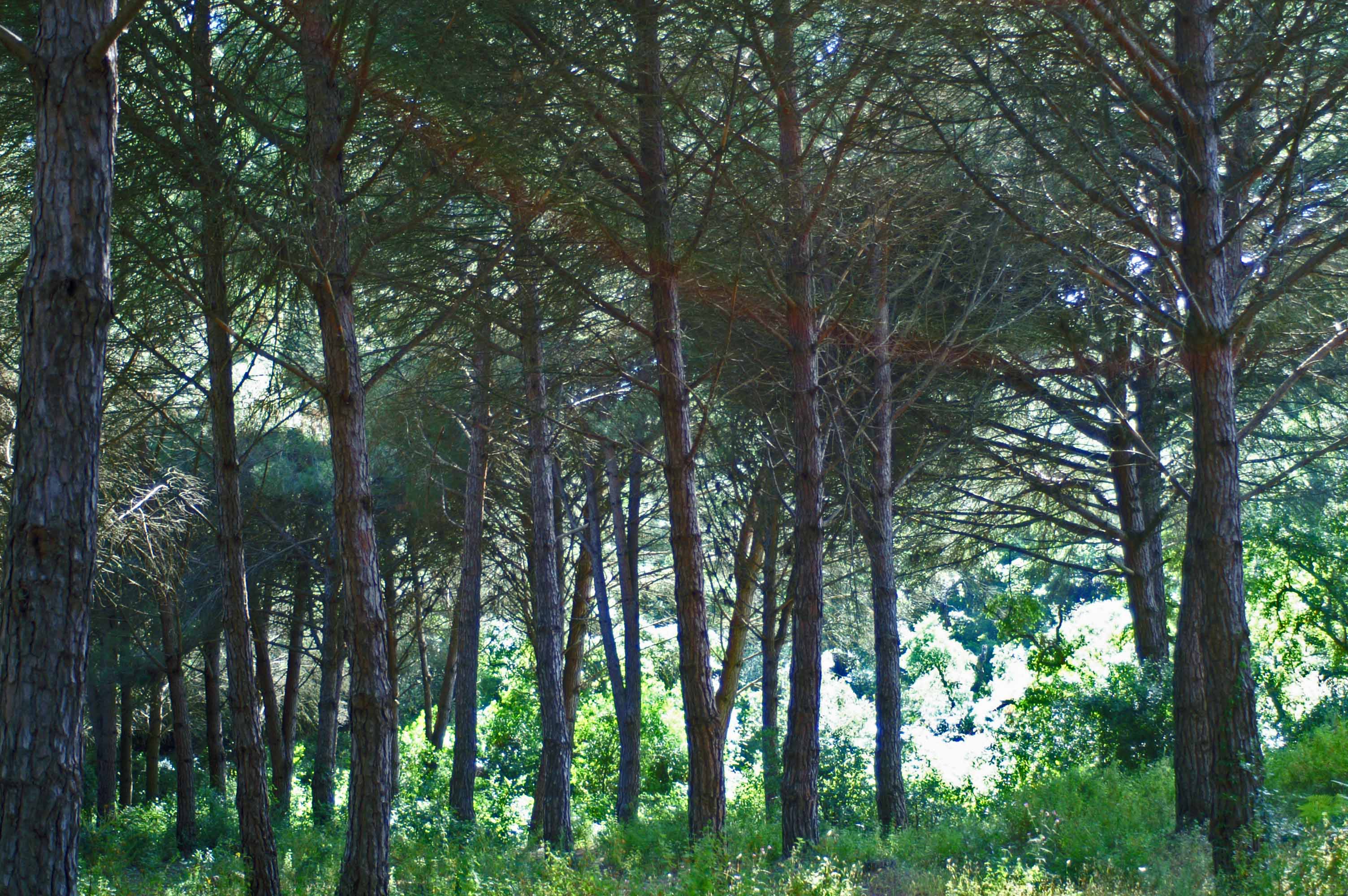
A path through the pine trees

The area has long been used by the local people as a recreational area and now there are picnic areas and barbecues set up in cleared areas beneath the trees, some of them quite extensive. The shady woods are a lovely outdoor ‘breathing space’ for families living in the local towns and villages, and are probably the most popular nature spot for miles around. Many families spend a day out in the country here, and it is especially busy on a Sunday, the traditional ‘family’ day.

On Sunday outings I normally steer clear of any area I know to be a popular family venue. Today, feeling in need of some fresh air and gentle exercise, and persuading Jon that he did too, I went along with his suggestion to drive out to Pinar del Rey, albeit with some trepidation on my part. It’s not too far from where we live and once through the small town of San Roque you are out in the countryside. It is still green, and colourful now with the tougher flowers of summer, purple thistles, patches of yellow Spanish Oyster plant and the lime green-yellow flowerheads of Fennel. Turning into the entrance to the site it was immediately apparent that although it was by now late afternoon, there were a lot of people here: families sitting chatting around the wooden tables, lingering over their picnics, children playing amongst the trees and people just strolling along the shady pathways. It is great to see folks out and about and making the most of this wonderful public space, but, very selfishly I know, we were hoping for something a little more peaceful where there may be a chance of seeing some of the wilder residents of the area. There is just one paved road for cars that eventually reaches an abrupt end and the only way forward is on foot. That is where we stopped today, in a spot where there were no other cars or people in immediate sight and close to the beginning of one of the marked footpaths, the ‘Sendero de las Aguilas‘.

Stone Pines backlit by the sun with Cork Oaks behind

This is a lovely path, pleasantly shady and the air fragrant with the fresh resinous scent of Stone Pines. A Blackcap was singing, moving from tree to tree as we approached but picking up the song each time he changed perch. I heard a Greenfinch calling and caught sight of a Blackbird, otherwise all was quiet. The track is almost on the edge of the part of the forest dominated by Stone Pines, its edge is marked by a water course bounded by other tree species and shrubs such as Oleander; and beyond it is more woodland comprised mainly of Cork Oaks.

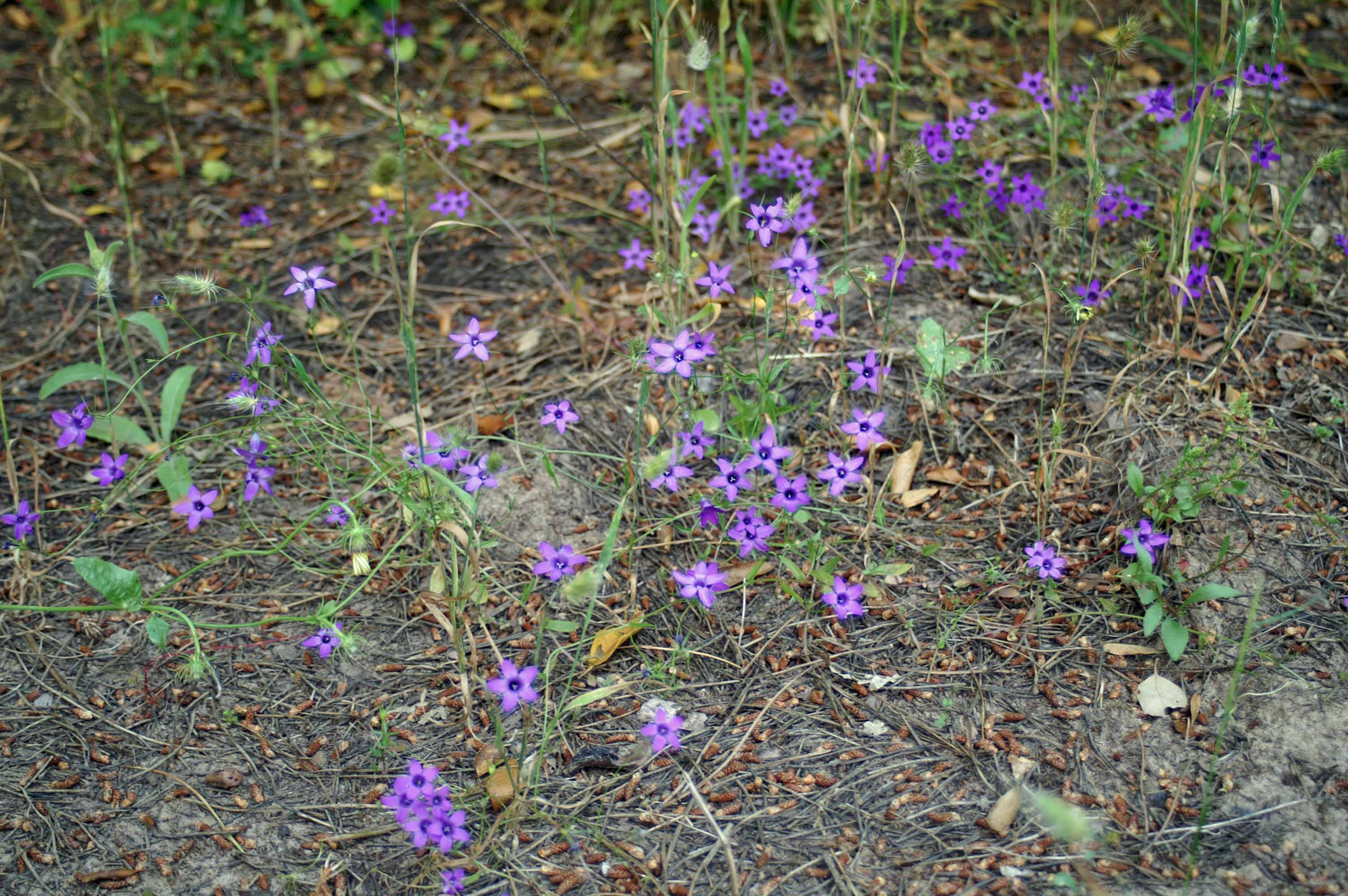
There were several patches of some very pretty and delicate flowers growing alongside the path that I had not seen before, coloured in various shades from pale mauve to purple and magenta.

The little purple flowers are held on very thin stalks

I discovered later that the plant is  a Campanula (Campanula specularioides). Apparently it got its latin name because of its similarity to the flowers of Venus’ Looking-glass, (sp. Legousia), which used to be called Specularia. (Betty Molesworth Allen).

A patch of campanula with bigger flowers showing several variations inn shade

While I was busy with the flowers, Jon discovered a very intriguing scene that was being acted out on another part of the forest floor; where ants were milling around a large hole and running back and forth over a pile of freshly excavated soil.Some of them were actually carrying grass seed heads and there were a great number of similar seedheads piled around the edges of the soil pile, clearly harvested by the ants, that were either being carried into or out of the hole.Perhaps the oddest thing was the presence of four beetles, a couple of which were being harassed by ants, while others seemed to be burrowing into the piled up seedheads.

An intriguing scene involving harvesting ants and round-bodied beetles

Meanwhile, up in the trees a Crested Tit foraged around the pine cones. These lovely little birds are one of the most elusive species for me in terms of getting photographs and today was no exception. It was too shady there to get a decent picture anyway as I discovered when I attempted to capture an image of a pair of Blackcap in another treetop. A Jay was a little more obliging, sitting halfway up a better-lit trunk.

Jay - Garrulus glandarius

We heard a Robin singing and spotted him perched on a low branch next to the path, flying off as we approached.

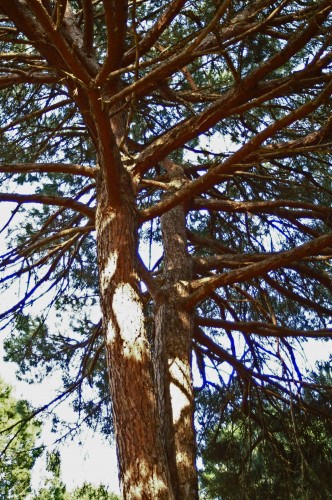
A very large old Stone Pine with a double trunk

Many of the pine trees are huge specimens that are reputed to be those originally planted in the early 1800s, they are impressive and beautiful and present countless opportunities for photographs; the light and shade on the trunks, the textures of the bark, the sunlight filtering through the canopy and so much more. Part of the track runs parallel to the river bank and the damper conditions here support a different flora, amongst which is the dramatic Acanthus. It is not a common plant in this area, except on calcareous outcrops, but it is often cultivated, so I am unsure if it would have occurred naturally here.

Acanthus leaf with greenbottle fly. The leaves of this plant were patterns for the design on capitals of many Corinthian pillars of the ancient world.

Acanthus mollis - flower. The common name of Bear's Breeches comes from the shape of the flowers.

The shape of the top of the tree gives it the common name of Umbrella Pine

We took a different route home as I was keen to see the progress of the Stork families, so at the entrance/exit to the park, rather than turning left towards San Roque town, we turned right to go to San Roque Estacion. This is a very quiet road, particularly since the new stretch of dual carriageway was constructed, and is not in very good repair, but it is much more scenic and tuneful too – we must have heard at least half a dozen snatches of Nightingale song as we passed by. We saw a Nightingale too, very unusually perched on a power cable near the junction of this road and the new one. We saw Storks on their nests from here too where the road crosses the railway line, but had much better views once on the road driving towards Jimena. Most of the nests had at least two or three grown-up young, and many were crowded with the whole family jammed in at once.

This is always a busy road, but we risked a very quick stop so I could take this photograph:

Parent White Storks with their grown-up young. The adult hiding her face at the back and looking a bit tatty is most probably the mother!

Summer begins

June 5th

The weather for the first days of this month has been rather unsettled; most mornings, although warm, have been overcast with levanter cloud and sudden strong breezes have sprung up from nowhere. But bursts of very hot sunshine and warm evenings that stay light until about 10pm, all confirm that summer has begun. The ambience of the garden and surroundings has changed noticeably now that many parent birds have fledged young to keep track of and feed. For a few days following seeing the young Nightingale I heard it frequently and loudly summoning its parents with a loud, insistent piping call. One morning I heard it piping frantically and went out to look just as a Kestrel swooped low through the garden, probably looking for the source of the calling. I’ve had a few glimpses of adult birds dashing across the garden, but haven’t  seen the young one at all.

Wren family 

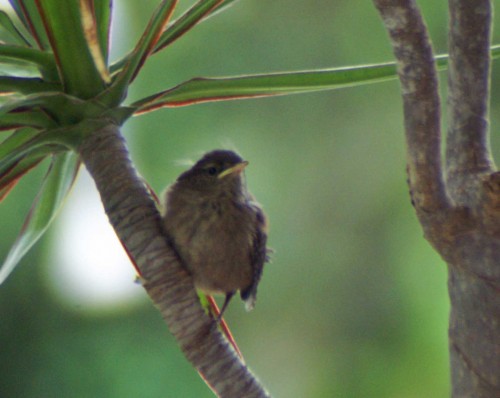
On Friday morning I heard baby bird calls very close by and discovered the source to be a tiny fluffy fledgling Wren that was perched on one of the dracaena plants on the covered terrace. It was incredibly cute, with its yellow gape and wispy downy tufts of feather still attached to its head. It was not alone either, there were two more tiny siblings close by, all ‘tsup,tsup, tsupping‘ animatedly and I could hear a parent urgently trying to muster them and persuade them to join them over the wall in the cover of the cork oaks.  Finally  they all took off at once, buzzing the short way across the lawn and up and over the way, tiny wings whirring, hardly bigger than large butterflies.

3/6/11-Fledgling Wren, downy 'ear' tufts still visible on its head

That wasn’t the last I saw of the little family; later in the evening I heard them just across the garden wall, in the same place they had headed to in the morning. One popped onto the top of the wall and sat enjoying the late evening sunshine.

3/6/11-8.00pm - A Wren fledgling enjoying the late evening sunshine

A little later again, while watching TV, through the window I caught sight of a bird fluttering around the light fitting on the terrace. Intrigued, I watched it pop in and out a few times. It was a Wren that then flew to the end of the terrace, began calling then flying back and forth and in and out of the light fitting. (Wrens have nested in that fitting twice in recent years and as I believe it may still be used as a roost by its maker, I have not cleared out the old nesting material). In response to the adult’s calling the babies came and with much fluttering and popping in and out, finally all seemed to settle in there. What a touching little scene that was and a wonderful display of bird parenting; I’m not sure if they were joined in there by an adult, but I’m sure they would have stayed close by. Much to my surprise and delight the family returned to roost on Saturday night too, again there was much fluttering around and popping in and out before they settled, but by 10pm they were tucked up safely for the night. Sunday brought a different scenario though. At least one Wren did arrive and popped in and out of the roost, but I don’t think any stayed in. Then from somewhere, a male House Sparrow appeared and although too big to get into the light fitting, he appeared to ‘guard’ it, blocking the entrance. He left after afew minutes, but by now it was almost dark. I didn’t see the Wrens come back, so either he had frightened them away or they were already inside and the House Sparrow had just been looking to see what was happening in there.

3/61/11-Ilex Hairsteak with large chunks of wings missing

I’m delighted that the pair of Spotted Flycatchers are in and around the garden frequently throughout the days, out hunting until it’s almost dark. (Their pairing was confirmed when I witnessed an attempted mating on a garden lounger!)  On several consecutive mornings I have watched them from the terrace as they hunt from perches low down on various plants and posts, and even garden furniture. A favourite place seems to be on the aeonium plant, which happens to be next to the patch of flowering thyme which the Ilex Hairstreak butterflies and various other insects visit for nectar. Not surprisingly there are a few butterflies struggling around with chunks of their wings missing.

3/6/11-Lang's Short-tailed Blue on marjoram

The privet flowers are all but over now, so the insects I had such wonderful views off recently will have had to seek pastures new. Fortunately the wildflowers at the front of the neighbouring cork oak plot, and those of the vacant plots opposite are all blooming profusely now. They won’t be there for much longer as the owner of the plots will be along anytime soon with his little tractor and cutting machine to mow them all down. I think he may have to do it as dried grass etc. could become a potential fire hazard in the summer. The thought of that spurred me to go and have a good look at what is growing there and see what other insects I might find too.

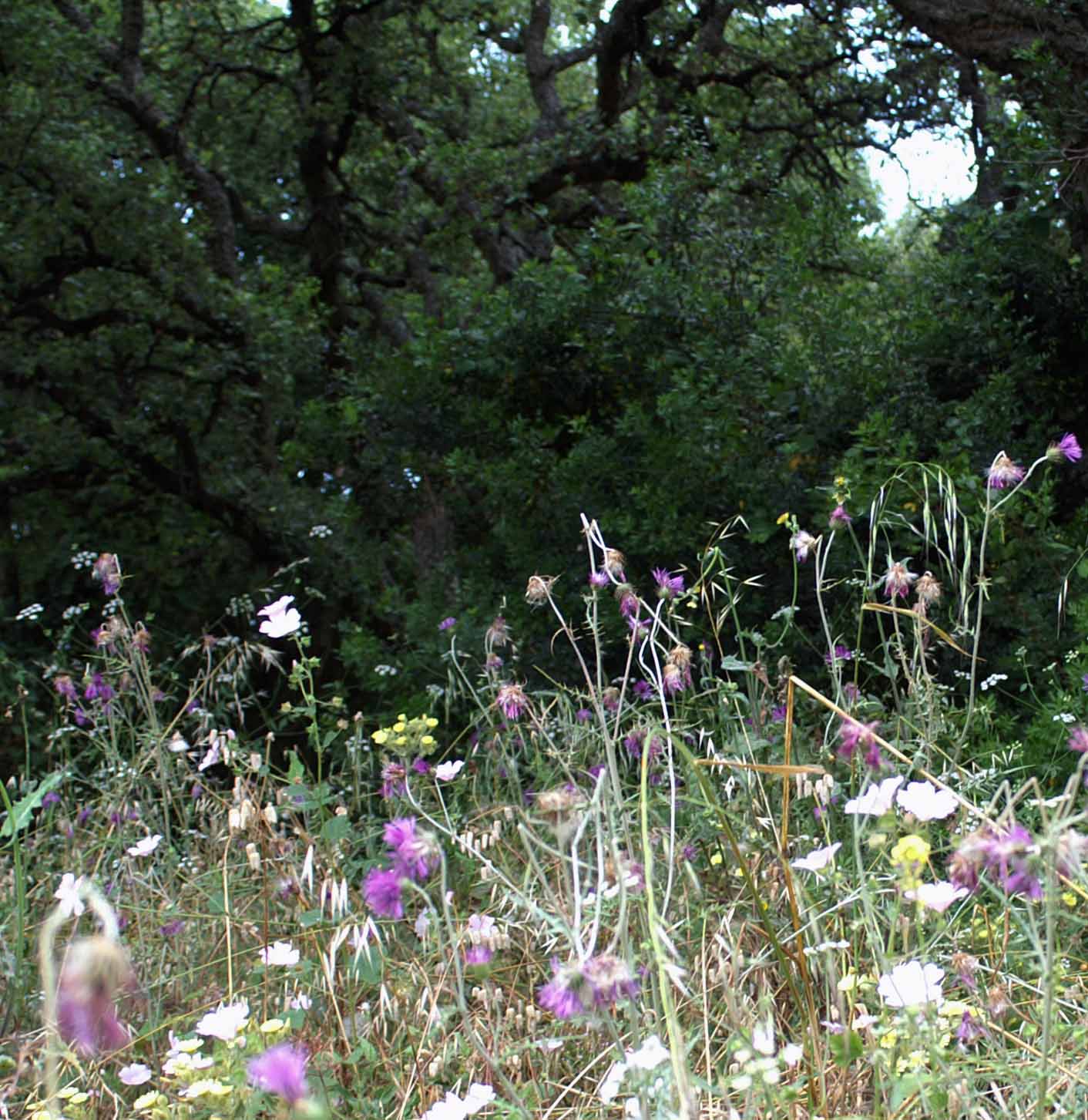
3/6/11-Wildflowers on the edge of the cork oak plot may look straggly, but there are a good variety of species there providing nectar for a range of insect species

The wildflowers growing at the front of the cork oak plot are a bit straggly as they are shaded by the trees for much of the day, but having a closer look I was surprised by the number of species I found there.

3/6/11-Rabbit's bread - Andryala integrifolia , with tiny hoverfly -Sphaerophoria scripta

3/6/11-Hoverfly-Syrphus ribesii

3/6/11-A pretty lemon-yellow flower of Tolpis -Tolpis barbata - a member of the daisy family

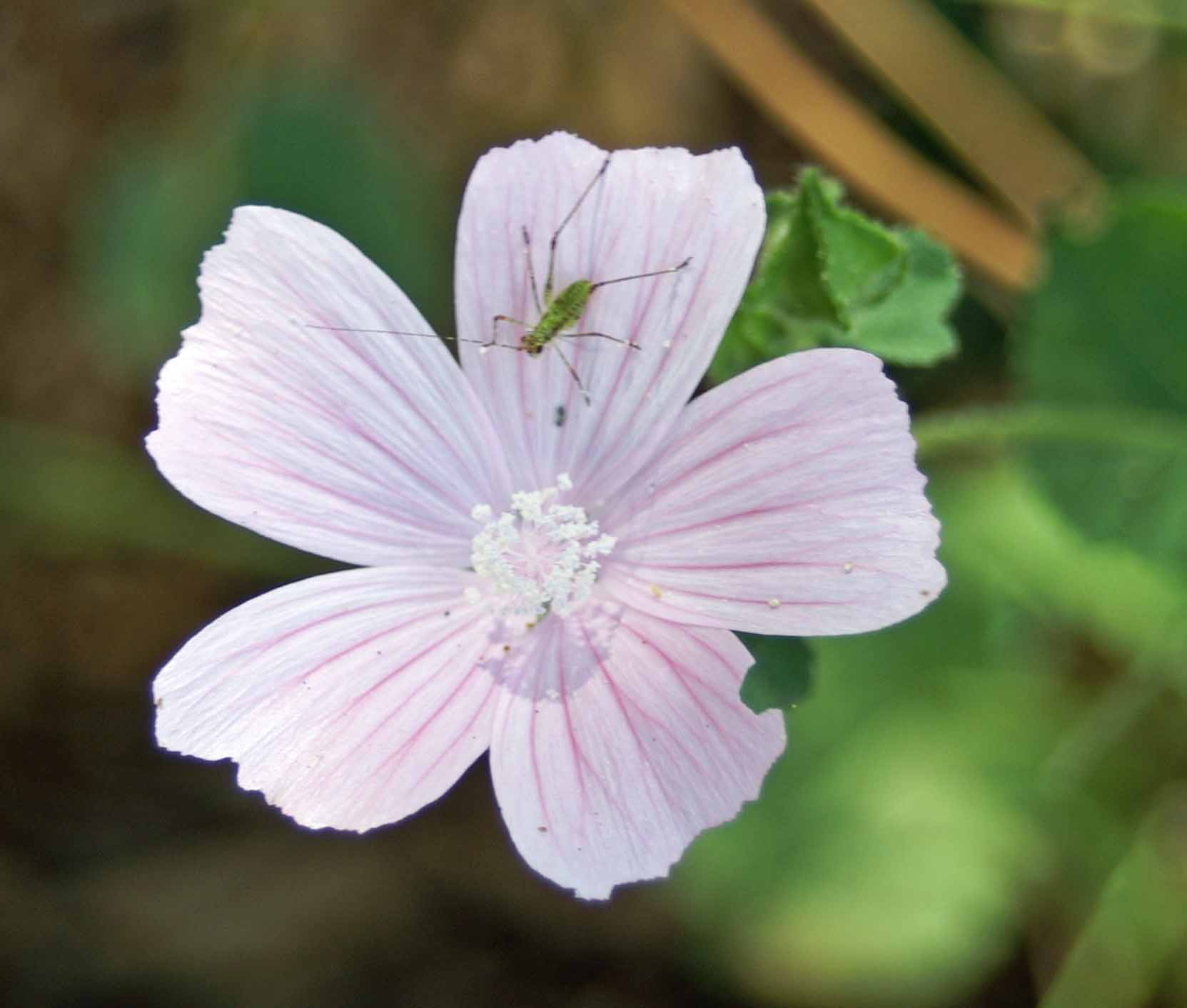
3/6/11-A mallow flower holding a tiny young Oak Bush Cricket

The wildflower species that appears to be one of those most important to an array of insect species, with plants in flower in various places from late spring through to September, is Scabious. It tends to be an untidy plant and the flowers are smallish but pretty, and everything from minute flower beetles, butterflies and hoverflies to the huge Mammoth Wasps and Violet Carpenter Bees seem to find it irresistible.

3/6/11-Scabious is very attractive to a wide variety of insect species

3/6/11-Sotogrande -Mammoth Wasp(m) - Scolia

3/6/11- A not-sure-what-this is, but it resembles the 'eristalsis' species

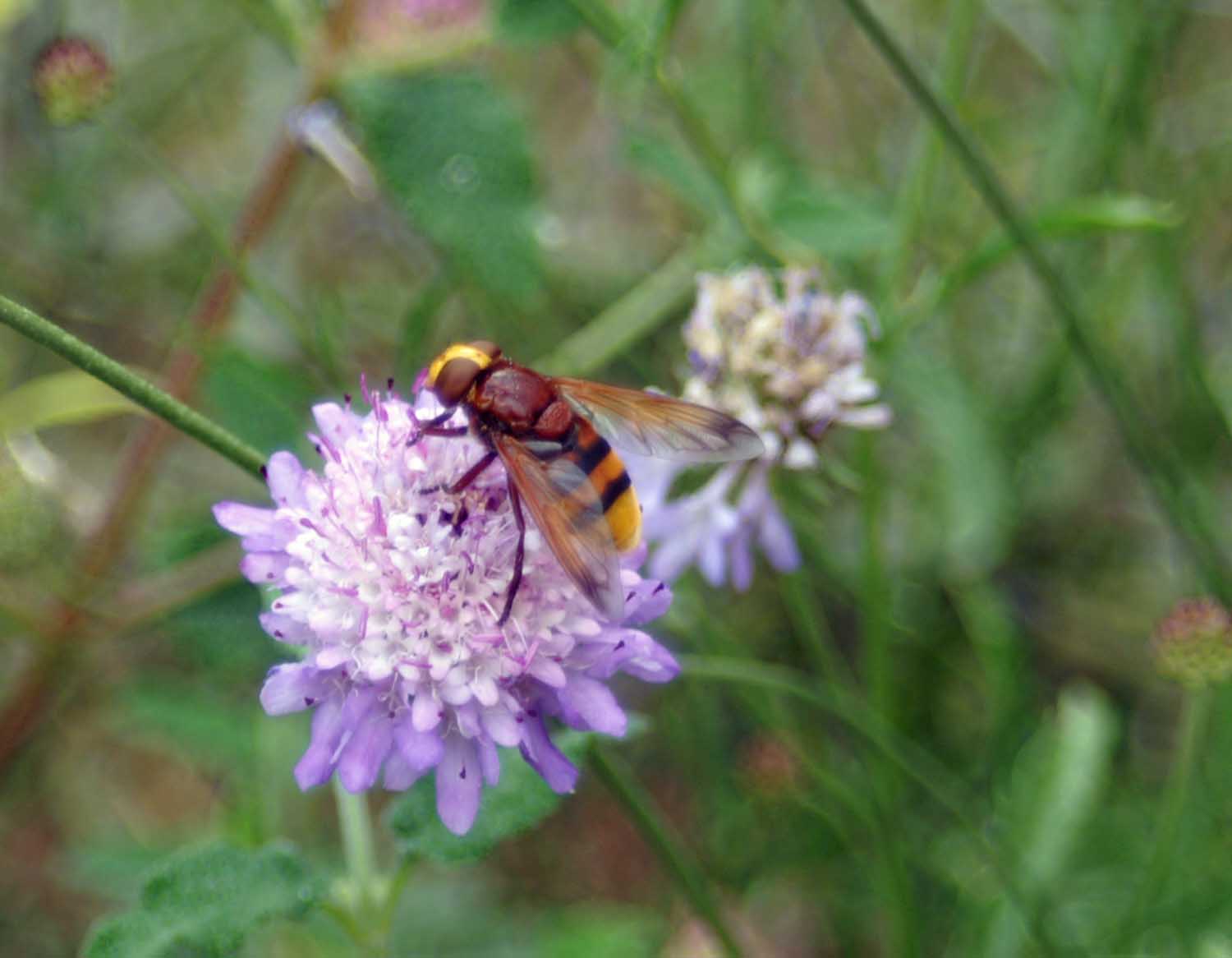
3/6/11-Banded Hoverfly-Volucella zonaria

I was sitting out on the terrace this afternoon and – aagh! – I saw a Geranium Bronze butterfly fluttering around my geranium plants, then land on a leaf. Oh dear, what to do? I hate to think about killing anything, but then I don’t want lacy-leaved, or no-leaved geraniums either.

5/6/11-Geranium Bronze butterfly, probably laying eggs on my geranium leaves