Category Archives: Wildlife of Cadíz

Balmy weather and bounty for birds

What a difference a week makes; following two weeks of rainy days and general wintry weather, this first week of February has been sunny and warm, with temperatures of 16ºC or more in sheltered spots, and there is a general sense that spring is on the way. The nights are still chilly, but the drier warmer mornings have coaxed the birds from their recent hiding places and they have been much more active and visible. Some have begun to sing regularly, in particular Wrens, Blue Tits and Serins. Thursday morning was quite magical, the first birds I heard were Jays squawking as they made their way through the cork oaks, and my first sighting was of 3 lovely Goldfinches feeding  on weed seeds and Blue Tits, one exploring the nooks, crannies and plants on the terrace, all the while keeping up contact with another nearby. The regular Blackbirds were about on the grass and a Short-toed Treecreeper arrived to scrutinize the trunks of some of the palm trees.

Goldfinch feeding on the seeds of groundsel

A Blue Tit in a sunny spot in a Cork Oak tree

A Short-toed Treecreeper exploring a palm tree trunk

I could hear Spotless Starlings whistling and calling tunefully from high up in the palm trees at the back of the house and watched a Wren, first singing from various spots along the top of the garden wall, then poking about in the foliage growing against it. A very colourful Greenfinch appeared briefly on the fig tree; I haven’t seen one for ages.
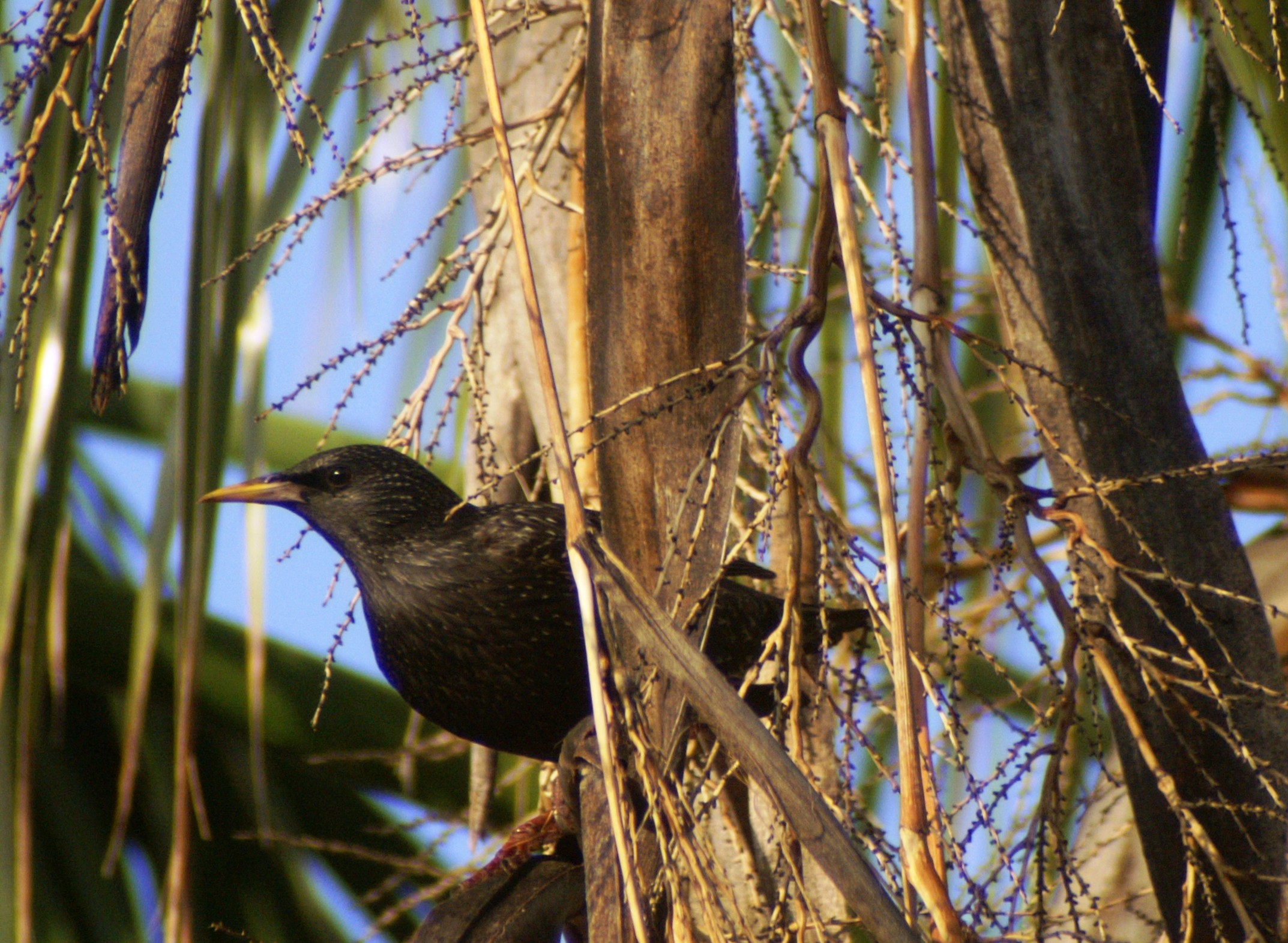
Spotless Starling - (this is a young one)

A Wren singing from a shrub growing against the garden wall

Short-toed Treecreeper taking a drink or perhaps looking for insects

From the kitchen window I saw a pair of Blackcaps after the berries on the dama de noche shrub, two Chiffchaffs flitting about, and two female Chaffinches and half a dozen Housesparrows all pecking around on the ground. The Robin was out and about too, again I hadn’t seen one for a while another Treecreeper came in, landed on a yucca tree trunk, then flew across to the birdbath, something I’d not seen one do before. I think it was drinking, but it may have been looking for insects. (My picture was a bit rushed, but the bird was only there for a few seconds and it took me by surprise).

Cultivated garden plant: Night-scented Jessamine– Cestrum nocturnum Spanish: Dama de Noche (Lady of the night)
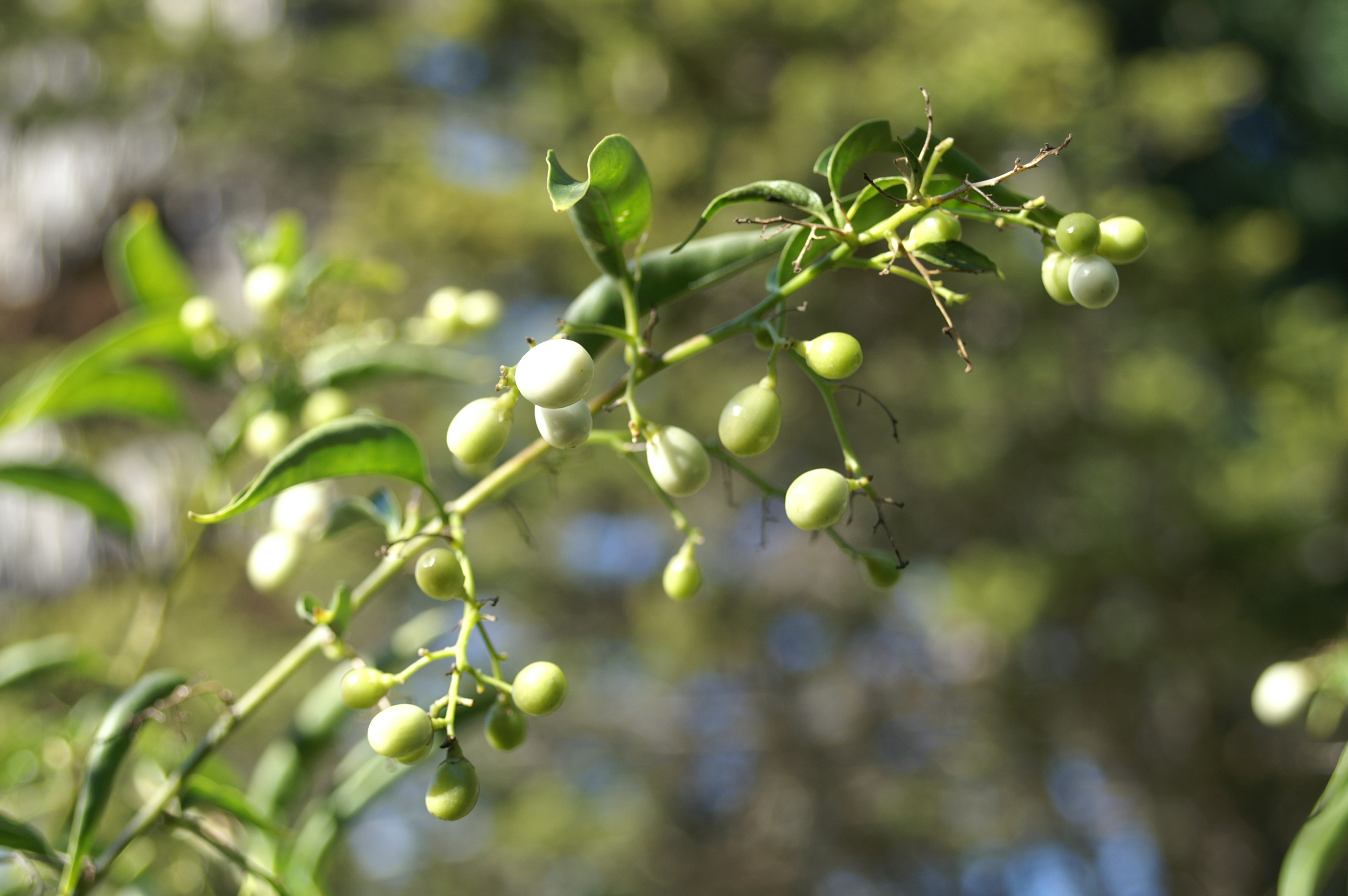
Berries of Dama de noche

A tropical and semi-tropical member of the Cestrum family, this Mediterranean classic is grown for the amazing night-time perfume that on a hot August night permeates the air (and our house) with its almost-overpowering scent. This is why it is grown, certainly not for its beauty; it is generally a leggy, untidy shrub and the flowers are small, lime green and held in clusters that during the day have no perfume. The small white berries appear in the late-autumn winter, which is why I don’t cut my plant back sooner – I wait until the Blackcaps have enjoyed them.

Blackcap enjoying the berry bounty of the 'dama de noche' shrub

Watching beautiful birds the easy way

I love to get out and see and photograph wildlife in a wild habitat, but I am so fortunate with the visitors I get to my own garden that I often get better views and insights into behaviour within the confines of my own garden walls. Last February I had some exceptional views of a variety of birds,  without even having to venture out of the house.

Firstly, at the beginning of February, there was the very handsome male Black Redstart. I happened to catch sight of him as I walked past a downstairs window where he was literally a metre or so away, using the leg of an upturned patio table as a perch from which to spy insects that were around on the grass below him. He must have been finding some as he was there for quite some time, making frequent drops to the floor and flying up again.

4/2/10-Black Redstart in the garden

Black Redstarts are resident all over this area throughout the winter months, arriving from their breeding areas in the mountains and more northerly parts around the middle to the end of October and staying until about the third week of March. Every year we have lived here we have enjoyed the company of a female of the species, who until the territory was claimed by a Robin a couple of years ago, would be seen on various perches in the garden close to the house. Now though, as soon as she appears the ever-vigilant Robin chases her away and she is restricted to sneak visits while he attends to business elsewhere. I love to see the Robin of course, but I miss seeing the little Black Redstart perched on the garden furniture, bobbing and quivering her rusty-red tail.

Female Black Redstarts are not as striking as the males, but have a bright and alert presence

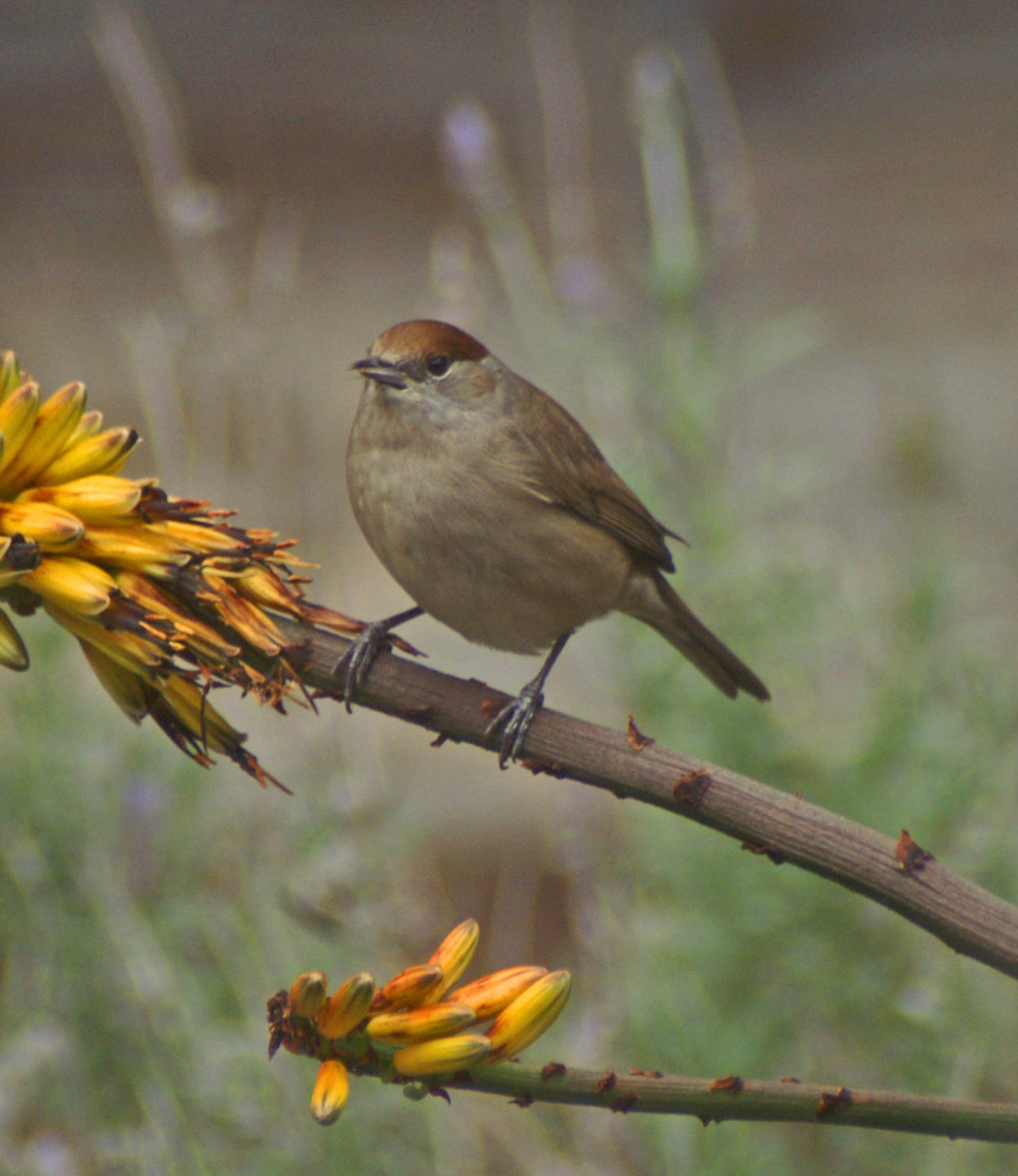
When we moved to Spain from South Wales 81/2 years ago,  I brought with me a smallish aloe cactus in a plant pot. The plant has thrived here outside in the garden and is now quite large, producing its first flower spike in February of last year. It soon attracted the attentions of a female Blackcap who began to visit the flower every day and as the plant is not far from my kitchen window, I had some lovely close views through the window without disturbing her in the least.

20/2/10-Blackcap female probing an aloe flower

Blackcap – Sylvia atricapella SPANISH – Curruca capirotada

Blackcap pairs are often closely bonded and frequently seen together as they forage for food, but this time it took a few days for the male to follow suit and even then he was much more wary and stayed for shorter lengths of time.


28/2/10- The male Blackcap followed a week or so later

Some birds seem to be  strongly attracted to yellow/orange coloured flowers, but I’ve never been sure what they are actually eating; I assume it’s a part of the flower itself, unless they harbour tiny insects. In Wales, every spring House Sparrows always tore my yellow crocuses and berberis flowers to shreds and then returned for the re-hot poker flowers later in the year.

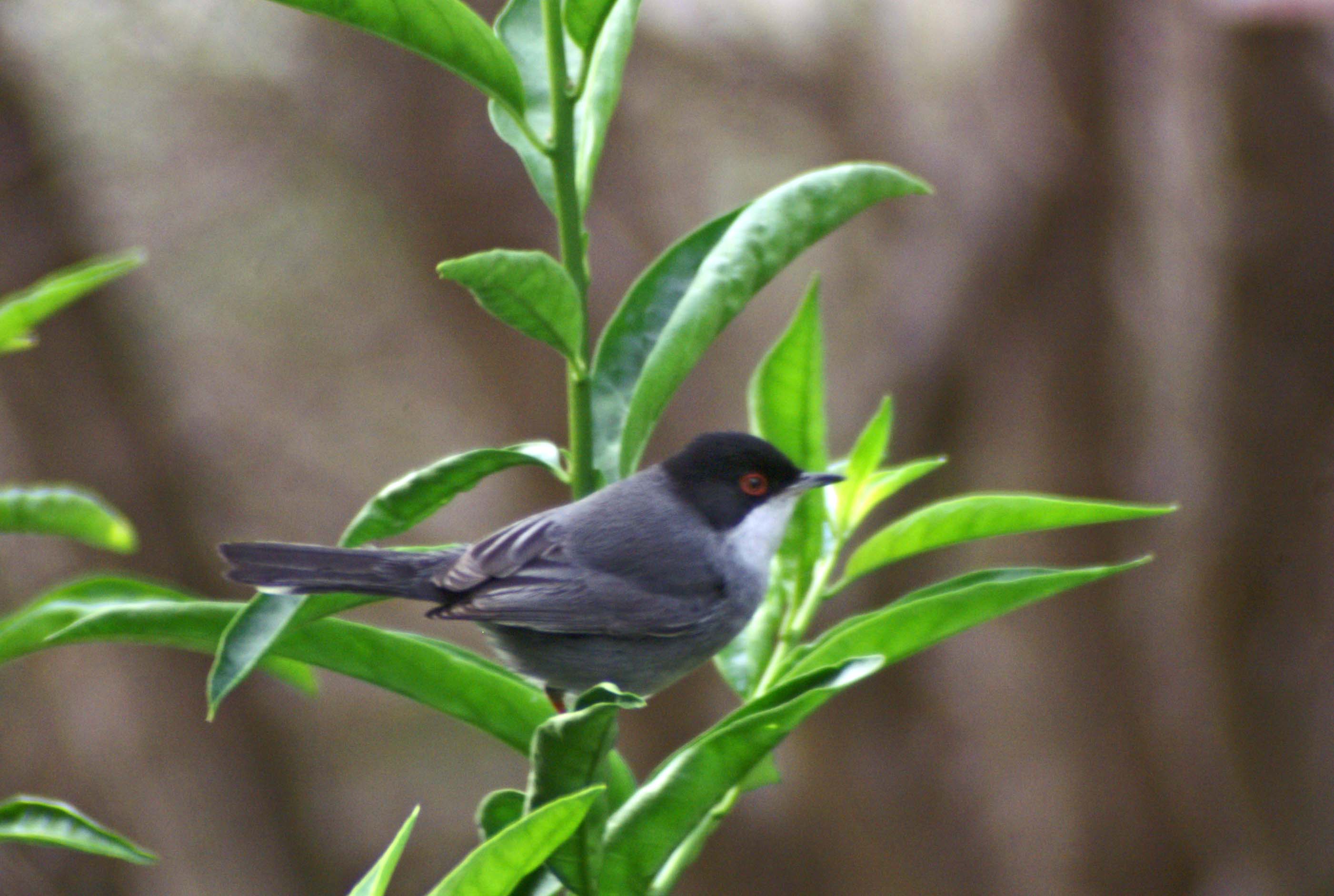
A pair of Sardinian Warblers are also regular visitors to the garden, but usually stay well concealed within the hedges and shrubs. I had some lovely views of the male as he visited the ‘Dama de Noche’ shrub that I can see from the kitchen window. Although his mate was never far away, she preferred to stay out of open view, although she did join him for a bath one morning.

26JAN-Sardinian Warbler (M)

Sardinian Warbler – Sylvia melanocephala  SPANISH -Curruca cabacinegra

My ‘bird bath’ is rather makeshift, being nothing more than an upturned flower pot with its saucer balanced on top, but it serves the required purpose and is very well used. I’ve noticed that small birds often bathe together and prefer quite shallow water.

The Egrets have landed

30th January 2011

LAGUNA de las CAMELLIAS, SOTOGRANDE PORT

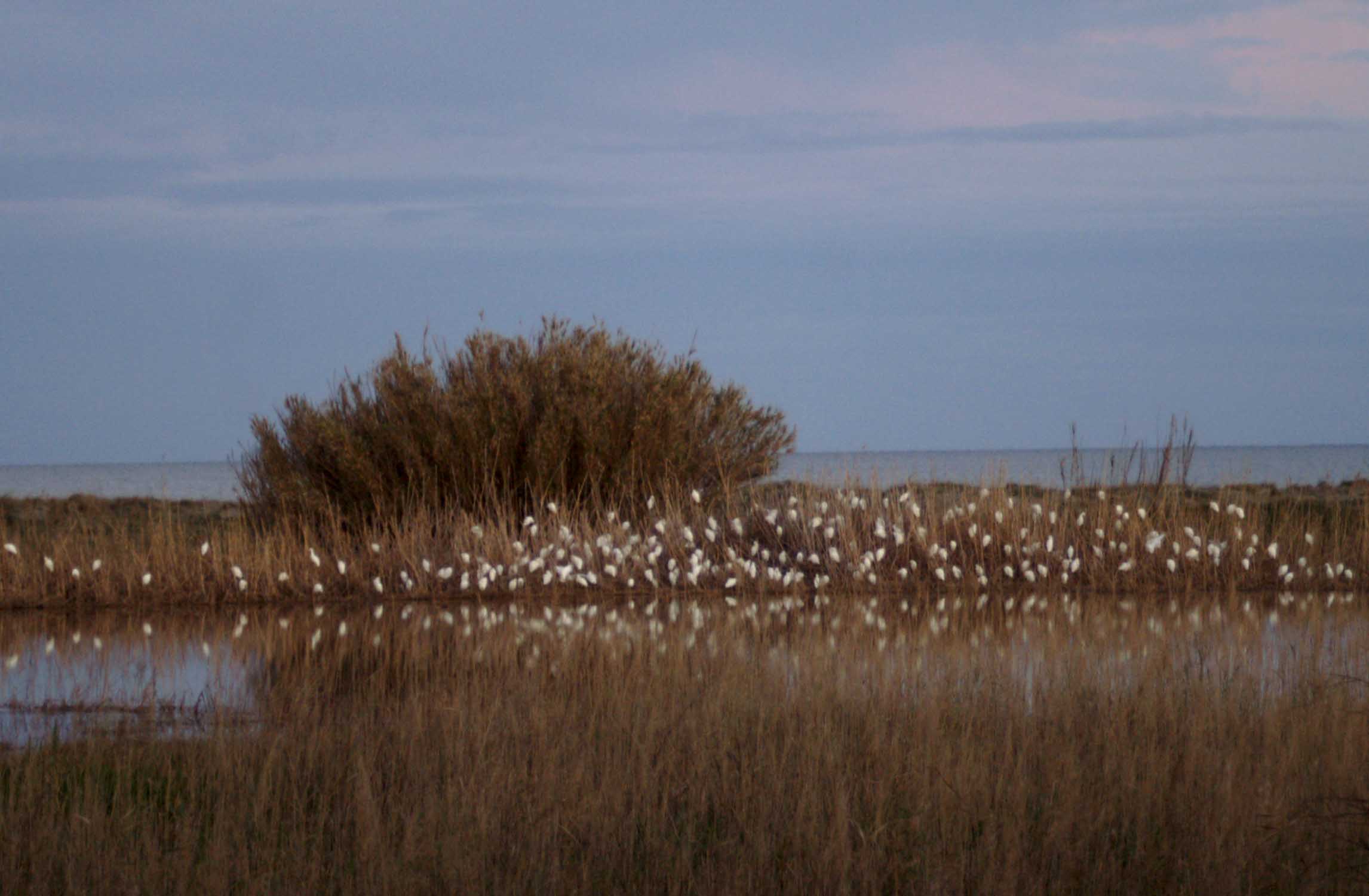
This lagoon, very close to the entrance of Sotogrande Port and backing onto the beach, Sotogrande Playa, is not very big (approx 250x60m), but it is more or less surrounded by reed beds. It is home to a number of resident species of birds that you may or may not see, but one species can be relied upon to provide a regular spectacle: this is the spot chosen by hundreds of Cattle Egrets as their night-time roost.

In the fading light, a White wagtail perched on top of a reed stem in the centre of the lagoon.

I arrived at the lagoon this evening at about 6.15pm as the sun was beginning to go down and tint the sky rose pink. There was not the slightest breath of a breeze, the sea and the surface of the lagoon were almost perfectly flat and the reeds motionless. I heard the calls of Cetti’s Warblers, two of them that seemed to be communicating, saw Chiffchaffs aplenty amongst the reeds,watched White Wagtails dart after flies from perches on reed stems and Crag Martins that skimmed close over the water. But although the light was beginning to fade, there were no Egrets.

A sunlit Cormorant flying to roost

I watched the sky and saw Starlings set off for their roosts, Cormorants in ones and twos passed by hurriedly on their way across to theirs, somewhere upriver and then a single Egret heading my way. It flew in as though to land, but then looped around and flew back in the direction it had come from. Three birds together then did exactly the same thing, then three more. I was baffled by this, wondering if perhaps the water-level, which is very high at the moment, had covered the bank they roost on and forced them to seek alternative accommodation.

Cattle Egret - Bubulcis ibis

Then suddenly they began to arrive in larger groups, flying in quite fast then parachuting down at speed to settle amongst the reeds on the banks of the lagoon like large snowflakes.

A group flying in, legs extended, preparing to drop down to land

The first arrivals were landing in reeds in front of the buildings on the outer edge of the port; although closer to people, this is probably the most sheltered spot. As more arrived, some were slotting amongst those already there while others were spreading further round the bank. In a matter of two minutes the concentration of birds trebled and the noise level increased as the birds jostled for position. I thought back to the birds I had seen earlier and though it possible that they had turned back to wait until a number of birds had settled, seeking the greater safety and security of a large group.

After two or three minutes the covering of birds had begun to thicken - there are about 150 of them in this initial stretch close to the front of buildings and sea wall

After a few minutes of watching I decided to walk a little further around the board-walk to try to find a clearer view and was surprised to discover a second, quite separate roost behind a flooded area of the reed bed that backs directly onto the beach.

A second roost, backing on to the beach

There were a smaller number of birds here, but still about 200-250 individuals.

By 6.50pm the majority of the birds had arrived, although there were still small groups of new arrivals dropping in from the darkening sky

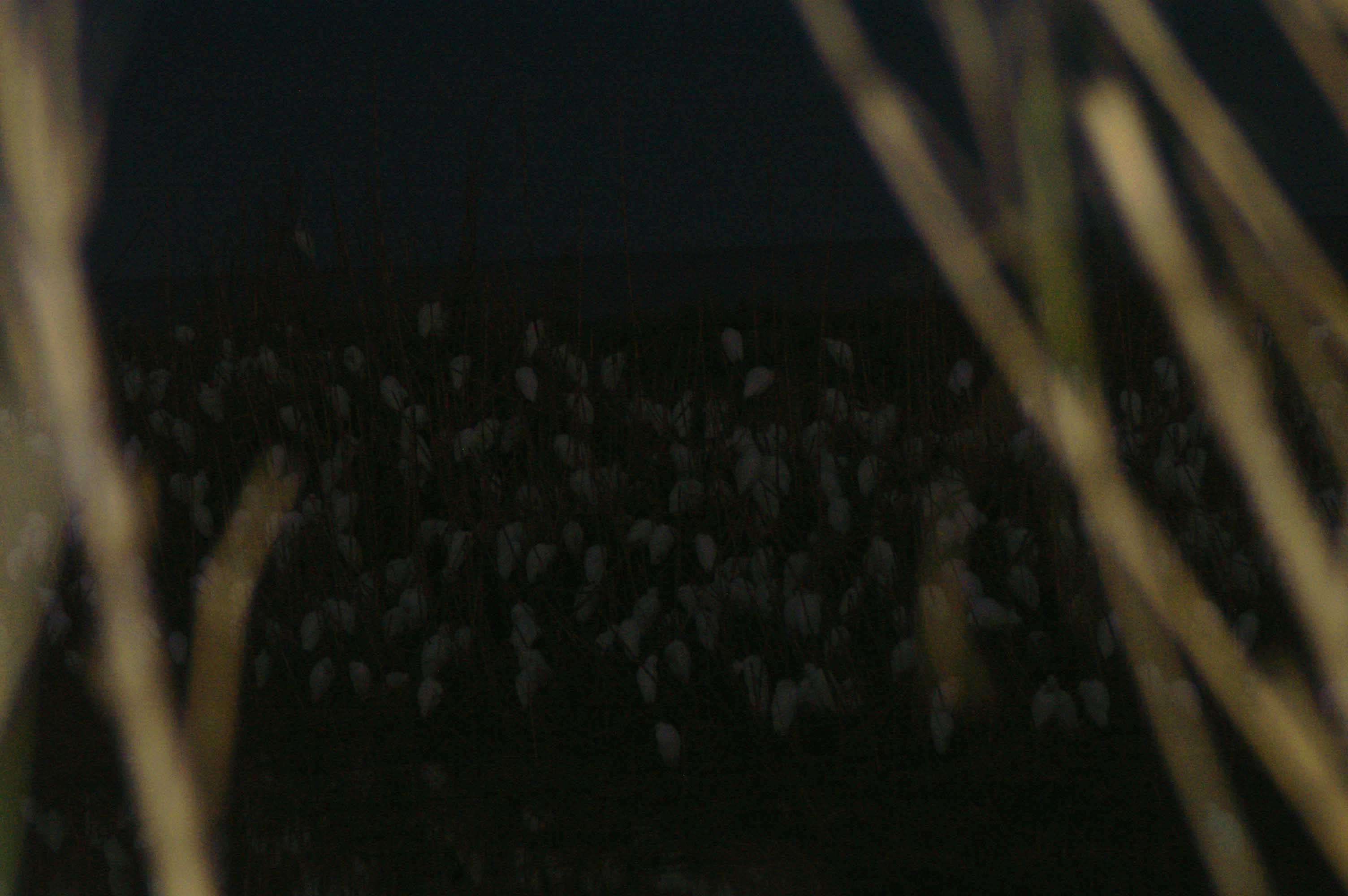
I stayed until it was almost dark and the birds were beginning to settle, although late arrivals set up protests and a few shifts of position. I’m not the best at counting large numbers of birds, but from rough counts from my photographs I would say there were at least five – six hundred birds in the two roosts, maybe even more. I have witnessed the sight on several occasions and it is always one worth making the effort to watch, even when it is as cold as it was last night.

A last picture of birds in the almost-dark


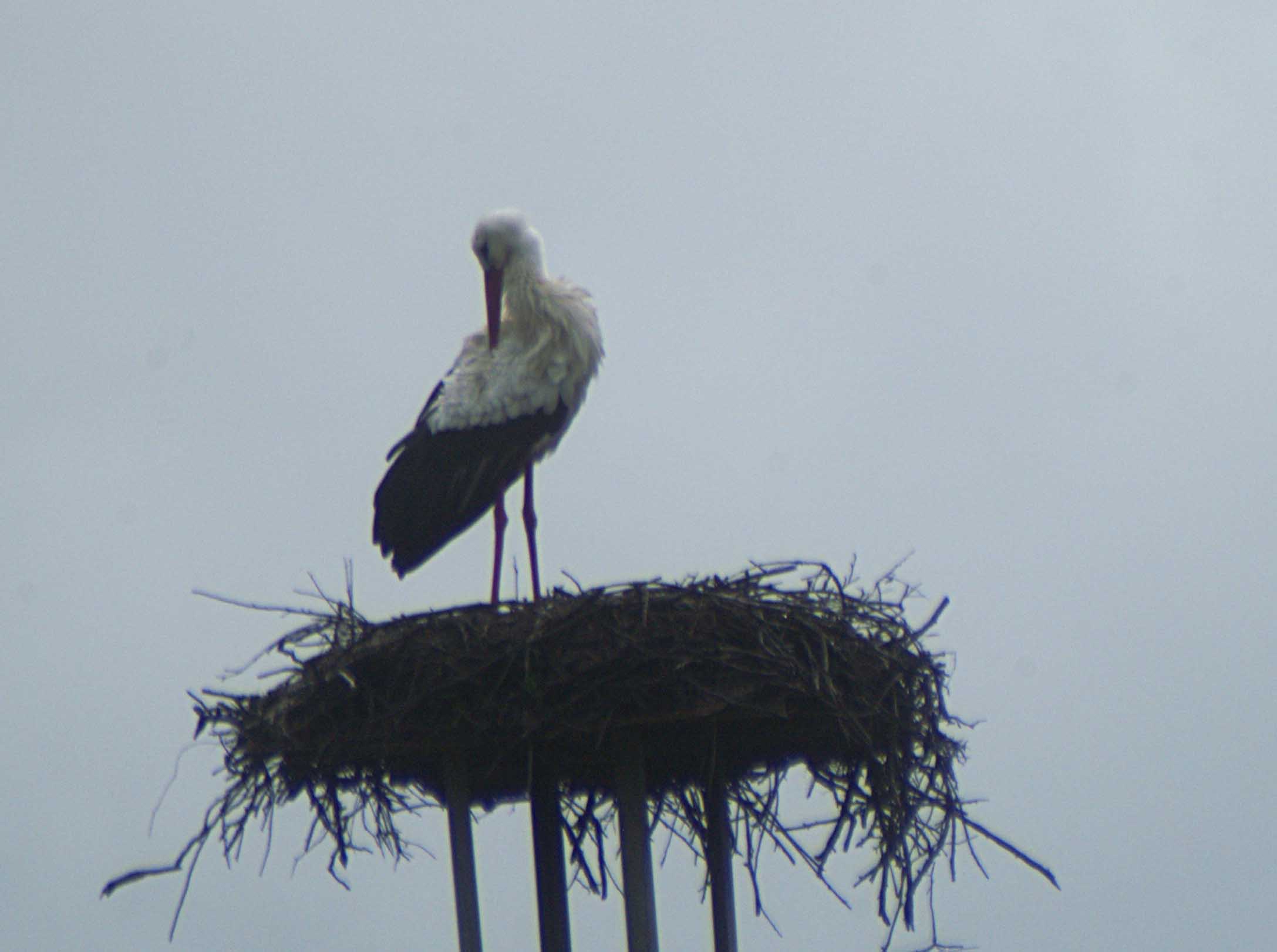
White Storks sitting out the rain

White Storks are a characterful and integral part of the local landscape and their residence here is actively encouraged, with many areas providing purpose-made platforms on top of pylons etc. A breeding colony thrives at San Roque de Estacion where nests occupy the tops of just about every available low-rise pylon set along the railway track. The numbers of birds here has increased noticeably over the eight years we have lived here and birds are having to move along the A-405 road towards Jímena de la Frontera to  find fresh nesting sites. Many of the birds remain here during the winter months rather than migrating to N Africa and can be seen around and about hunting in fields and even up on their nests. I love to see them and if I’m heading in that general direction, often make a longish detour to see what they’re up to and the sight is always included in tours for visitors that don’t know the area.

 WHITE STORK – Ciconia ciconia

By now, late January, many of the birds have returned to their nests with their mates and occupy them pretty much constantly, guarding against the invasion of potential squatters. I went for a look yesterday and found that many of the nests were indeed occupied, by either one or two birds, although there were a few empty ones too. The birds stay put even in the rain and I took some photographs as they were drying off and preening between some heavy falls.

A damp bird preening its feathers

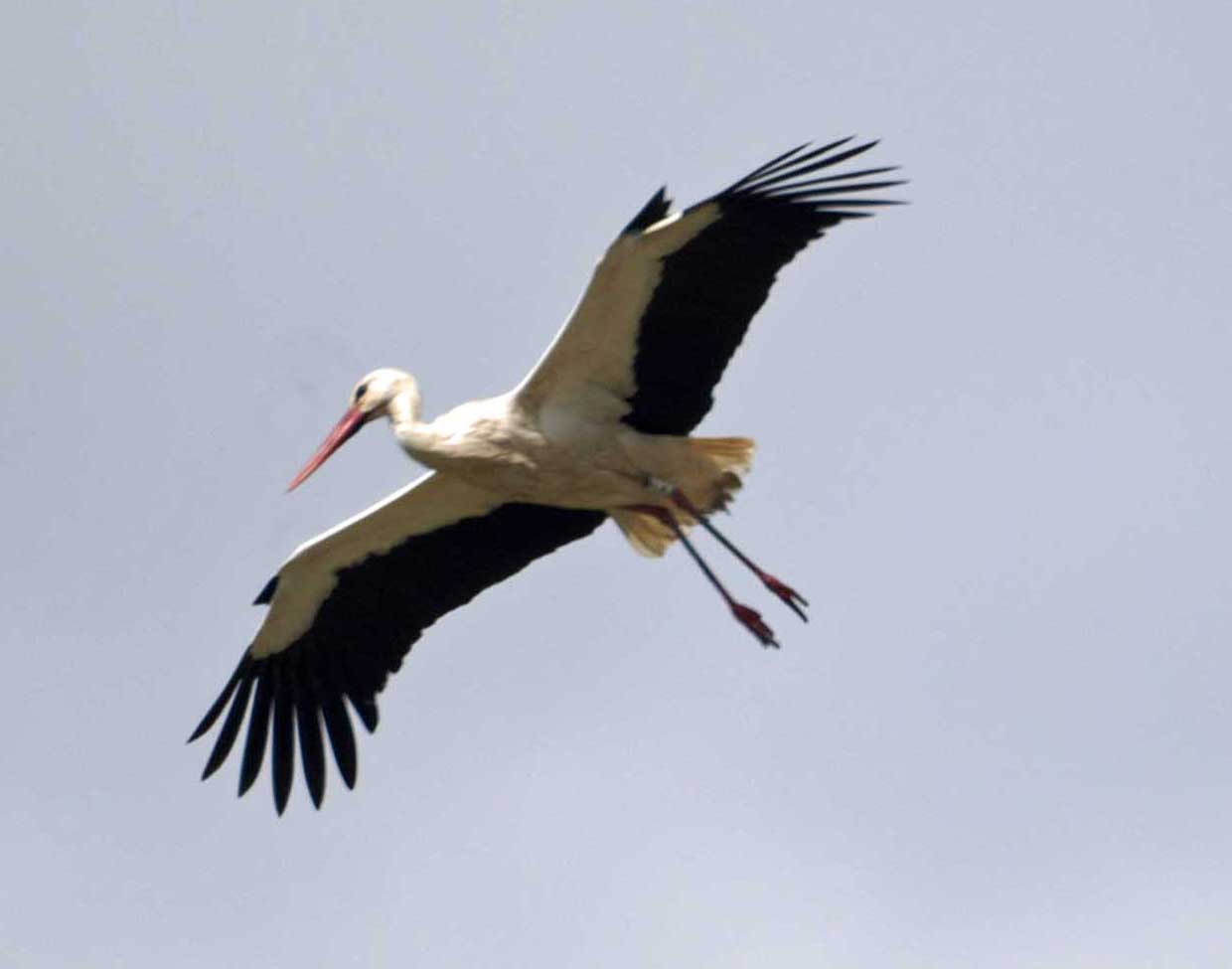
A White Stork (with leg ring) coming in to land

WHITE STORKCiconia ciconia Spanish : Cicueña Blanca

  • White storks (Ciconia ciconia) have been studied intensively over the years as their habits and survival are closely connected to how we treat or manage our environment. They are one of the key species used to promote public awareness in the fight for nature conservation.
  • White storks travel south to the warmer climates of Northern Africa for the winter and return to various parts of Europe to breed in summer. According to the last census, Poland is by the far the most popular host for White Storks with over 50,000 breeding pairs. Spain follows second as an attractive host with Portugal and France showing an increase in numbers.
  • Between the years 1970 and 1990, there was a sharp decline in the White Stork population and the census count was at its lowest in 1984. There has since been an increase in breeding pairs, particularly in the western part of their nesting regions but their numbers have not reached what it was before the decline. Their status is therefore listed as ‘depleted’.
  • Hazards: Out of the many factors that affect the White Stork’s survival, mankind has the largest impact. Development in areas that were previously natural breeding grounds displaces them. Uses of chemicals in modern agricultural practice depletes or poisons their food. Some suffer electrocution by high voltage power lines, especially those along the White Stork migratory path.
  • Reasons for Re-population: Between 1984 and 1994-05, the population increase along the western migratory path has been attributed to favourable winter climates. A number of White Storks also chose to winter in Southern Spain instead of crossing the Strait into Africa. Changes in their feeding habits also led to a rise in number of breeding storks along the Iberian Peninsula (more irrigated fields and large garbage dumps provided alternative feeding).

The Human Connection

White Storks build their lives close to humans, nesting near populated areas and even on rooftops whereas their counterpart the Black Stork, chooses to remain at a distance and not have human contact. It makes sense that how we live will naturally affect the life of the White Stork thus effectively changing the status of the White Stork from just being

Extract from Waterbirds around the world. The Stationery Office, Edinburgh, UK. 960 pp. Boere, G.C., Galbraith, C.A. & Stroud,  another bird to being a lighthouse, warning us of the changes in the environment. In paying attention to their survival, we also help protect the land in which we live.

SourcesD.A. (eds). 2006.

Ciconia ciconia, White Stork. http://www.birdlife.org.